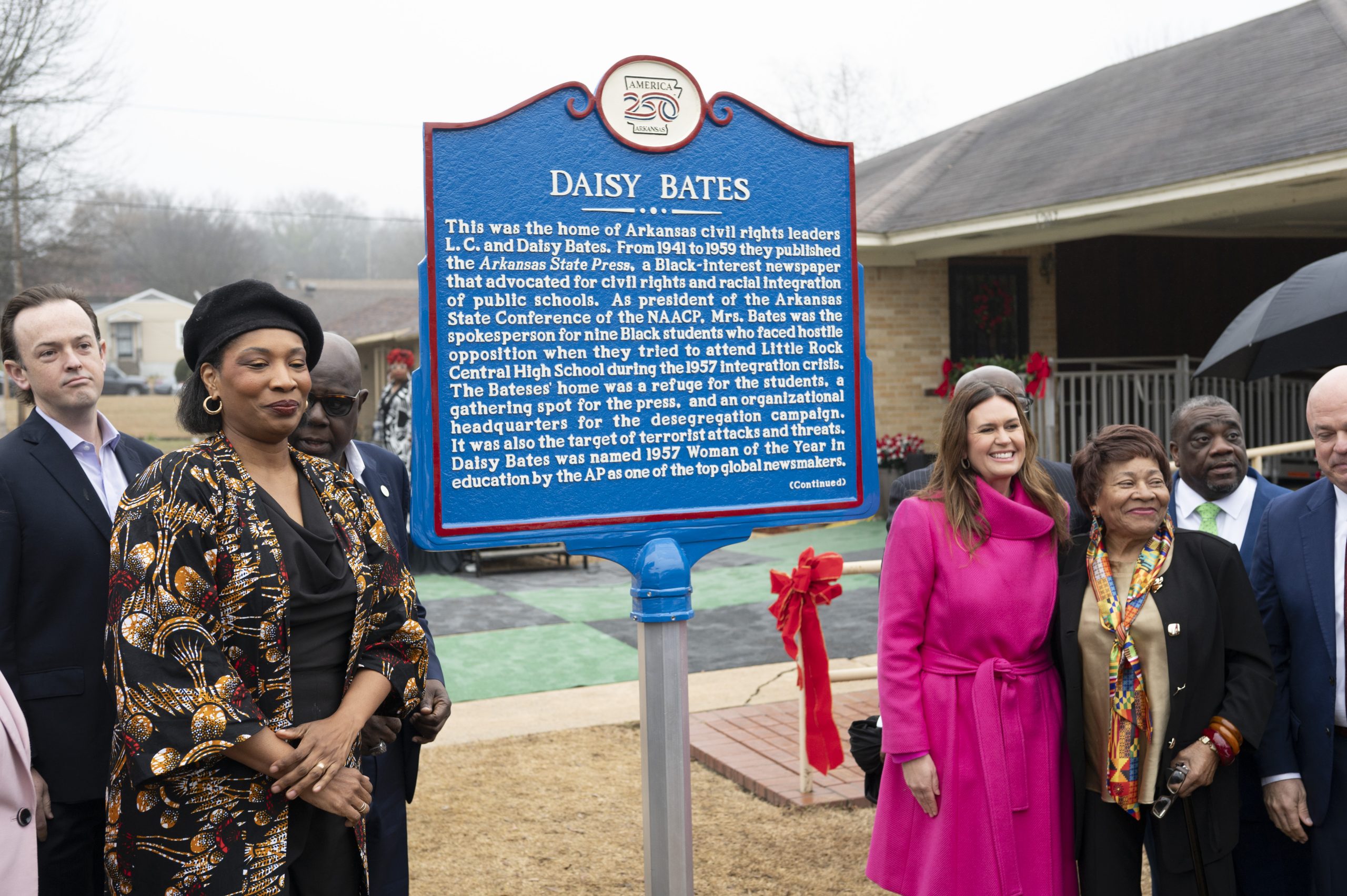
Close friends and associates, elected officials and more stood in the sleepy, light rain Tuesday morning outside of Civil Rights legend Daisy Bates’ former home to unveil a new historical marker that celebrates Bates’ dedication to organizing around school integration in Little Rock.
The red, white and blue, two-sided sign tells of Bates’ Civil Rights work in Arkansas. The marker supports the Arkansas250 Commission’s mission to unveil 11 historical markers around the state that help tell the story of Arkansas since the 1776 signing of the Declaration of Independence.
Bates died in 1999, at age 84. She and her husband, L.C., moved to the house in 1955. Their home, along West 28th Street in Little Rock’s South End neighborhood, served as the command post for the 1957 integration of Little Rock Central High School. Bates worked tirelessly and in the face of violent threats and actions from white supremacists to help the Little Rock Nine integrate Central High School. The Little Rock Nine spent much time at the Bates house, and Civil Rights luminaries such as Martin Luther King Jr. and the first Black Supreme Court Justice Thurgood Marshall stayed there.
The Little Rock Nine would meet with Bates at her house each day before school and were taken to Central High and then dropped back off at the Bates home. In 1958, when Gov. Orval Faubus shut down all public high schools in the city rather than comply with Brown v. Board, the Little Rock Nine would also study and try to make up for that lost year at Bates’ home. White supremacists targeted the Bates home several times in those years, burning crosses on the front yard, throwing a rock through the living room window with a note saying that dynamite would be next, and even shooting at the house. Luckily, no one was ever injured in these attacks.
The marker unveiling comes a day after the Daisy Gatson Bates state holiday that coincides with the national President’s Day, and on the same morning of news that another iconic Civil Rights leader, Rev. Jesse Jackson, died peacefully at his Chicago home at age 84.
Charles King, president of the L.C. and Daisy Bates House Museum Foundation, began Tuesday’s program with a moment of silence for Jackson, whom he referred to as an American hero.
Mary Hardin, who knew Bates and is also on the Bates House Museum board, said she believed the house was made specifically for the Bates family.
“I imagine things in my head, and I sometimes feel that this house in 1955 was built for the purpose that it was used,” Hardin said.
Hardin talked of a lesser-known integration attempt at Central High that Bates helped organize.
Hardin said that in 1956, seven Black girls who lived close to the school attempted integration at Central High, but the Little Rock School District superintendent at the time, Virgil Blossom, turned them away.
“Therefore, in this house on this block, Mrs. Bates was able to notify Thurgood Marshall, who was able to then file the lawsuit, and on comes ’57 that most of us have heard about,” Hardin said.
Hardin is referring to a 1956 lawsuit Marshall, working for the NAACP at the time, filed against the Little Rock School Board, which refused to integrate their schools, even after the Brown v. Board of Education decision.
Pine Bluff civil rights attorney Wiley Branton Sr. worked with Marshall to file the suit.
Bates’ Civil Rights work and activism have been much overlooked, especially when compared to the well-known, almost household names of male leaders of the Civil Rights Movement. But her work was deeply important, especially for Black Arkansans. Bates served as the president of the Arkansas NAACP, ran the Arkansas State Press newspaper for the local Black community with her husband, and organized impoverished Black people in the rural city of Mitchellville in the Arkansas Delta, among many other things.
Bates was the only woman to speak at the 1963 March on Washington — invited to speak last minute only after the original speaker had gotten stuck in traffic, as historians at the Mosaic Templars Cultural Center in downtown Little Rock will let visitors know. A statue of her was unveiled in the U.S. Capitol in 2024.
The Bates Foundation helped transform the Bates home into a museum in 2009.
This marker is the second out of several historical markers that the Arkansas250 Commission plans to put up. The markers honor some of the most significant events or sites in Arkansas over the past 250 years since the United States officially declared independence from England. This year’s July 4 marks the U.S.’s semiquincentennial anniversary. In July 2024, Gov. Sarah Huckabee Sanders created the Arkansas250 Commission to celebrate the milestone.
Sanders was among the elected officials present at the unveiling in front of the Bates home. Reps. Denise Ennett and Fred Allen were also present. Congressman French Hill sent a letter to be read on his behalf.
Sanders told a story of how her father, a former pastor, welcomed a Black man into his church in the 1980s.
Sanders’ father is former Arkansas governor and current U.S. Ambassador to Israel Mike Huckabee. Huckabee was the pastor of Immanuel Baptist Church in Pine Bluff and produced a Christian radio show at the time. The church had an all-white congregation at the time.
“A young Black man heard one of my dad’s sermons on the radio, and he asked to come and attend church with him,” Sanders said. “My dad quickly welcomed him, and soon after announced his plans to welcome that young man to the entire congregation. There were many members who were upset, some even refused to let him sit in the pews.”
Sanders said that her father laid out an ultimatum to his churchgoers at the time: “Unless you greet this man like a brother in Christ, then I’m quitting. And the members backed down, and that man joined them and worshiped with the congregation moving forward, and for decades until it closed, Immanuel Baptist welcomed any worshiper of any background. That story is from the 1980s — uncomfortably close to today.”
The governor went on, saying that, “We like to imagine that everyone in our country treats each other like brothers and sisters in Christ, but we know that certainly wasn’t true in the recent past, and unfortunately, isn’t true everywhere today. But if there’s a lesson that I took from my dad, it’s that we have to do what’s right, even when it’s not easy. And to quote the author C.S. Lewis, ‘I do not believe one can settle how much we ought to give. I am afraid the only safe rule is to give more than we can spare.’ Daisy Gatson Bates lived that virtue to its absolute maximum.”
Sanders acknowledged that Bates put her life on the line “for a very simple principle that every child should be treated the same, regardless of the color of their skin.”
Sanders attended Central High about 40 years after it was integrated and she said it was clear that Bates’ work paid off.
“Today, she is immortalized, not just here and at Central High School, but at our state Capitol, at Civil Rights museums around the country and in the halls of the United States Capitol, and more importantly, every school in our country opens its doors to any child, regardless of race,” Sanders said.
The governor said that the past cannot be forgotten, and that people must remember that this is a country where slavery, Jim Crow and bigotry as seen in her father’s church have all caused suffering.
“The progress to today didn’t come naturally,” Sanders said. “It took heroes like Daisy Bates giving all they had to move our nation forward, and as we fight the injustices that still remain in this great country, let’s remember the wise words of C.S. Lewis, ‘The only safe rule is to give more than we can spare.’ Daisy Bates did, and so must all of us.”
During her time as governor, Sanders has backed and signed legislation that prohibits the teaching of critical race theory (CRT) in schools across Arkansas. Critical race theory is not typically taught in K-12 schools and is normally found at the college level. Despite that, Sanders’ office has labeled critical race theory as a curriculum that “emphasizes skin color as a person’s primary characteristic, thereby resurrecting segregationist values, which America has fought so hard to reject,” according to the governor’s executive order from Jan. 2023.
When a federal appeals court upheld the statewide ban on critical race theory in public schools this past July, Sanders celebrated the ruling as a “big win” for “education freedom” against “woke indoctrination.”