It’s not a competition to her, but Ethel Tompkins wants the world to know that in Arkansas, Hoxie’s school integration crisis came first.
“It’s getting better, but up until a few years ago, if you ask about integration in Arkansas, the first thing that comes up is the Little Rock Nine. However, we integrated two years before they did, but we didn’t have as much publicity … so we kind of got lost in history,” Tompkins told the Arkansas Times.
Tompkins, who returned to her small, northeastern Arkansas hometown in the 1990s to care for her parents after living in Southern California for years, serves as a living history of a little-known school desegregation crisis. Now, her story is immortalized in the Hoxie: The First Stand Museum, which opened its doors for the first time last Tuesday.
Ethel Tompkins speaks at the new Hoxie civil rights museum she has worked to put together for several years now Credit: Arielle Robinson
Tompkins was one of 21 Black students who integrated the Hoxie School District in July of 1955, two years before the more famous and widely publicized Little Rock Central High School crisis about two hours away. She was the first Black person to graduate from Hoxie High School, when she did so in 1961.
Hoxie’s school board, comprised of all white men at the time, voluntarily decided to integrate the schools. Black families in Hoxie did not push for integration like in other parts of the South, Tompkins said.
Locals quote Hoxie schools superintendent at the time, Kunkel Edward Vance, as saying one of the main reasons for integrating schools was because it was “right in the sight of God.”
Although morality was of concern, the other two main reasons were that integrating schools saved the city money and complied with the 1954 Brown v. Board of Education decision, which ruled that segregating schools based on race is unconstitutional.
A copy of a 1955 New York Times article documenting the integration process in Hoxie is in the museum Credit: Arielle Robinson
Today, Hoxie locals say that integration went relatively peacefully until a Life magazine feature photographing its success was published in late July 1955 and drew the ire of white supremacists, who descended upon the city from nearby towns as well as far as Little Rock and other parts of the South to try to stop the progress being made.
After a legal battle that made its way up to United States Attorney General Herbert Brownell Jr.’s office, the attorney general sided with the Hoxie school board in complying with Brown v. Board of Education, which helped crush white supremacist resistance there and also set the stage for further school integration battles in Arkansas that helped culminate in the Little Rock Central High Crisis starting in 1957.
Hoxie was the first school district where segregationists fought school integration through the federal courts, as well as being the first school district in the country to have the federal government intervene to ensure compliance with Brown v. Board of Education, hence the museum’s name — Hoxie: The First Stand Museum.
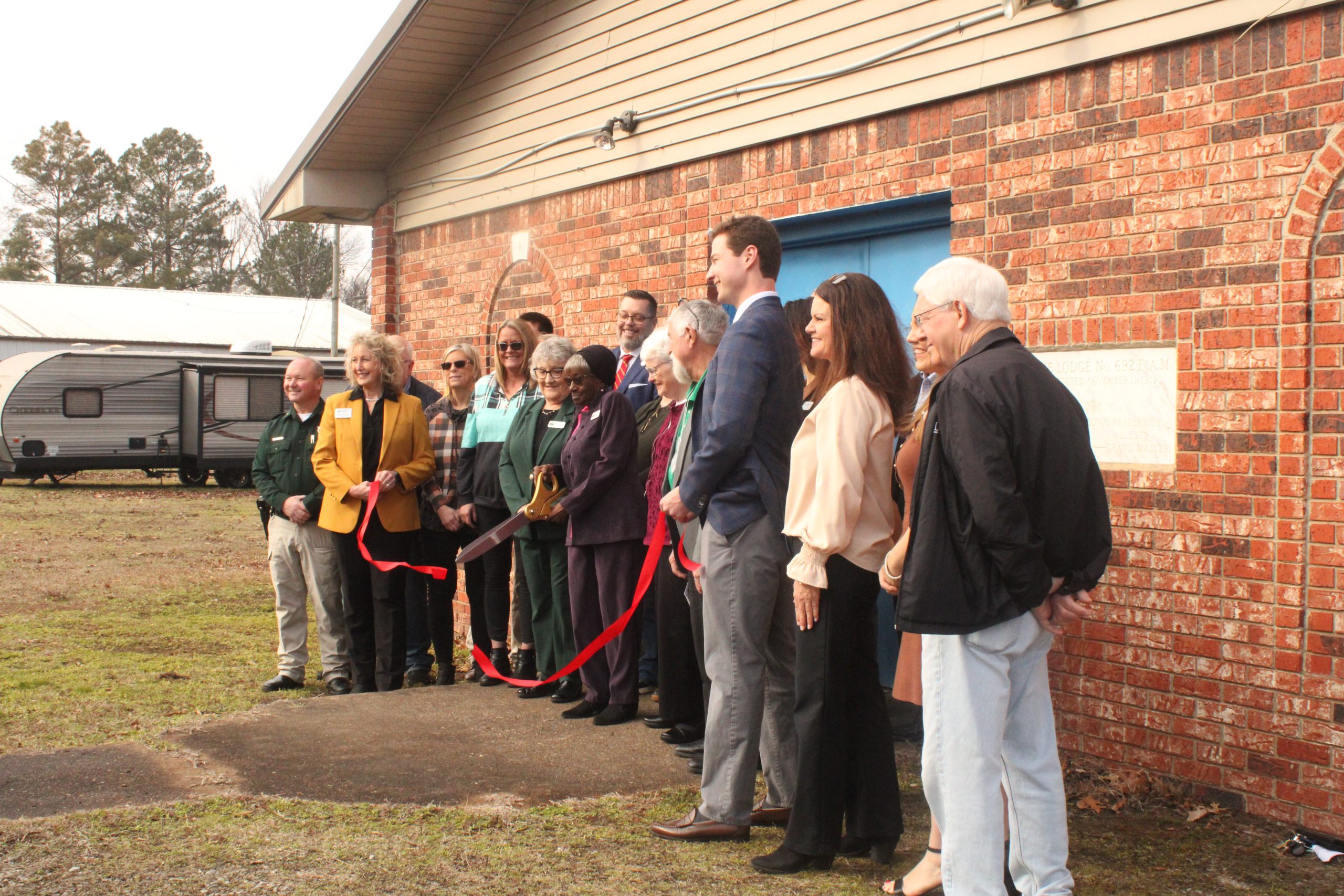
Tuesday morning, Tompkins stood with members of the Lawrence County Chamber of Commerce, State Rep. Bart Schulz and Hoxie locals to cut the ribbon in front of the newly opened museum space committed to telling the story of the Hoxie school integration crisis of 1955. A dedication was also held to Tompkins, for whom a new exhibit hall within the museum is named.
The 2,736-square-foot museum is located in a brick former masonic lodge building along Southwest Lawrence Street, next to the police department. Off in the distance, one can hear a train horn in the background every once in a while as it chugs through the city.
Inside the Ethel Tompkins Exhibit Hall, artifacts such as a diorama of Hoxie’s former school for Black children, maps, old black-and-white photographs and newspaper clippings tell the story of Hoxie itself, along with the school desegregation crisis.
A diorama made by local students of Hoxie’s former school for Black children is shown in the museum Credit: Arielle Robinson
Frances Green, a 1959 graduate of Hoxie High School, dedicated the museum space to Tompkins on Tuesday.
Green, who said that she and Tompkins had become good friends over the past decade, recalled a story from Tompkins when she was a little girl in the late 1940s. Tompkins had tried to drink from a water fountain when her father had pulled her away. Not knowing that Jim Crow laws barred her from drinking out of that one, Tompkins asked her father, “Well, why can’t I?”
Green said that the various barriers Tompkins faced as a Black woman never stopped her from achieving what she wanted to throughout her life. After serving in the U.S. Navy and working in the computer science field in California, Tompkins returned to Hoxie and worked in the Lawrence County Library.
“Did you know that even 50 years after those Jim Crow times, in the 1990s and early 2000s, occasionally, a library client would refuse to be assisted by a Black woman?” Green said.
Still, Green said, Tompkins continued undaunted and promoted Black History Month programs during her 20 years working in the library as a research librarian, which led her to further explore the story of Hoxie’s school integration.
Green said the ribbon-cutting and grand opening are just the beginning.
In the future, the museum hopes to unveil immersive and interactive digital technology that brings “an immersive, multi-sensory experience” to visitors, and staff will continue to add new things in the coming weeks, such as more artifacts and different ways to tell Hoxie’s story besides reading off of posters.
A poster of a 1955 article documenting how white supremacists and the Hoxie School Board ended up in court over integration Credit: Arielle Robinson
The museum has been funded through community donations and a community fund leftover to help various organizations throughout northeastern Arkansas, Tompkins said. Staff is currently preparing to apply for grants, also.
Tompkins spearheaded the effort to keep Hoxie’s story alive. In 2017, she founded the nonprofit bearing the same name as the museum and serves as its president.
But her interest in sharing the city’s story goes back much further, and stems from a general love of African-American history.
“Around 1992, ‘93, I started checking to see what information I could find on school integrations, just things in history,” Tompkins said.
Knowing she was the first Black person to graduate from Hoxie High School, Tompkins’ curiosity guided her to look into the school integration crisis in her hometown, but she struggled to find much information about it.
“I couldn’t find anything,” she said. “I didn’t find any books, I didn’t find any major articles.”
Over the years, she was able to find bits and fragments of information and combine them with her personal experiences to piece more of the story together.
Tompkins said she was encouraged to start a nonprofit to qualify for grants to research and promote knowledge of Hoxie’s school integration.
Thus, Hoxie: The First Stand was created.
Among the board of directors is Green, who is vice president.
“Many times I’ve heard Ethel recount her father’s words when she was a child, that she was just as important as any person in the room and she should hold her head up and believe that,” Green said during her dedication to Tompkins.
Many of the items on permanent display in the museum have traveled with Tompkins as she has gone around the state, including the Arkansas State Capitol, to share Hoxie’s school integration story.
When Tompkins spoke to the room full of people Tuesday, she expressed surprise and gratitude at the exhibit hall named for her.
She said that not many around today know of the Hoxie school integration story, and people must keep talking about it.
“Hopefully I will be around a few more years, because I have constantly told people that I’m going to live to 120 just to annoy you,” Tompkins said, to laughter from the audience. “We have to keep talking, we have to keep presenting. It’s really hard to convince people that history was made in a small town like Hoxie.”
Tompkins said she thinks the city’s geography has made it difficult to convince people that Hoxie is significant in the history of school integration across the country.
Hoxie is a small, rural city in northeastern Arkansas, born at the crossroads of train tracks that ran north to St. Louis and east to Memphis. It is just south of Walnut Ridge in Lawrence County. Walnut Ridge is the county seat. Hoxie’s current population is around 3,000, and many residents worked on or owned a farm as a way to make a living throughout its history.
Tompkins told the Arkansas Times that while growing up, Black and white people in Hoxie both picked cotton for money.
“If there was somebody else that needed somebody to come pick cotton, it didn’t make any difference whether you were Black or white. We were all out there in the fields, in the hot sun together,” Tompkins said.
Much like other schools for Black children throughout the South, Hoxie’s school for Black children was in poor physical shape and was underresourced, especially when compared to the schools for white children.
Tompkins remembers attending Hoxie’s school for Black kids. It was a white, one-room schoolhouse where one teacher taught nearly 30 children of various ages. The high-school-aged children were bused to the Black school in Jonesboro at the time — Booker T. Washington High School.
The Black school in Hoxie was run-down, with no indoor facilities of any kind and outdated textbooks that were at least a decade old when Tompkins was a student. Tompkins said her teacher, whom she spoke of fondly, lived in Little Rock and would take a train up to Hoxie on the weekends to teach throughout the weekdays, staying the nights with Hoxie families.
Lawrence County was a very poor place at the time, Tompkins said, and the school board could not afford to keep the Black school open nor to keep busing Black kids out to Jonesboro, which also influenced the decision to integrate.
Going to Hoxie’s white school, Tompkins was now in a giant two-story building with about 1,000 white students.
Tompkins said her experience was fine, but she understands how it may have been traumatizing for the other Black students who had to transition to a much larger school with hundreds of new, white faces.
She said there are still Black Hoxie students who integrated and are alive and living outside Arkansas, whom she has been trying to convince to share their experience. Everyone has a different experience and story to tell, and Tompkins wants all perspectives to be shared and displayed, not just hers.
Tompkins said that by around 1958 or 1959, she was about the only Black student left in Hoxie High School.
“Most of them [the Black kids] ended up moving away,” Tompkins said. “Their parents moved away because the work situation, as years went on, got to the point to where in order to support the families, the dads had to go to different cities, different states to find work, so a lot of the kids ended up moving away.”
Tompkins thinks she had an advantage when it came to integration because she was around the 7th grade, making her a bit older than smaller children, and also because the house her father rented was in an area where they were the only Black family for several blocks.
“Hoxie was not segregated or divided like in a lot of cities, you didn’t have a Black neighborhood or a white neighborhood, it was divided as to how much could you pay for rent to rent a house or buy a house, that was the dividing thing,” she said.
Tompkins said that the fact that everyone was struggling to make a living lessened the impact of Jim Crow.
“The white kids there, because they were struggling to make a living, [my] Dad was struggling to make a living, most of them didn’t care about the skin color or anything,” she said.
Tompkins said she and white kids would play together and white parents would even invite her over for sleepovers, birthday parties and other events.
“That gave me also a little advantage too, when it came to the integration, because the other Black families … were not as closely associated with the whites in the neighborhood as we were,” she said.
Thurgood Marshall, who would go on to be part of the team of lawyers that represented the Little Rock Nine, sent an encouraging letter in August 1955 to two Black parents in Hoxie, stating that the National Association for the Advancement of Colored People (NAACP) was behind them.
Gov. Orval Faubus, famous for intervening in the Little Rock Nine situation, did not intervene in Hoxie and it almost cost him his 1956 reelection bid against more hardcore segregationists. These segregationists would be constantly watching Faubus’ moves as school integration continued to unfold across Arkansas in the following years after Hoxie.
School photos of Tompkins, as well as her high school diploma, are on display at the National Civil Rights Museum at the Lorraine Motel in Memphis. The Mosaic Templars Cultural Center in downtown Little Rock has a copy of the 1955 Life magazine article that set the Hoxie crisis off on permanent display.
“We’re here. We did something,” Tompkins told the room Tuesday. “And so my goal in life is to make sure that the word is out. I will not let it be buried, I will not let it go to the wayside. As long as I am able to get around — I’ll probably [have] a wheelchair and I’ll get somebody to push me around — but as long as I can talk, I’m going to tell the story of the Hoxie school integration, and I hope that the people that are here, every one of you that’s here, at some point in time, you will pass the story along back in your communities.”
Hoxie: The First Stand Museum is at 602 SW Lawrence Street in Hoxie, Arkansas. It is open every Thursday from 1-4 p.m. and on the second and fourth Saturdays of the month from 11 a.m. to 5 p.m. Admission is free.