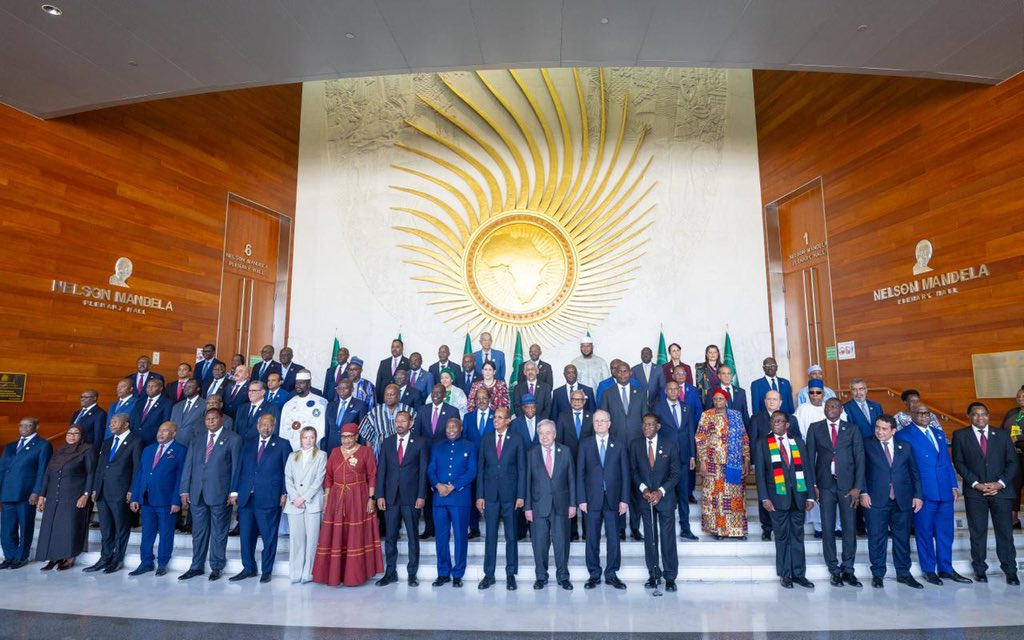
Addis Ababa, Ethiopia – The 39th Ordinary Session of the African Union Assembly of Heads of State and Government opened today at AU headquarters in Addis Ababa, Ethiopia, under the theme “Assuring Sustainable Water Availability and Safe Sanitation Systems to Achieve the Goals of Agenda 2063.” The two-day summit brought together leaders to discuss African solidarity, financial independence, peace, and institutional reform.
H.E. Mahmoud Ali Youssouf, Chairperson of the AU Commission, framed the summit around water and sanitation, describing access to water as a collective good that supports development and peace. He noted the challenges posed by geopolitical turbulence, ongoing conflicts, institutional fragility, and unconstitutional changes of government in parts of the continent. He urged member states to accelerate political and economic integration under Agenda 2063.
“Institutional reform and financial self-reliance are now imperative as external funding declines,” Youssouf said, calling for stronger domestic resource mobilization and faster implementation of continental programmes in industrialization, agricultural transformation, energy development, and infrastructure. He also acknowledged the rising expectations from Africa’s youth, women, and civil society, stressing that this decade of Agenda 2063 must deliver tangible performance and measurable results.
Youssouf expressed solidarity with populations affected by conflict in Sudan, the Sahel, eastern Democratic Republic of the Congo, Somalia, and the Palestinian people, urging respect for international and humanitarian law as fundamental to peace.
Outgoing AU Chair H.E. João Manuel Gonçalves Lourenço, President of Angola, opened the summit by urging leaders to ensure sustainable water availability and safe sanitation, calling access to water a political, moral, and strategic priority for development, public health, food security, and stability. He reflected on Angola’s year as AU Chair, highlighting progress in Agenda 2063 implementation, infrastructure investment, strengthening continental integration through AfCFTA, and AU reforms to improve efficiency.
On peace and security, Lourenço stressed that Africa’s development depends on “silencing the guns” and addressing conflicts in Sudan and the Democratic Republic of the Congo, as well as combating terrorism in the Sahel and Horn of Africa. He warned against legitimizing coups through subsequent elections.
Prime Minister Abiy Ahmed of Ethiopia urged Africa to move from reacting to global events to actively shaping the global agenda as the AU nears its 25th anniversary. He called for unity, confidence, and greater continental influence in world affairs, noting Ethiopia’s AI institute and plans for an AI university as part of a forward-looking vision aligned with Agenda 2063.
UN Secretary-General António Guterres highlighted the importance of strengthening UN-AU partnership, multilateral cooperation for peace, and Africa’s growing influence in global affairs. He reaffirmed support for African development, industrialization, and equitable access to financing.
H.E. President Évariste Ndayishimiye of Burundi was formally elected Chairperson of the AU for 2026, succeeding Angola’s João Lourenço. The new Bureau of the AU Assembly for 2026 is: Chair – Burundi; First Vice – Ghana; Second Vice – Tanzania; Third Vice – To be confirmed (North Africa); Rapporteur – Angola.
Deliberations at the summit will continue, focusing on water security and pressing peace and security challenges across the continent.