JAPAN NEWS
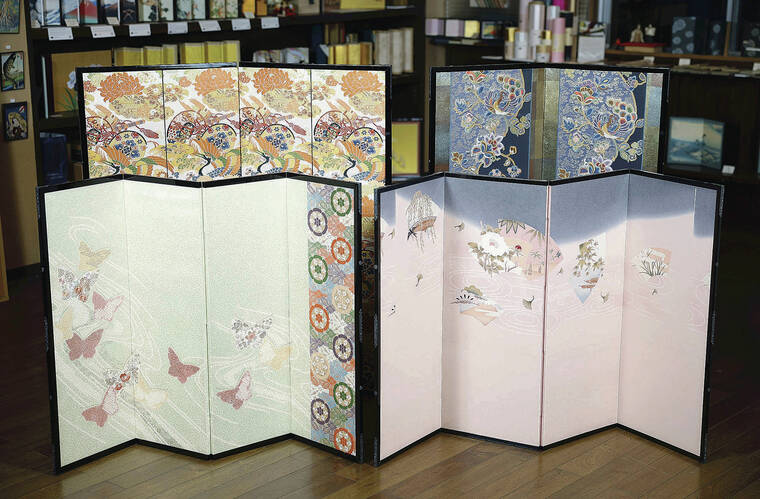
Byobu folding screens made with kimono and obi (sash).
TOKYO >> Byobu folding screens are a sure way to add elegance to any room, yet they are used less and less in modern Japanese households. But new types of screens are emerging, tailored to meet contemporary lifestyles.
Vibrant embroidered kimono, a photograph of drifting jellyfish, T-shirts and jeans — these are some of the many items used in byobu-making at Kataoka Byobu Store Co. in Tokyo.
The store, founded in 1946, is filled with byobu made with a range of materials featuring imaginative designs.
“We create byobu while exploring how they’ll be used in contemporary times,” said third-generation owner Koto Kataoka.
Born in Tokyo in 1988, Kataoka turned his focus to his family’s business after he was unable to offer substantive answers to questions about Japanese culture while on a high school study-abroad program in the U.S. He joined the family business after graduating university and another round of studying abroad.
Byobu traditionally serves three functions: stopping drafts, partitioning spaces and serving as canvases.
Don’t miss out on what’s happening!
Stay in touch with breaking news, as it happens, conveniently in your email inbox. It’s FREE!
The first function, considered to be the origin of the word “byobu,” is expressed in two kanji characters: “byo,” meaning to block, and “bu,” referring to wind.
Byobu also function as dividers, to create rooms in homes that have few walls, and to conceal clutter.
Many artists have created masterpieces on byobu, including “Wind God and Thunder God Screens” by Tawaraya Sotatsu and “Irises” by Ogata Korin.
“Since byobu can be folded with the painting facing inward, many works have been preserved in excellent condition,” Kataoka said.
His family’s store makes various folding screens, including backdrops for dolls used in the Hina Matsuri festival in March and warrior dolls on Children’s Day in May. Large gold byobu are used at hotels and wedding venues.
Amid declining demand, the store focuses on specialty orders.
Requests for byobu made from kimono have been increasing. These orders are fulfilled using urauchi, a technique in which washi paper is glued to the back of a kimono as reinforcement.
“It’s great that people are choosing to keep alive the memories associated with certain kimono by turning them into byobu,” Kataoka said.
He said he also receives many requests from foreigners who want to use byobu as decor. There are also requests for byobu for wall hangings, usually from restaurants and hotels.
He’s also excited about creating new types of byobu using photographs and manga images, and collaborating with artists.
“Byobu has a long history that connects the past and the present,” Kataoka said. “It would be great if our initiative became a tradition 100 years from now.”