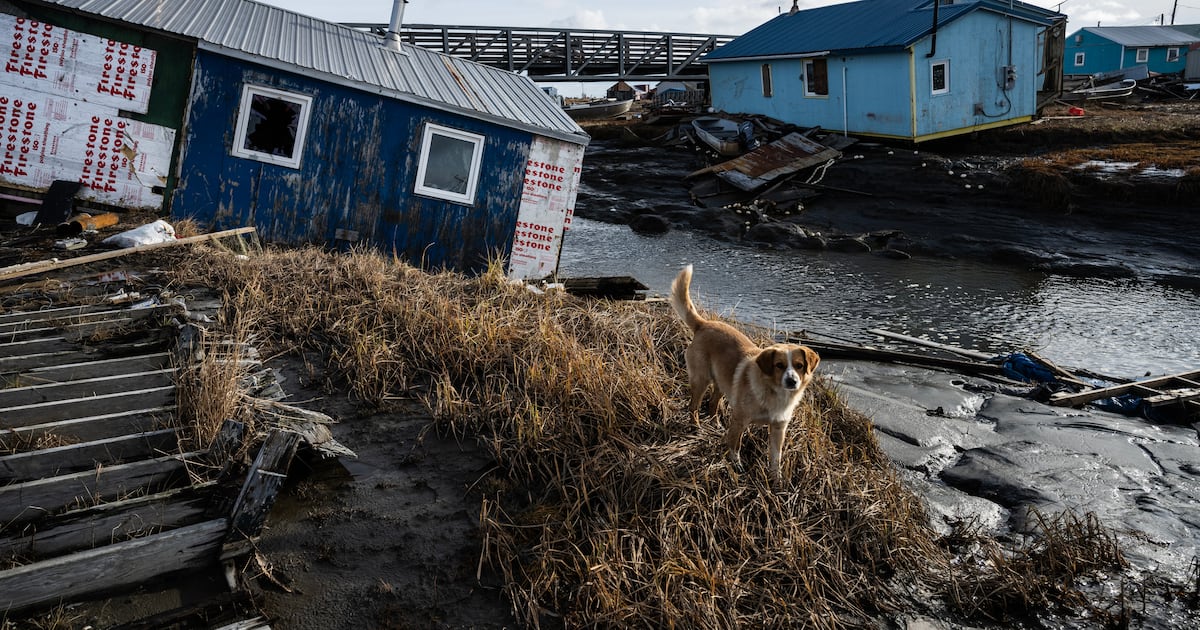
A loose dog walks near a home that tips toward a stream in Kipnuk days after Typhoon Halong devastated the village on the Western Alaska coast in October 2015. (Marc Lester / ADN archive)
The Alaska Legislature on Wednesday passed a resolution extending a disaster declaration over Western Alaska storms, allowing funds to be spent to repair villages ravaged by extreme weather in the fall.
Gov. Mike Dunleavy first declared a statewide disaster in response to the impacts of Typhoon Halong and other storms in Western Alaska in early October, after hundreds of rural residents’ homes were lost to storm damage.
Disaster declarations, under state law, allow the governor to spend money from the state’s disaster relief fund, and can last up to 30 days.
The disaster declaration was extended with approval from House Speaker Bryce Edgmon and Senate President Gary Stevens in November, December and January.
House and Senate majority members said that they were advised by legislative attorneys that after the Legislature convened for its regular session last month, the disaster declaration should be extended through action by the full House and Senate.
The advice came as Dunleavy asked lawmakers last month to approve spending $20.5 million in previously appropriated state funds from the disaster relief account, up $5 million from his previous request.
A resolution to extend the disaster declaration through March 8 and approve the new spending plan sailed through the Senate on Monday with no objection, but on Wednesday met opposition from the House Republican minority caucus over legal concerns.
The resolution passed the House in a 22-18 vote. Fairbanks Republican Rep. Will Stapp was the only minority member to join all 21 majority members in voting in favor of the resolution.
Republicans who opposed the resolution said they don’t dispute the spending requested by the governor, but contended that lawmakers should have gathered in a special legislative session late last year to extend the disaster declaration, rather than allowing Edgmon and Stevens to approve the extensions on behalf of the Legislature.
They also said that Dunleavy’s spending plan should have been presented as an appropriations bill, rather than a resolution, to allow more debate on the measure.
“Doing this as a resolution, I think, is dangerous. I think it’s a mistake. I’m not even certain that it’s legal,” said House Minority Leader DeLena Johnson, a Palmer Republican.
“We give up our powers of appropriation during a disaster. We give that to the governor. We allow the governor, rightly so, to immediately make decisions for the life, health and safety of those in need. But we don’t give them up forever,” said Johnson.
House Minority Whip Justin Ruffridge, a Soldotna Republican, said he was concerned that the Legislature ceded its authority by not gathering in a special session after the storm.
“What power do we give to the executive by allowing disaster declarations to continue without (the Legislature) taking up that order of business when the need was at its greatest?” said Ruffridge.
Under Alaska law, “a proclamation of disaster emergency may not remain in effect longer than 30 days unless extended by the legislature by a concurrent resolution.” However, the law also states that the governor is not required to call a special session after a disaster declaration if the presiding officers of both the House and Senate agree that a special session is not needed.
Questions on the governor’s authority to extend disaster declarations without action from the full Legislature last came to the fore in early 2021 during the coronavirus pandemic, when Alaska’s statewide disaster declaration ended amid legislative inaction.
House Majority Leader Chuck Kopp, an Anchorage Republican, argued Wednesday against the need for special sessions to extend disaster declarations, pointing to their cost. A one-day special session called by Dunleavy in August cost $300,000, Kopp said.
“Alaskans aren’t happy with that,” he said.
The solution sought by lawmakers to extend the disaster declaration through Edgmon and Stevens’ approval was “economically expedient” and “legally efficient,” said Kopp.
Rep. Louise Stutes, a Kodiak Republican who serves in the majority, said the method of extending disaster declarations outside of the regular legislative session may not be perfect, but “we’re moving forward,” she said.
“Time is of the essence, so I ask you to ask yourself: Do you want to be right in how it’s done, or do you want to do the right thing?” she said.