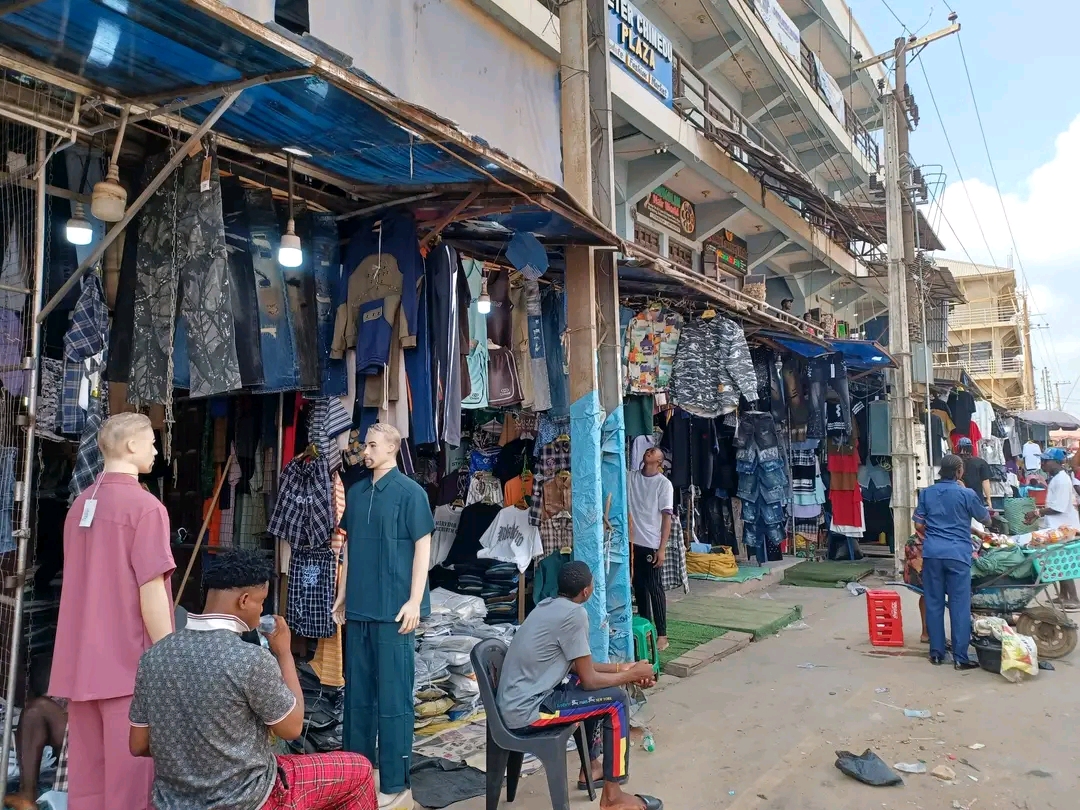
There was improved turnout of traders on Monday at the Onitsha Main Market in Anambra State after Nnamdi Kanu announced “total cancellation” of the infamous Monday sit-at-home in the South-east.
PREMIUM TIMES earlier reported that Mr Kanu, the convicted leader of the outlawed Indigenous People of Biafra (IPOB), announced the cancellation of the illegal directive in the region on Sunday.
Emma Powerful, the IPOB spokesperson, said Mr Kanu gave the directive from the Sokoto prison facility where he is serving life imprisonment for terrorism.
Mr Kanu’s directive came barely two weeks after Governor Charles Soludo of Anambra State ordered the temporary closure of the Onitsha Main Market due to traders’ compliance with the illegal IPOB sit-at-home directive.
Mr Soludo only reopened the market one week after the closure and threatened to sanction any trader who continues to observe the sit-at-home.
Traders at Onitsha market (PHOTO-Facebook)
Improved turnout
The market opened for business on 2 February, which was the first time the market would open on a Monday since 2021 when IPOB first imposed the sit-at-home directive on residents of the South-east.
But yesterday, Monday, 9 February, PREMIUM TIMES gathered from traders in the market that there was an improved turnout of shop owners in the market.
Arinze Ajaezu, a shop owner in the market, told this newspaper that the declaration by the IPOB and another self-acclaimed pro-Biafra group, Biafra Liberation Army, might have been responsible for the improved turnout of traders in the market.
“People came out much better than last Monday (2 February),” Mr Ajaezu, who deals in stationery, said.
“You know the news is everywhere that IPOB and other groups have cancelled the sit-at-home.”
He, however, lamented that buyers were yet to resume shopping in the market.
“Customers have not yet started coming. About 95 per cent of traders that opened today (Monday) did not make any sales,” he said.
Another shop owner and a former chairperson of the market, Kenneth Onyeka, told PREMIUM TIMES that traders turned out, but he expected a higher turnout given that the illegal directive had been cancelled.
Mr Onyeka said he believes that since IPOB and other pro-Biafra groups announced the cancellation of the sit-at-home just hours before Monday could have contributed to the low turnout of shoppers.
“I believe that there will be a higher turnout next Monday,” he said.
Video clips
Video clips circulating on Facebook showed some traders opening for business in the market on Monday, 9 February.
In one of the clips, shop owners were seen ready for business at the First Bank Line of the market. However, some shops in the line were still locked.
Another clip showed traders along Sokoto Road in the market opening their shops on the same Monday.
Sit-at-home in other parts of the South-east?
Findings by PREMIUM TIMES showed that sit-at-home in most parts of the South-east has largely disappeared.
A journalist based in Umuahia, Abia State capital, Emmanuel Nwazue, told this newspaper that business activities have been ongoing in the city because the sit-at-home directive has not been in effect in the area for years.
“The fact is that Umuahia doesn’t even observe sit-at-home at all – whether cancelled or not,” Mr Nwazue said, when asked if the recent cancellation had an impact.
Umuahia is close to Afara-Ukwu, the home of Mr Kanu, whose incarceration initially resulted in the illegal sit-at-home.
Mr Nwazue explained that the sit-at-home was only held in the state capital a few times after it was initially declared, but later stopped.
“So, today (9 February) was just like a normal day. Markets opened. Banks were working. People went to work.”
However, PREMIUM TIMES gathered that there was partial compliance with the sit-at-home order in Aba, the commercial hub of Abia State, despite the cancellation of the illegal directive.
In Enugu State, a PREMIUM TIMES reporter who visited the popular Ogbete Main Market reported that there was an improved turnout of traders on Monday. Some shops, however, remained locked in parts of the market.
The situation was the same in Owerri, Imo State capital.
A resident of Owerri, Benjamin Ohadoma, said the sit-at-home had been inactive in the state capital for a while.
Mr Ohadoma said markets had been opening on Mondays in Owerri, with fewer traders due to fear, but that there was a remarkable improvement in the turnout last Monday, 9 February.
He, however, said the sit-at-home has been active in volatile areas of the state, such as Orlu and Okigwe, where fear of criminal attacks often forces residents to stay at home on Mondays.
“Now, in Owerri, people usually come out to do their business on Monday. Every business is moving,” he said.
Ben Okolo, another resident of Owerri, told PREMIUM TIMES that the state government’s heavy deployment of security operatives helped to stimulate people’s confidence in coming out for business on Mondays in Owerri
“So because of that confidence, many markets in Owerri, like Ekeukwu, Alaba and the World Bank markets, usually open every Monday,” Mr Okolo said.
He said those who still obey the illegal directive in some parts of the state, like Okigwe, Orlu, and Orsu Areas, did so out of sympathy for the Biafra struggle and Mr Kanu.
In Ebonyi, another state in the South-east, the reality remains the same: Sit-at-home has not been active there.
Solomon Alegu, a resident of Abakaliki, the state capital, told PREMIUM TIMES that markets, schools, banks and hotels were open on Monday, as they are on any other day.
Mr Alegu explained that the sit-at-home directive usually recorded partial compliance in Abakaliki whenever Mr Kanu was to appear in court during his trial at the Federal High Court, Abuja.
“And even during that time, only a few shops were locked. But government institutions never observed it,” he said.
Background
The Monday sit-at-home began in the South-east in August 2021 when IPOB imposed it on residents of the region.
The directive was intended to pressure the Nigerian government to release the IPOB leader, Mr Kanu, who was facing terrorism charges at the Federal High Court, Abuja, at the time.
READ ALSO: Nnamdi Kanu announces ‘total cancellation’ of sit-at-home in South-east – IPOB
The group, in August 2021, suspended the weekly directive for the first time, limiting it to days Mr Kanu appeared in court.
However, residents of Enugu, Ebonyi, Imo, Abia and Anambra states continued to observe the directive largely out of fear.
Gunmen, linked to a group led by a controversial Biafra agitator, Simon Ekpa, often enforced the sit-at-home, and had killed many residents and punished others for flouting it.
IPOB repeatedly distanced itself from the continued enforcement of the sit-at-home, insisting that those behind it were criminals exploiting the group’s name.
Despite this, Mr Ekpa, a Finland-based Biafra agitator, persisted in declaring the sit-at-home.
For the second time, Mr Kanu, in July 2023, through his lawyer Aloy Ejimakor, directed Mr Ekpa to halt the action. Mr Ekpa dismissed the directive as fake, insisting the sit-at-home would continue unless Mr Kanu personally addressed him in Finland.
The enforcement of the sit-at-home had resulted in deadly attacks and the destruction of goods for years.
PREMIUM TIMES has documented how the sit-at-home destroys businesses in the South-east, prevents residents from accessing healthcare and even worsens food security in the region.
Efforts by Igbo leaders, including Enugu Governor Peter Mbah, Anambra Governor Mr Soludo and Ohanaeze Ndi Igbo, to end the practice yielded limited results.
While the sit-at-home has largely disappeared in Enugu, Abia and Ebonyi states, it persisted in Anambra and Imo.
Meanwhile, Mr Kanu was convicted and sentenced to life imprisonment for terrorism in November, while Mr Ekpa received a six-year prison sentence in Finland for similar offences which he committed in South-east Nigeria.