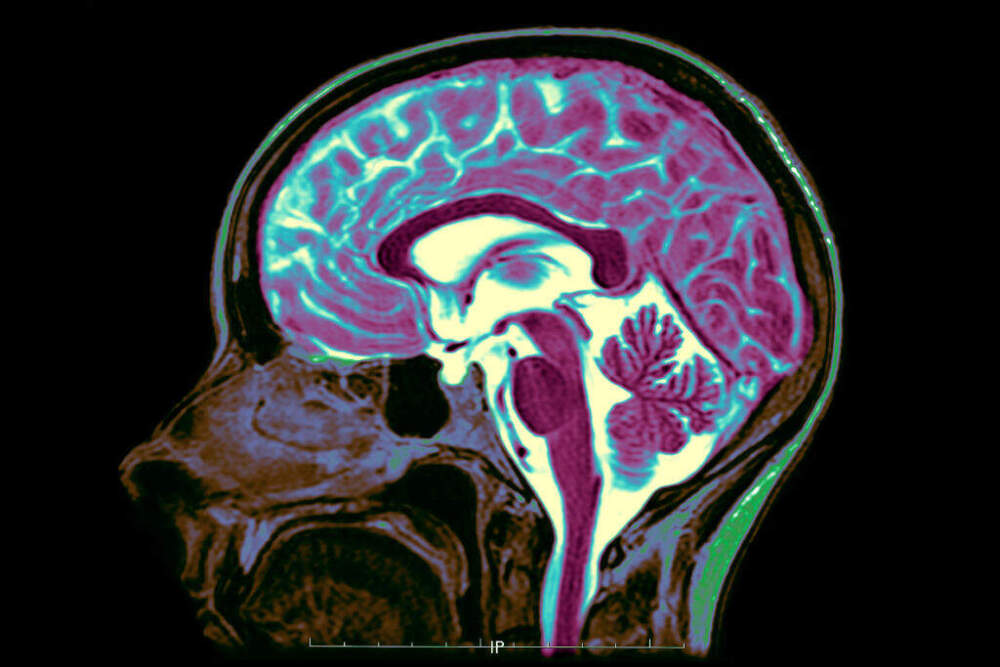
This is the first episode in ‘Brainwaves: Mysteries of the human brain.’
The brain is the organ that makes us who we are. It’s our conduit between reality and thought. But somehow, we’ve only scratched the surface in understanding how the brain actually works.
Guests
Nancy Kanwisher, professor of cognitive neuroscience at MIT.
The version of our broadcast available at the top of this page and via podcast apps is a condensed version of the full show. You can listen to the full, unedited broadcast here:
Transcript
Part I
MEGHNA CHAKRABARTI Today, we’re kicking off a weeklong look at the human brain and we’re calling it Brainwaves. Okay. I know. You see what we did there. Ha. But it’s actually a perfect title. Because every time we try to describe the human brain, I have to say it is hard not to use loose, ephemeral language about it like waves.
Because brainwaves are the best we can do to put the fact of human thought into words, and it’s unsatisfactory to be sure, because what is human thought really?
How does it work? We all, all 9 billion of us humans, we all know something happens when we’re thinking, but we don’t know exactly how it happens, but that something really changes when we’re thinking, something flows. So that’s why we call it a brainwave. What I’m saying is that it’s hard not to drift into the mystical when talking about this still most mysterious of human organs.
CARL SAGAN: This intricate and marvelous network of neurons has been called an enchanted loom where millions of flashing shuttles weave a dissolving pattern.
CHAKRABARTI: The in Imitable Carl Sagan, in a 1980 episode of Cosmos, exploring different parts of the brain and what they do. And by the way, I absolutely love that phrase, an enchanted loom. So today, in episode one of Brainwaves: Why is the brain so hard to research?
Joining me to answer that question is Nancy Kanwisher. She’s a professor at MIT in cognitive neuroscience. She spent her career studying the “functional organization of the brain as a window into the architecture of the mind.” And by the way, Professor Kanwisher, I think that’s a metaphor that Dr. Sagan would’ve loved also.
Welcome to On Point.
NANCY KANWISHER: Thank you. My pleasure to be here.
CHAKRABARTI: So what first got you interested in delving into the mysteries of the human brain?
KANWISHER: For me, it’s hard to imagine how you could not be interested in the brain. Because it’s who you are. And so you watch yourself do things and think things, and you think, what is that?
What just happened? Why did I think that? Why did I see that? Why does this thing look like that? How can we not wonder what’s going on in our own minds?
CHAKRABARTI: Exactly. How can we not? And yet it’s still, after, I’d say thousands of years now, of human beings attempting to understand better what’s going on in our minds.
I think one of the first archeological pieces of evidence of trying to tinker with the brain came from ancient Egypt, right? So what, 1700 BC or even earlier. But we still don’t really understand it. I like to think of it as, this is not original to me, but as the original black box.
In terms of something happens in there, but we don’t have satisfactory ways of accessing that. Is that a decent analogy?
KANWISHER: It is as a subjective experience of a regular person. But on the other hand, the cool thing is that we actually do have ways to approach it scientifically. All kinds of different ways to open the black box and ask what’s going on.
And we can do that just by measuring behavior. If you had a car and you’re trying to figure out how does this thing work and you couldn’t open the hood, you could drive it around. You could figure out some stuff, you could study sometimes cars break down like this, sometimes they break down like that.
That would give you a lot of clues about how cars work. But at the same time, you could open the hood and look inside. And so when we try to understand the mind and the brain, we go at it with both approaches. We measure behavior, the external emanations of whatever’s going on inside and try to infer what’s going on inside from what people do and see and report.
But we can also look inside with amazing tools of the last few decades of neuroscience research.
CHAKRABARTI: The last few decades, right? That being key, the advances have been really incredible. Throughout the rest of the show, I want to talk with you in detail about what those advances are and how they work.
But first, can we just take it down to the most fundamental level? How would you describe, the brain is grey matter. About what? Eight pounds of it? In an average human? Is that too much?
KANWISHER: I think it’s more like three.
CHAKRABARTI: (LAUGHS) Three? So I just radically expanded the size of the human brain.
Wishful thinking. Okay. Three pounds of it. Sort of what are the most important parts of the brain to understand in this conversation?
KANWISHER: Okay. I guess we could break it down into three main kind of chunks. There’s all the subcortical stuff where you have these nuclei that do different things, and they do some pretty basic survival things like controlled breathing rate and digestion and stuff like that.
They also do some more important things like control your habits and your ability to learn. And then sitting on top of that is this massive bundle of fibers, millions of miles of fibers. You can think of it as a wires of each neuron has a wire coming out of it that connects it to other neurons.
And so about 40% of the volume of your brain is white matter, or just wires.
About 40% of the volume of your brain is white matter, or just wires.
CHAKRABARTI: Oh, so the neurons that you’re talking about —
KANWISHER: Yeah, the connections.
CHAKRABARTI: 40% of the brain are those neurons?
KANWISHER: Something like that.
CHAKRABARTI: Wow.
KANWISHER: And then sitting on the top, the outer surface is called the cortex. And it’s the size and thickness of a large pizza.
And so if you imagine taking a large pizza and trying to fit it in your head, you have to crumple it up. That’s why the brain is all folded, because its native structure is this surface. And to fit that surface in your head, you have to crumple it up.
CHAKRABARTI: Okay. Help me out here. So are there neurons in the cortex as well?
KANWISHER: Yeah. Yeah. That’s where the cell bodies of the neurons are.
CHAKRABARTI: Got it.
KANWISHER: That’s where most of the conscious thinking, perception, action, planning, all the stuff that we think of as thoughts and intelligent behavior is constructed mostly in the cortex.
CHAKRABARTI: Okay. And all of this is happening because those neurons connect with each other.
KANWISHER: Yeah, they have to connect with each other or they can’t do anything.
CHAKRABARTI: And so those are, those connections are called I guess it’s the space between the connections technically is the synapse.
KANWISHER: That’s right. It’s a whole thing, like, it’s the structure on what’s called the pre-synaptic neuron and the post-synaptic.
They come together. There’s a space between, and there’s a whole lot of fancy molecular biology that enables a chemical signal to go from one neuron to the next.
CHAKRABARTI: And how many synaptic connections are there in a brain?
KANWISHER: Around 100 trillion.
CHAKRABARTI: (LAUGHS) I just looked it up before we started talking that there are —
KANWISHER: So did I. (LAUGHS)
CHAKRABARTI: There are, in comparison to the 100 trillion synaptic connections in a human brain, there are only 100 to 400 billion stars in the Milky Way galaxy.
So we’re talking about a system between our ears that is inherently more complex … than what like a galaxy would be if all the stars were connected.
KANWISHER: Yep.
CHAKRABARTI: How do you wrap your head around that fact?
KANWISHER: I think the number of neurons is relevant and indeed it is a very complicated thing, but it’s not just a number of neurons. We could take this five ounces of yogurt that I was eating right before we started here and say there’s God knows how many atoms in there, or how complicated.
It’s not that complicated. The atoms are really similar. So the question with brains is what are the regularities that we can discover? Across all of those neurons and all of those synapses, what are the principles that help us understand what is going on in general? How do these things enable computation?
How do they enable us to see, how can we take visual information and bring it into our eyeballs and have it make some neurons fire in the retina in the back of your eye? And then do a whole bunch of computations and know what we’re looking at. And we can think about those questions without having to have a story about each neuron individually.
We can rather say, there’s these kind that do this kind of thing, and they make that kind of connection to these other neurons and that enables this kind of computation. So we go up a level in, or two in generality to try to extract the principles that span that large number of neurons in synapses.
CHAKRABARTI: Got it. Okay. So we’re starting to get into why it’s so hard to research the brain here, but before we do more of that, I think there’s a great example that you have of even in today’s world, where we have more machines or tools than ever. It can still be really hard. You have a friend named Bob, is that right?
Can you tell us the story of you and Bob?
KANWISHER: Yeah. Yeah. So Bob is a friend of mine who I have known really well for a long time. And a bunch of years ago he was staying over at my house on route to a conference in a neighboring state. And he was going to leave early in the morning.
And so early in the morning I hear him shuffling around in the next room and I was vaguely only half awake. And I think, okay, that’s fine. Bob’s going to his conference. You don’t need to feed him breakfast, you don’t need to get up, go back to sleep, blah, blah, blah. And then I hear this crash and I go in and Bob is unconscious on the floor there.
And so I shout at him and I’m terrified and I call 911. And long story short, after multiple days of doing every possible test, and first telling me this is a heart thing, not a brain thing. And my saying, consider that it’s a brain thing. It was a brain thing. He had a large tumor smack in the middle of his brain.
CHAKRABARTI: Wait, can we go back? I don’t want you to make this long story short.
KANWISHER: Okay. Okay.
CHAKRABARTI: So you found him on the floor.
KANWISHER: Yeah. Yeah. And I shouted and he didn’t answer.
CHAKRABARTI: And then you called —
KANWISHER: And then I called 911. And then as we were waiting for the ambulance, he started to wake up.
He’s woozy but he’s coherent. And he and I are trying to figure out what the hell just happened, and we don’t know what just happened. And so he is coming to, and he feels a little weird, but more or less, okay. And so when the EMTs arrive, they take all his vitals, and they say we can’t find anything wrong.
And they say to us, you could go to the hospital or not. I’m like, I think we need to know what just happened.
CHAKRABARTI: Right. (LAUGHS)
KANWISHER: So I drove him myself to the Mount Auburn ER and which is like a mile from my house, and they did test after test. They couldn’t find anything wrong.
CHAKRABARTI: Totally normal, Bob.
KANWISHER: Totally normal. So nobody’s stressed out and we’re like, okay, that was totally weird, but whatever. He seems okay. And just before I left the ER, I figured that eventually, I was like, I got to go to work. He can call me when he is ready to be picked up. Just before I left, I thought I should report this thing that I’ve noticed about Bob over the last few years.
And what I had noticed and not really allowed myself to fully engage on, because it was so scary, is that Bob had completely lost his ability to navigate, to know where he was in the world. And so I had seen this in a bunch of ways. Like Bob and I used to go hiking together all the time. And I was better with the maps than he was, but he was okay.
But things had gotten so bad that he would routinely get lost in his hometown. Where he’d lived for years.
Part II
CHAKRABARTI: So your friend Bob for a while, couldn’t even find his way around his own hometown.
KANWISHER: That’s right.
CHAKRABARTI: So when you remembered that, what happened then?
KANWISHER: It was a catastrophic kind of loss of an ability. And yet it was weird because at the same time, Bob had this very high-powered job.
He was doing great. He was flying around the world doing important stuff, getting highly paid, widely respected in his field, doing just fine. And so on the one hand, it just seemed weird, like how could there be something wrong with him given how well he was functioning in the world?
And the stupid thing is if anybody should have understood how that could happen, it was me.
CHAKRABARTI: The cognitive neuroscientist.
KANWISHER: The whole point of my research for decades has been that different parts of the brain do different things, and that means you can have a real problem with one part of your brain that produces a catastrophic but specific deficit, and the rest of your brain can function just fine.
But it didn’t really all come together for me until that moment in the ER where I’m thinking, huh, okay, consider the possibility this is a brain thing. Of course, the ER doc just said, oh no, this is not a brain thing. This is a heart thing.
CHAKRABARTI: Oh. Because he had lost consciousness —
KANWISHER: Who knows why. Docs are overconfident. Anyway. So I go off to work, and I check in a few times, and they haven’t found anything. Everything’s fine. And then that night I’m over at a friend’s house and the phone rings and Bob says, get over here. Immediately. They found something in my brain.
CHAKRABARTI: So they finally did a scan, essentially.
KANWISHER: They finally did a scan after 12 hours of doing all these other things and thinking this is not a brain thing. They finally do what I told them to do, check his brain, and they, so then I drive over there quickly. On the way over there, I remembered that we had scanned Bob in one of the experiments in my lab.
A few years before, so I called my lab tech on the phone and I said, find those old data. I can’t remember what it was, a few years ago. See if you can find them, because when we do a functional scan, we also do an anatomical scout just to get the lay of the land. And they’re not designed for clinical uses; you can see stuff.
So let’s look and see. Maybe it’ll be useful. So I get into the hospital and the MRI tech says, You want to see this thing?
CHAKRABARTI: Oh boy.
KANWISHER: Oh my God.
CHAKRABARTI: Not really what you want to hear.
KANWISHER: Not what you want hear.
KANWISHER: So we go in and there is this enormous thing in the middle of his brain, the size of a lime.
CHAKRABARTI: A tumor the size of a lime?
KANWISHER: Yes.
CHAKRABARTI: Oh my God. Horrifying.
KANWISHER: So then I go back and I look up the anatomical scans that my amazing lab tech has just sent me, and I look through the same part of the brain. And the amazing thing was even those, the scans were from like three or four years earlier, you could see it. It was smaller.
But it was there. And that ended up being quite diagnostic, told us that it was quite slow growing. And that’s good news, right? And it turned out that what he had was something called meningioma, which is not cancer. It’s not great. You can’t have this big thing in the middle of your brain blocking fluid flow around the brain.
You got to take it out. But at least it’s not one of the really aggressive, horrible cancers that will kill you.
CHAKRABARTI: Okay, so this is so fascinating. First of all, is he okay?
KANWISHER: He’s doing fine.
CHAKRABARTI: Did he have it removed?
KANWISHER: He had it removed. It took 11 hours of neurosurgery and he’s doing great.
CHAKRABARTI: Is it one of those surgeries where he was conscious during the procedure?
KANWISHER: No. No. Thank God.
CHAKRABARTI: Okay. I’m just fascinated by those procedures because you can have the patient be conscious.
KANWISHER: Oh, absolutely. Yes, we collaborate with people who do those. Yeah. It’s amazing.
CHAKRABARTI: I won’t get us off track, but they removed a lime size. I’m just picturing a lime, like holding it up against my head.
KANWISHER: No, exactly. Like how do you even get it out without. Anyway, they managed to, it was in the space between the two hemispheres so they could get it out without disrupting other tissue. Incredible.
CHAKRABARTI: But here’s what’s so fascinating about this story to me, is that we’re talking this huge about this huge mass.
But it only had a functional impact on this one narrow aspect of who he is in terms of what? Being able to have his accurate sense of direction.
KANWISHER: Exactly.
CHAKRABARTI: It could have, I’m just amazed it didn’t have an impact on a ton of other things.
KANWISHER: Exactly. No, that’s the thing about the organization of the brain is that different bits do different things, and so you can radically disrupt one of them and really lose a complete ability.
And yet everything else can be fine.
CHAKRABARTI: Okay, so this is why, again, I’m just obsessed with why the brain is so difficult to research because it’s big. This lime sized thing is big and it’s obviously coming into contact with multiple, in one specific area of the brain, but it’s big.
So multiple parts of that area, which I presume a lot of them do way different things than directionality. But yet those other things weren’t impacted.
KANWISHER: That’s true. I find that kind of mysterious too. But I guess it was just bumping into, and, maybe eating a little bit of one part of the brain and evidently not having much of an effect on the others.
But the thing is, the fact that different parts of the brain do different things is actually a real lever that we have as scientists to help us understand it. It’s like one of the oldest methods in science is you have a complicated thing you’re trying to understand whether it’s a machine or a cell or a brain.
Is like first figure out what the parts are. And then try to figure out what each part does, and then maybe someday you’ll figure out how the parts work together.
CHAKRABARTI: But that sort of, that trillion level connection of synaptic connections makes me think that another challenge though is if that same sized, same type of growth had happened in another person, it very likely that it could have, in fact, impacted a different function, even though it was in the same location.
KANWISHER: Absolutely. If it was in the same location, I’m not sure. But it is one of the basic methods that’s been around in our field for a hundred years. Long before we could look inside the brain with fancy imaging methods. The main way we had to understand the organization of the brain was by studying people who lost specific abilities.
For example, people who have something called prosopagnosia, which means that they can’t recognize faces. And in a few cases, they’re completely normal at everything else. They can recognize words and scenes and places, and they know where they are. Unlike Bob, they just can’t recognize faces.
CHAKRABARTI: Wait, so let me get some clarification on this.
When you say recognize faces, do you mean that they can’t, they see someone’s face who should be familiar to them and they don’t know who that is, or they just don’t even know they’re looking at a human face?
KANWISHER: No, they know what’s a face. So the title of the Oliver Sacks book is misleading, nobody would confuse their wife for a hat.
CHAKRABARTI: Ah, got it.
KANWISHER: They would rather confuse their wife for someone else, or be unable to tell the difference so that … it’s a face. You just don’t know which face.
CHAKRABARTI: Wow. But you can recognize everything else in your visual environment.
KANWISHER: In the specific cases, right? Often brain damage affects many things, and then you can have multiple deficits. But in the cases that are of most interest to scientists are those rare cases where the deficit, the lesion is very small, and the deficit is very specific.
CHAKRABARTI: Wow. But doesn’t that also, couldn’t that lead us to believe, or me, as a lay person that different functions are highly localized in the brain. Whereas in fact what we know from research like yours is that a lot of brain functions happen in different places and work together. Am I wrong about that?
KANWISHER: Okay. What I would say is many functions, many parts of the brain conduct extremely specific functions. Okay. Even for those extremely specific functions like face recognition or navigation, there will be multiple brain regions that do it, right?
So it’s true that a given mental function needs lots of brain regions. But it’s also true that for many brain regions, that region just does one thing.
CHAKRABARTI: Oh, I see. Okay.
KANWISHER: So take face recognition, for example. There’s this very specialized region that my lab wrote about decades ago called the Fusiform Face Area.
It’s very specifically responsive to faces, and it’s the same region that when lesioned makes you prosopagnosic, make makes you unable to recognize faces. So we know that region is specifically involved and necessary for face recognition, but you can’t recognize faces just with that region alone.
You need eyeballs, you need a retina. You need your primary visual cortex. And of course, to be able to say who you’re recognizing, you need to be able to speak or press a button or somehow get the information out. So a whole mental process will recruit many different brain regions for different stages, but at the same time, many individual brain regions do just a teeny, tiny, very specific part of that.
CHAKRABARTI: Oh, fascinating. Okay, so now let’s get back to just the mechanics of why doing this research has been so challenging. Because you hinted to it before, prior to the sort of just the recent past. What tools did researchers have? Observation.
KANWISHER: You could study behavior, like I mentioned. Like driving a car around and trying to figure out how it works without opening the hood. So that actually got us really far. Like a lot of what we know still about psychology and perception and thought and language processing is done with simple behavioral experiments.
They’re actually very powerful. You have to be clever in the design of your experiments. You have to really think hard, but you can learn a lot just by studying behavior. And then you can learn yet more by studying how behavior gets disrupted in people with brain damage. What bits can be disrupted independently, of which other bits, and all of that was going on in very rich detail before any of the modern methods came along.
CHAKRABARTI: Okay. And then there’s also, the more brute force methods, right? In terms of, was there conscious patient surgery going on and like surgeons poking at different parts of the brain and seeing how that affected a person’s abilities?
KANWISHER: Yeah, absolutely. Absolutely.
CHAKRABARTI: So one of the major methods in our field happens from people who are undergoing neurosurgery and going way back many decades, there were some famous neurosurgeons in the Montreal Neurological Institute in Montreal who reported all kinds of wild things like if they’d have people’s brains open for neurosurgery and they would stimulate different parts and they would find all kinds of wild things. Like one of my favorite was they stimulated this woman’s brain in some location. I forget where, but anyway, she reported, I feel that I’m not welcome here.
CHAKRABARTI: Oh, wow.
KANWISHER: Isn’t that wild? And there’s another recent paper from a colleague at Stanford who reports that another brain region, when patients are stimulated there, they have a feeling of incipient possibility. Like that things will change soon in the future. Like these totally weird, fascinating, intriguing things.
CHAKRABARTI: This is why we’re going to just come back to this over and over again this whole week. That it seems so almost like magic to me, and I’m not prone to that. Because I love science, but the idea that a part of the brain can be stimulated, I suppose even just by like pressure or, I don’t know, electrical current or something.
KANWISHER: They’re doing this with electrical currents.
CHAKRABARTI: Okay. But just through that, something happens through how the currents are then processed by the brain that make us feel these like spiritual, emotional things like a physical process turns into a matter of the heart or the soul. It amazes me.
KANWISHER: Yeah. Because that’s where our mind lives. And you go activating neurons there, you affect mental experience.
CHAKRABARTI: We’re going to do a whole hour on consciousness later, but go ahead.
KANWISHER: Okay. But in a more mundane way. So you take that face area. And some colleagues of mine showed years ago, they had somebody who had an electrode right there on top of his face selective region, and they stimulated it while he was looking at a face.
And there’s this amazing video of this guy talking about what he’s experiencing. He’s looking at his neurologist and he goes, whoa, your face just metamorphosed, like you turned into someone else. That was a trip.
CHAKRABARTI: Oh my.
KANWISHER: Yeah, so that’s fascinating. And freaky, but it’s also deeply informative. Because it tells us that very region is not only activated when you look at faces, it is causally involved in your perception of the face.
Because if you stimulate it, you change what the face looks like.
CHAKRABARTI: It also makes me feel highly vulnerable, honestly. We can get to that later, but, okay. So there was these observational, there were observational techniques, there were some surgically related techniques, but the really big change came with imaging.
KANWISHER: Yep. Yep. And in the early ’90s, some really smart physicists, I had nothing to do with this. Figured out how to take MRI scanners that had been around for a while already, and tweak the physics of how they got the images so that they could one, take the images really fast. So instead of taking like 45 minutes to get a series of images through your knee, like cross sections through your knee or something, they could take a series of cross-sections through your brain in a second.
So they could take them fast. But then the other equally important thing is they tweak the physics so that the brightness of each little 3D pixel in the brain in their images showed you not just the density of tissue, but blood flow. And blood flow is related to neural activity. And so you put those two things together and you get movies of brain activity.
CHAKRABARTI: And this was in the ’90s.
KANWISHER: Early ’90s.
CHAKRABARTI: Early ’90s. How long have you been in the field?
KANWISHER: Oh, God. All that time. And more. … But in fact, the first, before MRI, the earlier brain activation method was called PET, positron emission tomography. And the first PET study was published on the cover of Science in my first year in graduate school in 1981.
And I looked at that blurry image and I thought, must do that.
CHAKRABARTI: Oh, wow.
KANWISHER: It took me 10 years of beating at the doors before I was ever allowed access to a brain imaging device.
CHAKRABARTI: 10 years. Gosh, golly. But the reason why I ask that is, it’s like having the scales fall from your eyes as a researcher to basically see it’s like, what, almost real time brain activity in terms of the change in blood flow in different parts of the brain.
What, the first time you were able to do that in a research project or experiment, what was that like for you?
KANWISHER: Oh, like beyond thrilling. Just mind blowing, right? So one of the first experiments we did we finally got awarded a few hours a week on the scanner over at MGH. And, nobody told us how to use it or what to do.
It’s okay, Saturday morning, six to nine, it’s yours. Here are the keys to the 747. Go fly to Europe. Ah! So I recruited two of the smartest people I knew and it’s okay, we’re gonna try to figure this thing out. And it was just wild, there was like, which I had no idea what we were doing.
CHAKRABARTI: Who was your subject?
KANWISHER: Oh, usually me or whoever we could grab from the lab. And we would go over there and these big error messages would appear on the screen, arcing may occur and we’d go, oh my God. But anyway, even early on, one of the first things we did was to just make the simplest possible experiment, pretty dumb when you think about it. It’s okay, let’s scan people while they’re looking at faces and while they’re looking at objects. And let’s see if there are any bits that are more active when people look at faces and objects. Because we knew about this phenomenon of prosopagnosia. And we thought there should be a bit in there in the brain that’s doing that.
And so I remember we scanned me first and I came out of the scanner and me and my two coworkers are in the little room next to the scanner doing a quick data analysis and it’s holy crap, there’s a little blob right there.
CHAKRABARTI: Oh no.
KANWISHER: Yeah. And then you could just, there was simple software.
You could just look at the time course of activation. You see these big bumps when I was looking at faces. And these little, teeny bumps when I was looking at objects.
CHAKRABARTI: Oh, there was a difference.
KANWISHER: Oh yeah. And they were like, Oh my God. And then my first thought was, Okay, that’s amazing. We’ll never see that again.
And so a few days later, okay, let’s try that again. Put me in again. Same blob, same response. And so then, then we started scanning other people and it was like really clear. Everyone had this little thing in more or less, the same place in the brain, and it was very selectively responsive to faces.
Part III
CHAKRABARTI: I wanted to stick with what you were talking about regarding what MRI imaging was able for you to see, because it’s a perfect example, the little sort of tiny bit of the brain that was necessary to see, to recognize human faces.
How do you know from that then that it is uniquely important or it’s part of a bigger system in the brain?
KANWISHER: Yeah. You don’t know from MRI alone that it’s important in the sense of causally involved, so you have to use other methods like electrically stimulating that region or like finding people who have damage to that part of the region.
If those causal manipulations affect their ability to recognize faces or affect the face they’re looking at right now in the case of stimulation, that tells you that it’s causally involved in face perception.
But of course, no part of the brain can act alone. Every part of the brain has to get input from other regions, has to send output to other regions, probably has to talk to lots of other regions.
No part of the brain can act alone. Every part of the brain has to get input from other regions, has to send output to other regions.
And so just because that region is specific doesn’t mean it’s acting alone. Of course, it’s acting with lots of other brain regions.
CHAKRABARTI: Alright. But our understanding of what that sort of system of regions might be and how they function can change. Let me go back here. Because no offense to cardiologists or heart researchers, but I look at the human heart as a really beautiful but purely mechanical organ.
KANWISHER: It’s a pump.
CHAKRABARTI: It’s a pump, right? The valves do what valves do. The atria and ventricles, they squeeze, the muscle does what it does. But in terms of how it works, we pretty much know. Whereas with the brain, I’m thinking of researchers who do memory research.
Again, just reading from like the lay press, I’ve heard that like every year or so there’s a different understanding of what parts of the brain are really important for where memory not only resides, but how we access it, et cetera. It seems like it’s very fluid in terms of what parts of the brain do what, and I don’t know if that’s a result of where researchers are looking at a particular time, like where they’re shining their light, or if the brain. I don’t know. Do these functional regions move around?
KANWISHER: No.
CHAKRABARTI: Okay.
KANWISHER: No, they don’t. I would say it’s only fluid for some things. So ones we don’t really understand yet. The face region, the navigation regions that were impaired in my friend Bob. Other regions that we found, like language regions, we have known where those regions are for a long time, and what functional MRI has added to that is the understanding of how incredibly specific those are. So that’s not changing at all.
They stay in the same place. The things that are more open to debate are other higher-level functions that don’t seem to have a uniquely specific machinery that implement them.
Like working memory. Okay. We can hold information after we see it or hear it for some period of time. Where does it live? It probably lives lots of places. There’s much debate about how distributed it is, and so some mental processes are spread around many regions like that.
But many are not. Like understanding the meaning of a sentence. This happens in your language cortex. In the temporal lobe. In the frontal lobe. And we can map that out in each person individually and we know exactly where those regions are. And my colleague Ev Fedorenko at MIT has shown that those regions are extremely specific for language, they do not turn on when you do anything else.
Okay. So those things are really rock solid.
CHAKRABARTI: Okay. So in those cases, the car analogy would work.
KANWISHER: Yeah. It’s like a carburetor, or I don’t know enough about cars, but it is like the different pieces of the motor that do different things.
CHAKRABARTI: But it sounds like in other cases, I just keep coming back to memory.
You mentioned working memory. It’s not so much like a mechanical analogy. It sounds more like a computational one.
KANWISHER: All of these are computational. It’s just that some of these computations are very specific and go on in particular brain regions and other ones are more general operations that recruit a lot of the brain in an overlapping way.
And so things like recognizing faces and understanding language and navigating have highly specialized machinery for each of those things. Whereas things like holding information in memory or accessing long-term memory, these are things that are more spread around in more general-purpose parts of the brain.
CHAKRABARTI: Okay. So back to the lab, you have the MRI as a very groundbreaking tool. I’m trying to remember. Functional MRI, is that?
KANWISHER: Yeah, functional MRI is like where we look, not just at the structure, but what parts are active in different conditions.
CHAKRABARTI: So that’s the one that gives you the movie of the brain.
And are CT scans as important as MRI?
KANWISHER: Not so much in my field. They’re blurry. You can’t really see the structures as well as you’d like.
CHAKRABARTI: Okay. So those are better for emergency rooms. Got it. Okay. No, I was just curious, because again, we’re talking about tools.
What is it right now that you have difficulty understanding or can’t see or can’t measure in the brain that you’d love some nerdy engineer out there to get a new tool?
KANWISHER: Oh, boy. Boy, do I have a wish list. Yeah, boy, do I have a wish list. It’s especially salient to me because the neuroscience tools that are available in animals are breathtaking.
CHAKRABARTI: What are they?
KANWISHER: Things like optogenetics that enable you to label a particular set of neurons, turn them on, shut them off at particular periods of time in a particular brain region, you have spectacular ability to measure and control neural activity in animal brains that we don’t even approach those abilities.
CHAKRABARTI: Yeah, we can’t do that.
KANWISHER: Yeah. So the kinds of things that I would really love to get better data on from human brains are recordings that enable us to record from lots and lots of neurons in the same place at once. And this is beginning to happen. There are methods called neuropixels that are being used in animals where you have like thousands of electrodes in approximately the same place in a brain.
And so you can really see the neural code with incredible precision. And so people are starting to be able to do little bits of this only, briefly during neurosurgery. When it’s clinically required, anyway. But giving these much higher resolution pictures of neural activity and how it changes over time, and that’s what we need to really study.
How does the brain compute?
CHAKRABARTI: Okay. You’ve now, I’m sorry I didn’t realize this before, but you’ve raised what is the biggest challenges in studying the human brain in that the person needs to be alive, the brain has to be functioning. You can get structural studies done —
KANWISHER: A dead brain.
CHAKRABARTI: Dead brain. And tissue level studies. Those are actually really quite important in some fields, like Alzheimer’s, et cetera. But in terms of learning how it’s working in real time, yeah.
KANWISHER: You have to be alive.
CHAKRABARTI:: Yeah. Yeah. Which is why ethically like you run into some big roadblocks.
So let’s jump to AI here. Is AI changing that?
KANWISHER: It has radically changed our field. Most obviously, we use AI tools to analyze our data. But at a much deeper, more interesting level, AI models have become our hypotheses of what the brain is doing. And I never thought I would be taking this seriously.
AI models have become our hypotheses of what the brain is doing.
Until a few years ago. Many other people jumped on this bandwagon long before I did, but they started by showing that convolutional neural networks, it suddenly became able to recognize objects really well. You show them an image and they’ll tell you that’s a person or a dog, or a toaster or a tree, or whatever it is.
Those work extremely well on natural images, and this started happening abruptly around 2012 and due to just more compute and more training examples. And so then that was the first time we actually had an AI model of visual object recognition. And that gave us hypothesis about what might be going on in the brain.
And on the one hand you might say, there’s no reason to think the brain is doing anything like that. Why should it be like that? It’s just a totally different thing. It’s a computer program, not a wet bunch of goo produced by a natural selection. But it turns out that there are striking similarities between how those AI programs optimized by deep learning methods function and how the brain functions.
And this is astonishing and fascinating and empowering.
CHAKRABARTI: Is it a superficial similarity though?
KANWISHER: I don’t think so. Because we can look, for example, in the visual system, we can look layer by layer in the AI models and we can look stage by stage in the processing stream in the brain. And we find not just similarities, but layer-wise similarities.
Early stages resemble early stages in the networks. Middle stages of processing in the brain resemble middle layers of the networks. There are striking similarities, and I don’t want to overstate it, they’re not the same thing, but the similarities are astonishing, and that empowers us to use these networks to ask all kinds of questions.
And so one of my favorite things is I think we can use these questions to answer why questions about the brain, notoriously, scientifically difficult questions, like, okay, why should the brain have special machinery for face recognition? Why should it have special machinery for language understanding?
Why shouldn’t we just have generically powerful mush that does everything right? And so I used to end every talk with that as just an interesting question that I never thought we’d be able to answer. And then a few years ago, my then postdoc Katharina Dobs came along and she trained an artificial neural network.
She gave it a whole bunch of labeled objects, object images with her labels and a whole bunch of face images with her identity labels. And she trained the network to recognize objects and to recognize faces. And importantly, she didn’t tell it, these are faces, these are objects. She just mixed them all together and trained it, and it got really good at both object recognition and face recognition.
And then she looked inside and she found that network had spontaneously segregated itself into two different pathways. Like the AI optimization had realized that we have two different problems here and we’re going to sign different parts of the network to solve them. And when we got that result, the hair stood up on the back of my neck.
It’s, holy crap. This totally different optimization method has recapitulated things that we’ve been looking at in the brain for a long time.
So evidently, this is just what a kind of computationally optimized solution looks like.
CHAKRABARTI: I see. I see.
KANWISHER: And so this is happening across the board. My friend Josh McDermott is studying how people hear, and he’s been studying in great detail how we localize a sound.
Where is it coming from, how do we perceive pitch? And he’s showing again and again that if you train an artificial neural network to do various audio tasks, they spontaneously recapitulate. What we’ve known about human hearing for decades.
CHAKRABARTI: You’re telling me that current research is showing how spectacularly elegant the brain actually is.
KANWISHER: It’s not just elegant, it’s showing us very specific properties of how the brain works, are echoed in these AI models.
CHAKRABARTI: Or that mother nature’s really good at making efficient system.
KANWISHER: Ys, it’s really good. And also, there are only so many ways to make these things go so that when you optimize the network, and evolve a brain, you often end up with similar solutions.
CHAKRABARTI: Okay. That’s interesting. The reason why I asked you if the similarities are superficial is because this is where we’re going to get back into sort of the woo side of brain research, is as I’m hearing you. I’m also feeling this impulse to hold onto my humanity and hold onto the romance of the black box that we started off with.
I don’t know why, but I just don’t like hearing that right now, already, we’re at the point where AI is starting to show us the whys of the brain, meaning that it may be as systematically complex as those 100 trillion synaptic connections in our brains.
KANWISHER: I hear you.
But as a scientist, I really like this. Because now we have a way forward. It’s enabled, has given us actual testable hypotheses of how the brain is computing, and that is just beyond thrilling.
CHAKRABARTI: Has the decades of research you’ve been doing about the human brain, has it changed the way you carry yourself through the world on a daily basis?
Do you look around and you’re like, my brain is processing that, that is a camera and now, and do you know what I mean?
KANWISHER: Yeah. I think every psychologist or cognitive neuroscientist is attuned to weird little things like, why did I make that misstep? Why was I confused by that thing?
Why did I misperceive that image? Why did I think that person meant this when actually they meant that? And we follow those things. Because there’s clues about the algorithms running inside. And so all of us use those and follow them whenever we can.
CHAKRABARTI: Oh, wait tell me more. Has it improved your life?
KANWISHER: Oh, I wouldn’t go that far. It’s given me hypotheses to test in the lab and that improves my life. Because those are fun.
CHAKRABARTI: Yeah. I don’t know if you’re a spiritually inclined person, but does that, sort of the thoughts about what it means to be human, what it means to be you. Does your mind ever drift in that direction while you’re doing your research?
KANWISHER: That is why I study the brain, is because that is who we are, right? And so I look at this, the bits we’ve learned about the organization of the human brain is a picture of what a human being is. For example, one of my favorite brain regions discovered by my colleague Rebecca Saxe, is a brain region that’s extremely specialized for thinking about what other people are thinking.
And I love that. Because I think that’s part of the essence of being a human being is to spend a lot of your waking minutes thinking about what other people are thinking. That’s part of who we are, and we all have one of those things, and I just love that. I don’t see that as undercutting our humanity. I see it as celebrating and revealing our humanity.
CHAKRABARTI: That is a beautiful thought. Like that as a species, it’s so important for us for survival to get a deeper understanding of what someone else is thinking, that we actually have a brain region dedicated to just that.
KANWISHER: Absolutely. And also the fact that we all have these things, like we study the parts of the brain that everyone has.
It’s part of what we all share. Like we have the same little machines running in our heads. And I think that’s lovely. It’s what it is to be a human being.
The first draft of this transcript was created by Descript, an AI transcription tool. An On Point producer then thoroughly reviewed, corrected, and reformatted the transcript before publication. The use of this AI tool creates the capacity to provide these transcripts.