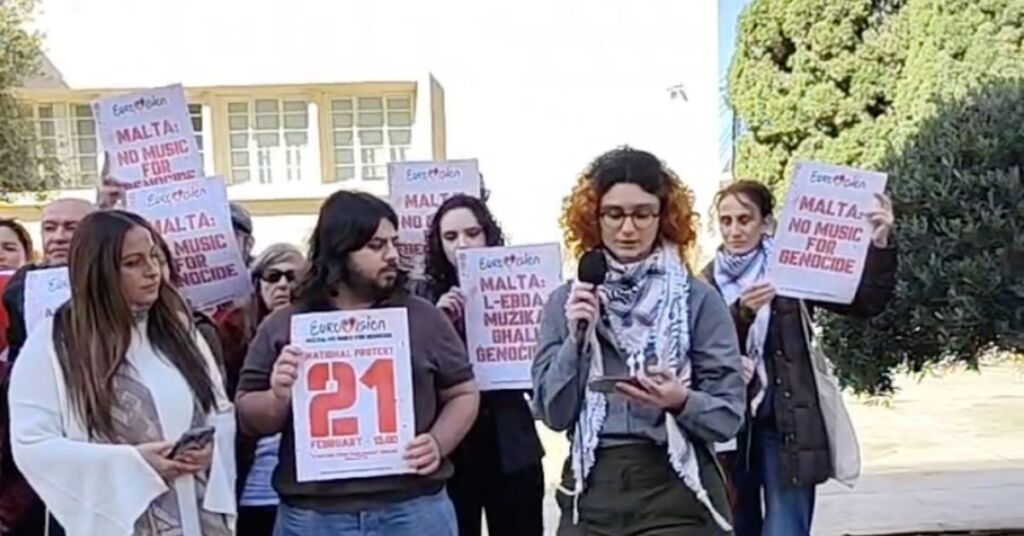
Campaigners from the initiative Malta: No Music For Genocide held a press conference in front of the national broadcaster’s studio to reiterate growing calls for Malta to formally withdraw from this year’s Eurovision song contest over the decision to allow Israel to participate while it is committing an ongoing genocide in Palestine.
The campaign, which was endorsed by almost 100 organisations, activists, and artists, is asking Malta to follow in the footsteps of five other participating countries who have already boycotted this year’s edition of the popular song festival: Spain, Ireland, Slovenia, the Netherlands, and Iceland.
Calls for a total boycott echo a similar campaign which had led to the suspension of Russia’s bid to participate in the contest shortly after it launched its ongoing invasion of Ukraine.
As the nation’s broadcaster, PBS – which falls under the domain of Culture Minister Owen Bonnici – is the primary authority involved in the Malta-side broadcast of the Eurovision. Towards the end of last year, the Culture Minister had rebuffed calls for Malta’s withdrawal, claiming the decision reflects Malta’s desire to encourage “a culture of dialogue”.
“We are making this call following the decision by the European Broadcasting Union to allow Israel to participate in the competition after the atrocities we have seen it commit. After the lack of action from the authorities, we are therefore calling a national protest on 21 February in Valletta,” Amy Marie Abela, an activist from Moviment Graffitti, said during the press conference.
A Moviment Graffitti activist holds up a placard displaying the date of the national protest calling for Malta’s Eurovision boycott.
“Over the past two and a half years, we have witnessed an ongoing genocide against the Palestinian people unfolding before our eyes. We must stress that this genocide is still taking place; the Israeli state continues to systematically kill Palestinians in Gaza and the West Bank. Palestinians are still living under apartheid, aggression, and violence from the Israeli state as well as from settlers, who are allowed to commit these acts with total impunity,” Abela added.
Activists demanded to know why Israel was allowed to participate in the Eurovision song contest because of the precedent set by Russia’s suspension as well as the fact that over 70,000 people have been killed in Palestine, Lebanon, and Syria since Israel escalated its military aggression after the October 7 attacks.
The government’s hands-off approach to challenging Israeli participation in this year’s song contest stands in stark contrast with its past recognition of the state of Palestine and its comparatively furious response to suspicions that Israel had manipulated the public voting process of last year’s edition.
“Having principles means nothing without concrete action. We cannot allow our authorities to speak into the void. Our demand that Malta does not participate presents an opportunity for Malta to demonstrate its commitment to human rights and justice for Palestinians, as the countries mentioned earlier have done…we still have the chance to be on the right and just side of history,” Abela said.
The president of the Malta Entertainment Industry and Arts Association (MEIA), Maria Galea, also voiced a message of solidarity during the press conference, arguing that artists have a duty to take a moral stand whenever they are presented with such a situation.
“Music should never be used to justify atrocities,” Galea added.