Giorgos Konstantinidis knows these forests—he has to. Like many here, he forages for mushrooms. We are in Kranea, a small village of around 200 inhabitants on the border of Pindos National Park, part of the Pindos Mountain range. Like many villages in the region, Kranea is Aromanian, or Vlach, dating back to 1511.
Shrouded in mist in winter, the Pindos Mountains rise like a rugged spine through northern Greece and southern Albania. Ancient forests of pine, oak, beech, and fir have been spared deforestation—protected by altitude and inaccessibility. The Pindos Range is one of Greece’s last bastions of biodiversity. Mount Smolikas often meets the clouds at 2,637 metres.
Pindos boasts over 2,500 species of mushrooms. Warm, wet summers brew ideal conditions for autumn foraging. Konstantinidis knows the secret life of mushrooms—their ephemeral existence born in dank earth and dark shadows. He looks for edibles like Boletus, Chanterelles, Morels, and the prized saffron-coloured Lactarius deliciosus, emerging from the pine-needle blanket that is the perfect host for fungi, not plants.
Giorgos Konstantinidis, not a scolar himself, teamed up with several mycologists to document the area’s richness in mushroom species. Photo: Toon Lambrechts
Foraging is intangible cultural heritage here, across Pindos National Park and the Zagori region, where for a brief period mushrooms appear like magicians, sprouting from roots and plant detritus. Konstantinidis moves stealthily through the forest, canvassing the bases of trees under leaf and pine clutter, shadowed by the imposing Pindos range. Soon, he hones in on a yellow-foot Craterellus lutescens, colloquially known as “trompeta,” Spanish for trumpet.
We move deeper into the forest until we’re confronted by a carnival of colours and shapes colonising the ground like fairy village houses. There’s Phellodon niger, the black tooth; Pholiota lenta, or sticky scalycaps; Gymnopilus penetrans, called common rustgill; and the alien-sounding Geoglossum, literally “earth tongues.”
The magic of mushrooms
Konstantinidis, a retired school teacher, discovered his passion for foraging decades ago.
“After finishing my studies at university, I realised I really missed the outdoors. As a child, I would go out into the meadows with my father, herding our cattle. I remembered trying wild mushrooms during our trips, so picking up mushroom collecting seemed a perfect way to explore Pindos again.”
Mushroom-collecting on the outskirts of Pindos National Park. Photo: Toon Lambrechts
The vast variety of mushrooms hides in dense forests of oak, black pine, fir, and beech, dots the meadows and pasturelands, or grows along the banks of the rivers Aliakmonas and Venetiko. So impressed was Grevena’s local government that they commissioned Konstantinidis to write a book on local mushrooms—a project that sparked unexpected enthusiasm among the locals.
“People were hungry for more. Eventually, friends and I founded an association to develop and share our love for fungi.”
Soon, the scientific community joined the mission to raise awareness about Greece’s edible fungal diversity.
“We discovered several unknown species and named them. Barsia hellenica, for example, a truffle-like fungus, can only be found in Greece,” Konstantinidis says.
Grevena has made a name for being the ‘Mushroom capital of Greece’. Photo: Toon Lambrechts
A mushrooming economy
On our drive back to Grevena, we stop at a workshop for mushroom products run by Fotis Paraskevaidis. He greets us with loukouki, a typical Greek sweet, and mushroom-flavored liquor. Bags of dried trompettes and wild garlic line the back.
“The yield from yesterday’s forest trip,” Paraskevaidis says.
Founded in 2007, the workshop now exports local mushroom products across Europe. A thriving, unique small-scale mushroom economy has emerged. Paraskevaidis contracts local villagers for seasonal mushroom picking.
“It provides a small income, but it’s important because economic opportunities in this part of the Greek countryside are limited.”
Paraskevaidis runs a food manufacturing business, blending mushrooms in traditional recipes. Photo: Toon Lambrechts
Mushrooming new identity
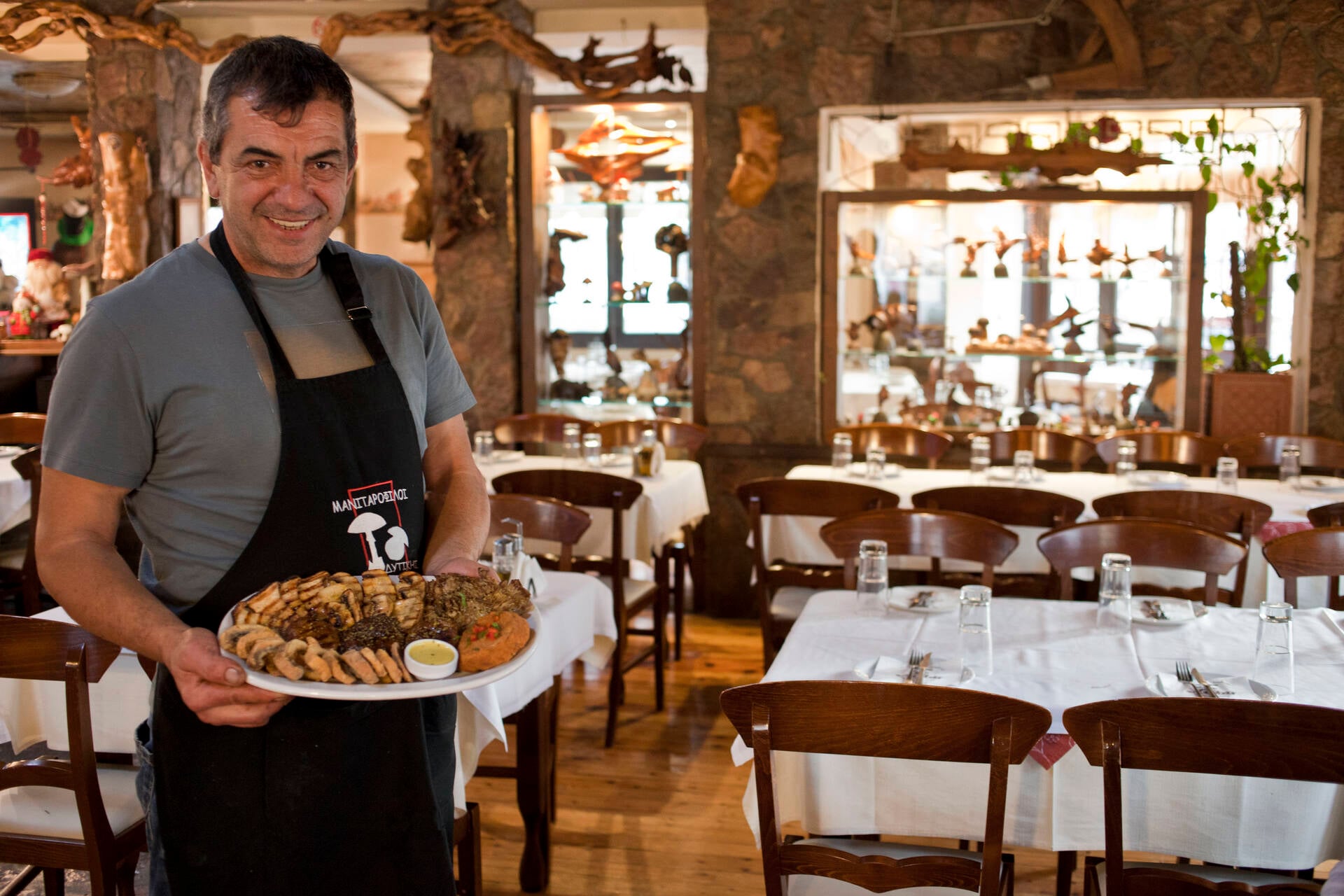
Back in Grevena, Konstantinidis takes us to a restaurant run by his friend and fellow mushroom enthusiast, Thodoris Karagiannis. The dark, wooden venue is decorated with an eclectic collection of all things mushroom. The menu features mushrooms in every form—even desserts.
“Initially, customers weren’t used to consuming wild mushrooms,” Karagiannis says.
“As a child, I often joined my father herding sheep. He would pick wild mushrooms and grill them, so I knew they were edible. For many, it took time to accept that uncultivated and mysterious mushrooms were both edible and delicious.”
Several recipes on the menu originate from the Pindos mountain region.
Touring the workshop, I can spot an employee busy preparing trachana, the Greek comfort food of fermented grain and yogurt. Photo: Toon Lambrechts
“Kokouti is one of my favorites,” Karagiannis says, pointing to a dish of fried mushrooms, onion, oil, and cornflour.
Mushrooms are no novelty for locals—they are part of a rustic and intangible tradition.
“People did collect mushrooms, but would simply grill them over the fire with a bit of salt. They collected three or four types; in recent years, I’ve used over 100 species in diverse ways.”
Many recipes were brought to Grevena by Pontic Greek refugees from the Black Sea, who pickled mushrooms or incorporated them into traditional dishes.
Karagiannis preparing copious amounts of mushrooms for an afternoon shift. Photo: Toon Lambrechts
“Manitaropita, the mushroom-stuffed pie, also originates from Pontic gastronomical tradition,” Karagiannis says.
Foraging mushrooms is a way of life for Konstantinidis and many in his town. It is also an essential aspect of community development and a growing economic activity. Last August marked the 19th Pan-Hellenic Mushroom Festival in Grevena.
“It attracts visitors from all over the world,” Konstantinidis, the patient zero of the local mushroom craze, says. “It’s a way to share our love for fungi and invite others to join in. Grevena has embraced its tradition of collecting wild mushrooms. It’s become our identity.”
*Toon Lambrechts is a Belgian journalist based in Thessaloniki.
A Pan-Hellenic Mushroom Festival is held at Grevena’s Mushroom Park every year. Photo: Toon Lambrechts