- The Washington Post’s decision to cut a large share of its climate and environmental reporters is not just a newsroom story; it reflects a broader weakening of the institutions that sustain a shared, reliable public record on complex and contested issues.
- Environmental reporting plays an underappreciated coordinating role, helping policymakers, regulators, markets, and communities see how dispersed decisions connect and where responsibility plausibly lies—work that becomes most visible when it is diminished.
- Mongabay founder and CEO Rhett Ayers Butler argues that cuts to environmental journalism thin the information infrastructure societies rely on to recognize risks and respond before harm becomes harder to reverse.
- This article is a commentary. The views expressed are those of the author, not necessarily of Mongabay.
See All Key Ideas
Word that the Washington Post would be cutting roughly one-third of its staff spread quickly this week. Among those affected were at least a dozen reporters, editors, and visual journalists covering climate and the environment.
The cuts will materially reduce the Post’s climate coverage. They come just over three years after the paper significantly expanded that desk, nearly tripling its size and describing climate change as “perhaps the century’s biggest story.” At the time, then–executive editor Sally Buzbee framed the investment not as a specialty beat, but as a recognition that climate touches nearly every domain the newsroom covers.
What has changed is not the scale of the problem, but the political, economic, and institutional context in which it is reported.
The layoffs were first reported by the New York Times as part of a broader retrenchment that will see more than 300 journalists lose their jobs. After the cuts, the Post’s climate desk is expected to retain only a handful of reporters.
This is not simply a story about one newsroom. It reflects a wider weakening of the institutions responsible for producing and maintaining a shared factual record, particularly on subjects that are politically contested and structurally complex.
Under ordinary conditions, information performs an underappreciated coordinating function. It allows people to orient themselves, to understand what is happening, and to trace responsibility across systems that are otherwise hard to see. When it works, it often recedes into the background. Its absence becomes evident only when facts arrive late, circulate unevenly, or fail to circulate at all.
Environmental issues are especially vulnerable to this erosion. The decisions that shape forests, fisheries, land use, and emissions are often made far from where their effects are felt. They are distributed across ministries, companies, financiers, regulators, and supply chains. Without sustained reporting that documents how those decisions connect, accountability blurs. Harm can persist even where concern exists, in part because the full picture is difficult to assemble.
Journalism, at its most basic level, is an attempt to make those connections clear. It places verifiable information into the public record and leaves others—officials, courts, markets, communities—to decide what follows. In that sense, it functions less as advocacy than as a form of civic maintenance, keeping the factual record from fragmenting entirely.
That role is easy to undervalue because it resists clean attribution. When a permit is revoked, a subsidy reconsidered, or a policy revised, journalism may have contributed without being named. More often, it supplies evidence that moves through other institutions over time, becoming one input among many—necessary, but rarely sufficient.
Trust accumulates in similar ways. It is built through consistency, presence, and a willingness to return to the same subjects long after initial attention fades. This is why beat reporting can matter even when its audience appears small. A story read closely by a regulator, a local official, or a compliance officer may matter more than one skimmed briefly by millions.
When coverage becomes intermittent, that trust weakens. Issues begin to feel abstract or intractable. Attention shifts elsewhere. Over time, the capacity of institutions to coordinate around shared facts erodes. In the absence of a credible record, people fall back on ideology, identity, or rumor as substitutes. Disagreements harden, not always because values diverge, but because common reference points disappear.
Seen in this light, the scaling back of climate reporting is not just a loss of stories. It represents a thinning of the informational infrastructure that allows societies to recognize problems early enough to respond.
None of this is to suggest that journalism alone produces outcomes. It does not enforce laws, restore ecosystems, or lower emissions. What it can do is clarify what is happening and where responsibility plausibly lies, improving the odds that decisions are made with a clearer view of their consequences.
The loss of a climate desk does not end climate journalism. But it narrows the space in which sustained, accountable reporting can occur. At a moment when environmental risk is compounding and political pressure on climate coverage is intensifying, that narrowing should give pause.
Some of what matters most is not what commands attention, but what makes attention possible in the first place.
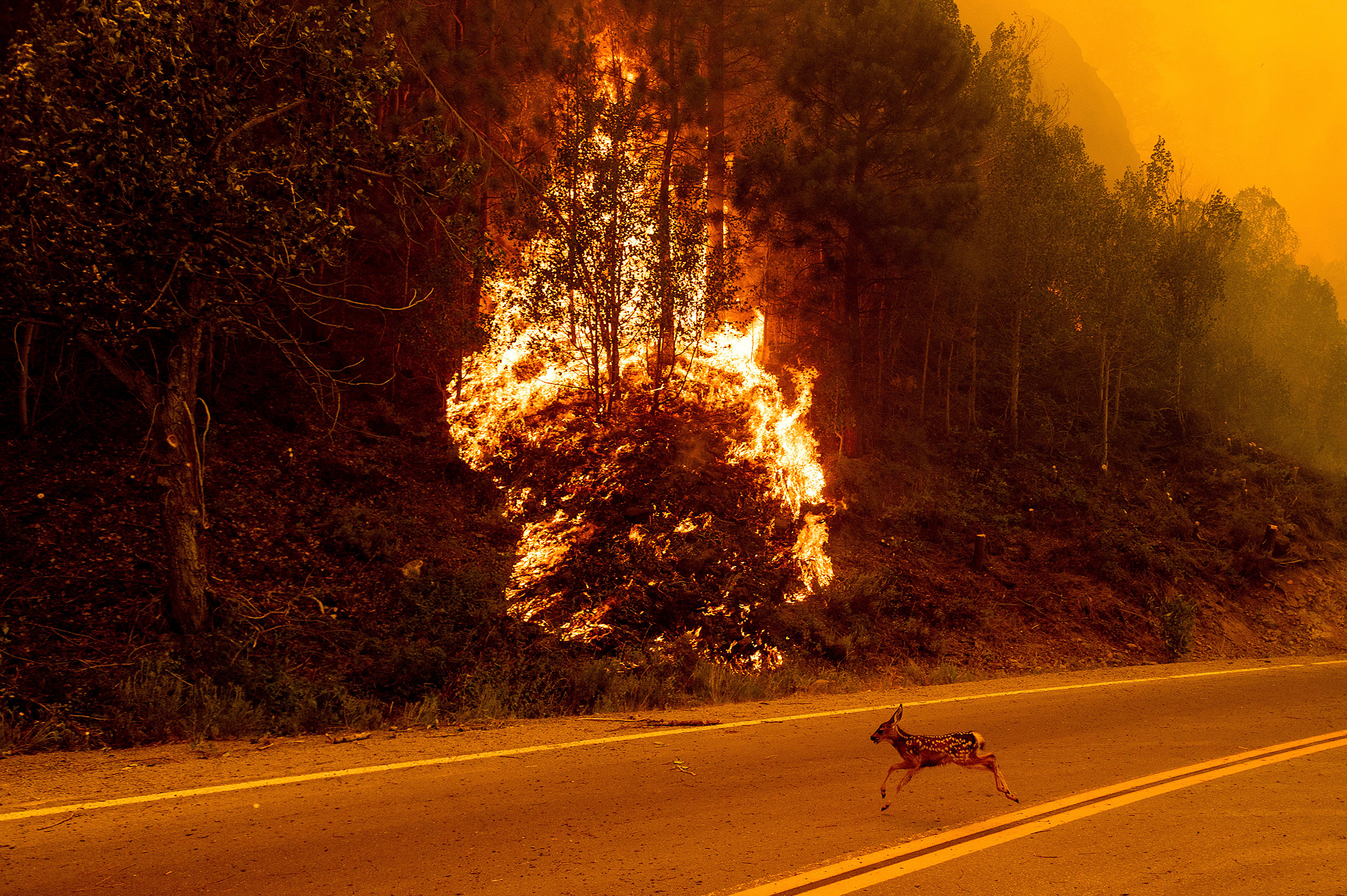
Header image: A fawn sprints across a road as the Sugar Fire, part of the Beckwourth Complex Fire, burns in Plumas National Forest, Calif., July 8, 2021. Photo credit: AP Photo/Noah Berger