Golan Rice could not have imagined how a chance encounter with a little bird on a windowsill would transform him from a senior state security official to a simple pilgrim on the Camino da Santiago and the co-founder of a new pilgrimage route to Jerusalem.
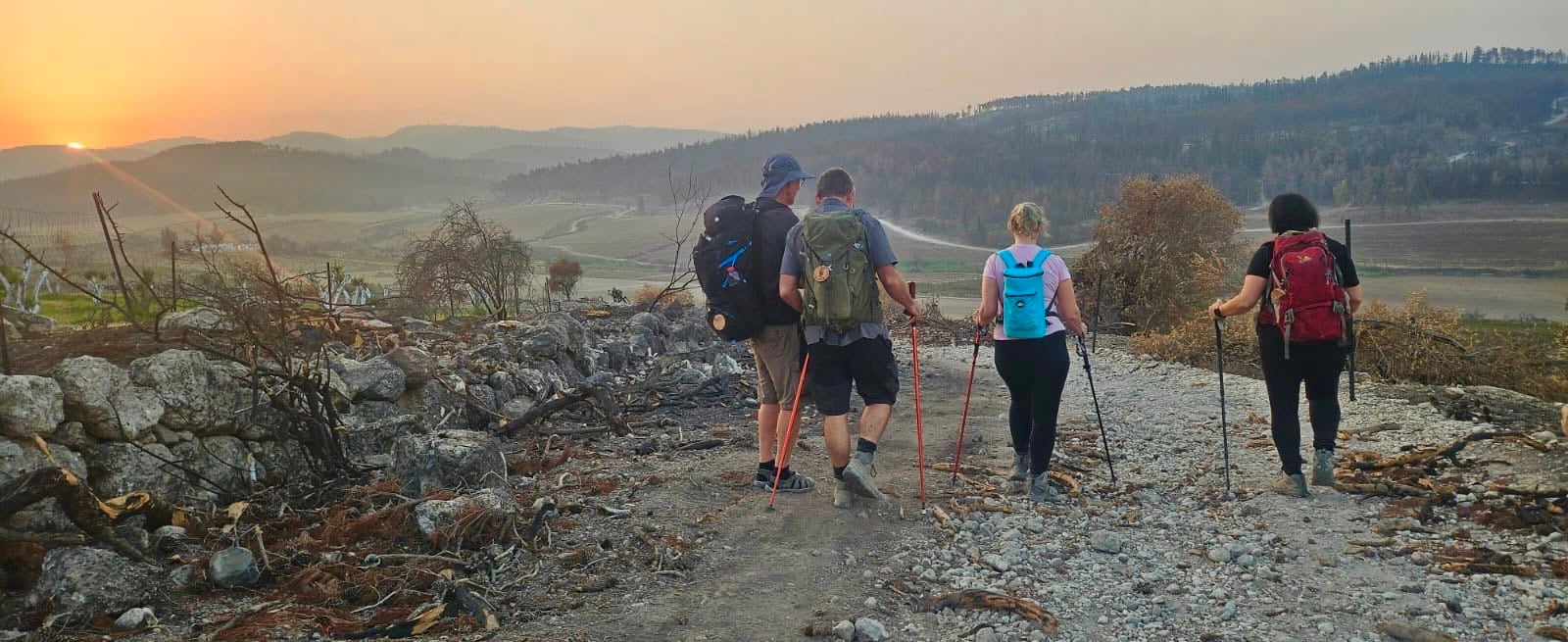
The 111-kilometer (69-mile) route, still in the making but already open for guided journeys, stretches from Jaffa Port in central Israel to the Jaffa Gate of Jerusalem’s Old City walls.
It is divided into six recommended sections, each ranging from 10 to 26 kilometers (six to 16 miles), and combines bustling urban streets with the nature and silence of the hills that lead up to the Holy City.
From Jaffa Port, the route passes through Rishon Lezion and Ramle in central Israel, Latrun, Abu Ghosh, and Ein Kerem, on the outskirts of Jerusalem.
What sets it apart from other treks, such as the Jesus Trail in northern Israel, is the way it exposes pilgrims — people from any faith (or none) and nationality — to communities and individuals who have signed up to become partners along the way, facilitating the exchange of stories, and, it is hoped, an internal journey and the opening of hearts to different beliefs and narratives.
A lightbulb moment
Now 56, Rice, who is Jewish, spent over 30 years in security, 15 of them at El Al. While leading a weekly team meeting one wet and gray March morning, he looked out the window and caught sight of a small bird standing outside.
The two looked at one another, Rice recalled on a podcast (in Hebrew) last year, describing how the experience so moved him that he resigned the same day to plan a personal journey.
Golan Rice. (Courtesy)
“I think the bird was there all the time. It was just that this time I saw her and listened to her,” he said during an interview on the podcast “L’tayel B’Klilut” (“Treading Lightly”).
That journey, both physical and internal, took him twice to different parts of the Camino de Santiago, a network of ancient pilgrimage routes across Europe that converge at the tomb of St. James at the Cathedral of Santiago de Compostela, in Spain.
Golan Rice holds a copy of his then-unfinished book in front of the Cathedral of Santiago de Compostela, in Spain. (Courtesy)
Rice was fascinated by the story of St. James, a Jewish fisherman, born Jacob, son of Zebedee, in the Galilee area of northern Israel, who became an apostle of Jesus. According to one legend, his bones washed up on Spanish shores covered in shells and were buried in Santiago de Compostela. The shell has become the symbol of the Santiago de Compostela pilgrimage route.
He had heard of the Camino during a work stint in Spain and decided to walk it like a pilgrim, with a backpack and a walking stick.
“I had spent my life in jobs that demanded discipline, frameworks, and planning,” Rice told The Times of Israel. “For the Camino, I didn’t plan how far I would walk or where I would eat. I confronted one of my biggest fears — uncertainty.”
He went on, “The greatest thing for me was the relationships along the way, the hosting, the energy, and the strength that the communities give to the pilgrim who is undergoing a personal journey. I was amazed by the meetings I had with people from different faiths and cultures.”
Rice said he learned three key principles for life — humility, simplicity, and gratitude — along the way.
His second pilgrimage, from Cadiz, which covered 1,200 kilometers (745 miles), with 40 to 50 kilometers (25 to 31 miles) between villages, was much harder than the first (from Saint-Jean-Pied-de-Port in France), with far fewer pilgrims.
“You look around and start to see things you didn’t see before,” Rice recalled. “You are moved by the simple things. I allowed myself to feel.”
Golan Rice and Yael Tarasiuk Nevo. (Courtesy)
Four years ago, and back in Israel, where he lives on Moshav Batzra, near Ra’anana, he would meet up with Yael Tarasiuk Nevo, an old friend from El Al security. She, too, had left El Al and was working to build social and community projects in the municipal welfare department of Bat Yam, near Tel Aviv.
Tarasiuk Nevo helped him complete a book about his Camino journeys (available in Hebrew and, soon, in Spanish).
Rice had become enthralled by stories and myths and their capacity to give people meaning. Tarasiuk Nevo, 43, from the central city of Rishon Lezion, was helping welfare clients tell their stories as a rehabilitation tool.
“One day, Golan told me that he wanted to make a third pilgrimage, this time to Rome,” Tarasiuk Nevo told The Times of Israel. “Suddenly, the lightbulb went on. We said, ‘How can it be that the Camino draws half a million registered travelers annually and that thousands walk to Rome, when there’s no pilgrim route to Jerusalem, which is so important to the three monotheistic faiths?’”
Finding the way to Jerusalem
Today, Rice and Tarasiuk Nevo work together on a model they have developed to help welfare clients in Bat Yam embark on internal journeys, spending much of their free time developing The Way to Jerusalem.
They began by consulting with academic experts and discovered that historical pilgrimage paths once stretched 450 kilometers (280 miles) to Jerusalem from Israel’s northern tip.
Having decided to start with the final 111-kilometer stretch (but intending to expand in the long term), they “knocked on every door” along the way, asking people whether they would partner, and what stories they wanted to tell.
People shop at the market in the central town of Ramla, July 9, 2025. (Yossi Aloni/Flash90)
They met with people from all walks of life, from municipalities, businesses, cultural sites, and sites of religious interest, to the owner of a shawarma stand at the Ramle market who likes to tell how his father would take him to Jerusalem every year to buy oranges, and a female ultra-Orthodox artist.
In Ramle, the mayor wanted to highlight the city’s religious and cultural diversity through the different foods available at its market, Tarasiuk Nevo said. As the city does not have a hotel, the municipality offered a simple apartment for pilgrims to sleep in.
In Rishon Lezion, the deputy mayor chose to highlight the first Hebrew-language school and synagogue in Israel and the city’s museum. The latter tells the story of Naftali Herz Imber, a Rishon Lezion resident for a time, who wrote the text for Israel’s national anthem, “Hatikva.”
The Haviv School in central Rishon Lezion, the first to use instruction in the Hebrew language. (I, MathKnight, CC BY 2.5, Wikimedia Commons)
As with the Camino, pilgrims will get a passport at the start, at the old, still-functioning, Libyan synagogue in Jaffa, once an inn for Libyan Jewish pilgrims who arrived by boat and journeyed to Jerusalem. They will collect passport stamps at stops along the way and receive a certificate at the tourist office just inside Jerusalem’s Jaffa Gate at the end of their journey.
“Everyone wants to tell their story,” said Tarasiuk Nevo.
The first Croatian pilgrim on The Way to Jerusalem sits down to eat and chat with the owner of a Ramle shawarma stall, March 12, 2025. (Courtesy)
There are now dozens of places along the way where pilgrims can knock on the door and ask for a stamp, knowing they will be invited in for a conversation and maybe a drink or a bite. If purchases or overnight accommodation are involved, they will be offered a discount.
“We want this to be sustainable,” said Tarasiuk Nevo, explaining that locals were more likely to help maintain the route if it generated a little income.
Added Rice, “The main thing locals will do is stamp a pilgrim’s passport, smile, and wish them ‘Derech Tzlecha‘ [a good journey, the Hebrew equivalent of the Camino de Santiago greeting, ‘Buen Camino’].”
While shells help to direct the Camino’s pilgrims, The Way to Jerusalem is indicated by a palm frond, symbolic for Jews, Christians, and Muslims.
Pilgrims on The Way to Jerusalem pass the Church of St John the Baptist in Ein Kerem, on the outskirts of Jerusalem, May 25, 2025. (Courtesy)
Partners such as local authorities, the KKL-JNF Jewish National Fund, and the Israel Nature and Parks Authority will incorporate this emblem into their own, provide the signage, and help publicize the project.
Around 30 ceramic signs out of a planned four to five per kilometer have already been attached to points of interest along the way.
Sites of Jewish interest include the Libyan synagogue at the beginning, ancient Tel Gezer in central Israel, and the site of the House of Abinadav, on a hill near Abu Ghosh, where, according to the Old Testament, the Ark of the Covenant was kept for 20 years after the Philistines returned it to the Jews.
The Libyan Synagogue in Jaffa. (FLLL, CC BY-SA 3.0, Wikimedia Commons)
Among places of Christian interest are the little-known Anglican community in Ramle, which offers prayer services and accommodation, the Trappist Monastery in Latrun, which also reflects the long tradition of winemaking in the area, the Saxum Visitors’ Center in Abu Ghosh, and the route from Abu Ghosh to Emmaus Nicopolis.
Jaffa, Ramle, Abu Ghosh, and Jerusalem are all mixed cities, offering experiences with Muslims, Christians, and Jews. Muslim points of interest along the way include the Mahmoudiya and Al-Bahr mosques in Jaffa, Ramle’s Umayyad-era White Mosque and Pool of Arches, an Abbasid water cistern, and the modern Chechen Mosque in Abu Ghosh.
View of The Pool of Arches, an underground water cistern, built during the reign of the caliph Haroun al-Rashid in 789 AD to provide Ramla with a steady supply of water, April 10, 2025. (Yossi Aloni/Flash90)
To be both meaningful and sustainable, the route traces ancient paths wherever possible, as trodden by Jews from the First Temple through Roman times, Christian Crusaders, or Muslim pilgrims during Ottoman times.
With minor diversions from existing paths to avoid dangers such as main roads, the route includes a final stop at the rooftop Muslala urban oasis in downtown Jerusalem, where pilgrims can refresh themselves and rest before going into the Old City through the Jaffa Gate.
The fragile future of the palm fronds
Rice and Tarasiuk Nevo, both married with three children, are currently funding the project out of their own pockets.
They have led a few hundred people, such as academics and tour guides, mostly in groups.
Father Olivier from the Benedictine Monastery in Abu Ghosh poses next to The Way to Jerusalem signage at the monastery entrance. (Courtesy)
Until they find the funds to upload all the necessary information to their website and commission the hundreds of ceramic signs they need in Hebrew, Arabic, and English, they are managing guided tours, with guides that they have trained. They book accommodation and meals along the way and transport luggage between the six locations.
The first independent international pilgrimage group is currently being formed and will undertake the route in April, with Rice and Tarasiuk Nevo providing the guide and itinerary.
Tarasiuk Nevo takes inspiration from Egeria, a fourth-century female pilgrim who wrote one of the earliest accounts of a Christian pilgrimage to the Holy Land.
“We believe The Way to Jerusalem can bring about change in the way we listen to and communicate with one another,” Tarasiuk Nevo said. “Whichever hero is in your heart, be it Moses, Muhammad, or Egeria, you walk together, doing the same thing physically, while listening to one another, with respect.”