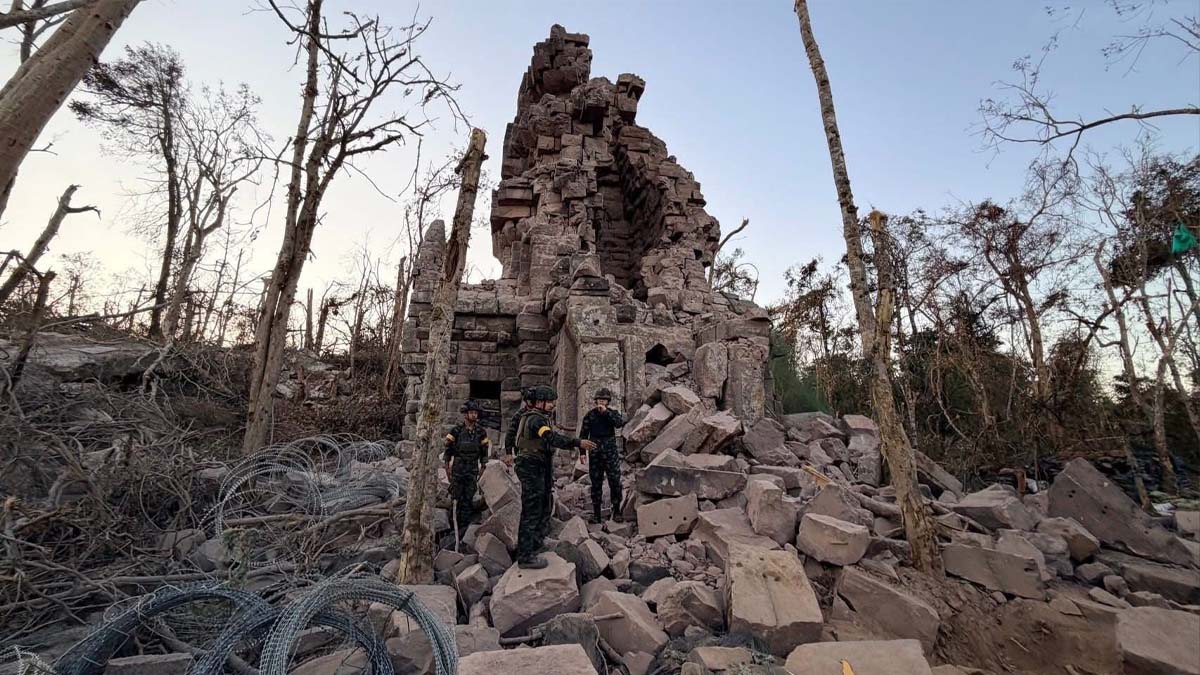
Cambodia’s Ministry of Culture has firmly rejected actions taken by Thailand at the Ta Moan and Ta Krabey temple sites, insisting the temples are under Cambodian sovereignty and saying it will not accept any restoration or conservation work carried out unilaterally by the Thai side.
In a statement released on Tuesday, the Ministry of Culture and Fine Arts said it strongly opposes activities undertaken by Thai authorities in the areas surrounding Ta Moan and Ta Krabey temples. It said Cambodia does not recognise any repair, restoration, or construction carried out without its consent after what it described as an illegal occupation by Thailand.
The ministry said Cambodia remains committed to protecting and preserving its cultural heritage while supporting cooperation based on mutual respect, legality, and principles recognised by the international community.
It stressed that Cambodia rejects any use of force against cultural and archaeological sites, including unilateral restoration, conservation, registration, or construction activities that lack Cambodian approval or that undermine the legal, historical, and cultural status of the areas.
According to the ministry, Ta Moan and Ta Krabey temples are entirely within Cambodian territory, as clearly defined by the 1904 and 1907 Franco-Siamese conventions and treaties, as well as officially recognised maps that remain valid under international law.
The ministry called on Thailand to immediately halt all activities at both temple sites, respect Cambodia’s sovereignty, and resolve all related issues peacefully and in line with international law. It said the temples had suffered extensive damage as a result of Thai actions.
On January 28, 2026, the Bangkok Post reported that Thailand’s Ministry of Culture planned to restore around 30 ancient structures in the Ta Krabey temple area and nearby sites around Ta Moan that were damaged during fighting with Cambodia.
The report said Thai authorities believed the structures could be restored to their original condition and that work would begin at sites deemed ready to preserve them as part of Thailand’s cultural and historical heritage.
Earlier, on January 2, 2026, the Ministry of Foreign Affairs and International Cooperation said that following 21 days of fighting in December 2025, Thai forces had illegally occupied 14 locations inside Cambodia across four provinces. These included three areas in Banteay Meanchey, two in Pursat, three in Preah Vihear, and six in Oddar Meanchey.
Speaking on Tuesday, government spokesperson Pen Bona said Cambodia remains firmly committed to defending national sovereignty and territorial integrity. He said the government continues to pursue a peaceful resolution to the Cambodia-Thailand border dispute through existing mechanisms and in accordance with international conventions, treaties, and law.