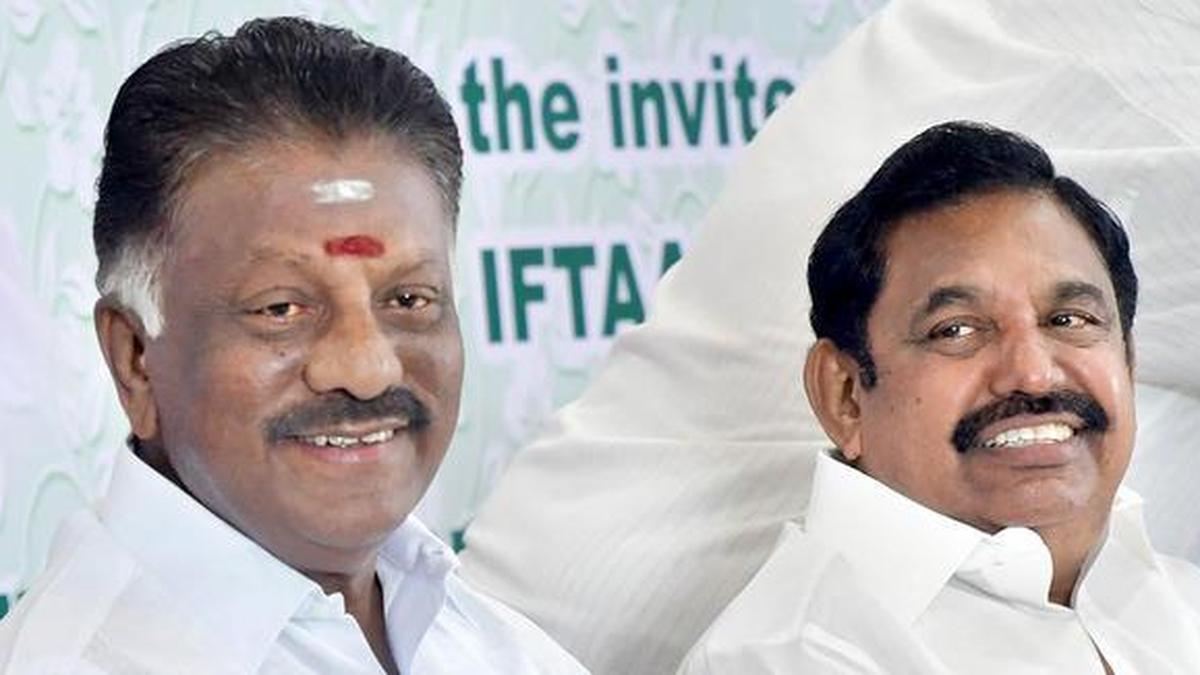
AIADMK leader Edappadi K. Palaniswami stresses that the decision to expel former Chief Minister O. Panneerselvam from the party was taken by the general council.
| Photo Credit: Ravindran_R
AIADMK general secretary Edappadi K. Palaniswami’s outright rejection of the appeal made by former Chief Minister O. Panneerselvam to be readmitted into the party, on the grounds that the decision to expel him was taken by the general council, raises the question whether the party general secretary can veto any such decision.
Interacting with journalists in Salem recently, Mr. Palaniswami emphasised that the decision to expel his former colleague was made “not by the general secretary but by the general council” for “betraying the party.”
He referred to the resolution adopted at a general council meeting in Vanagaram near Chennai on July 11, 2022, wherein Mr. Panneerselvam and his three erstwhile followers were expelled from the organisation.
Mr. Palaniswami’s repeated reference to the general council has given the impression that any decision taken by it is irrevocable.
However, the Rule 20-A (viii) and (ix) of the AIADMK’s rules and regulations [as amended at the general council meeting in July 2022 and available on the website of the Election Commission] clearly identifies the general secretary as “the supreme authority to take a final decision” on the disciplinary proceedings.
Besides, the general secretary “is empowered to take such actions as he/she may deem fit” on important political events, policies, and programmes of urgent nature, without waiting for meetings of the executive committee (EC) or the general council.
Apart from the presence of an element of urgency in the matter in view of the Assembly election, for which electoral tie-ups are being forged, the party’s history provides an opportunity for Mr. Palaniswami to reconsider the case of Mr. Panneerselvam.
In September 1984, the then Food Minister and one of the founder-members of the party, S.D. Somasundaram, was dropped from the Cabinet headed by M.G. Ramachandran who had, by then, assumed again the post of general secretary. Somasundaram was also ousted from the organisation. The decisions followed a resolution adopted by the general council.
In fact, the general council’s decision was, in turn, preceded by the EC’s recommendation against Somasundaram for levelling serious charges of corruption and maladministration against the AIADMK regime.
Before this development, Somasundaram had been a trusted lieutenant of MGR, commanding the respect of partymen at all levels, until he chose to challenge the leader in 1984. In April 1986, he even took out a procession to Raj Bhavan (now Lok Bhavan) and presented a memorandum to then Governor S.L. Khurana, listing 30 charges of corruption pertaining to several government departments, including Excise and Commercial Taxes. Seven months later, a meeting took place between Somasundaram and MGR, after which the former was taken back into the fold.
In March 2023, Mr. Palaniswami was one of the prominent speakers at an event held in the city to mark the birth centenary of Somasundaram.
When asked about the rule in the party’s bye-laws that gives the general secretary overarching powers, the AIADMK deputy general secretary and a veteran of the party, K.P. Munusamy, says it is important to be mindful that the decision to expel Mr. Panneerselvam was made “in tune with the sentiments of the party members”.
Published – February 01, 2026 12:01 am IST