
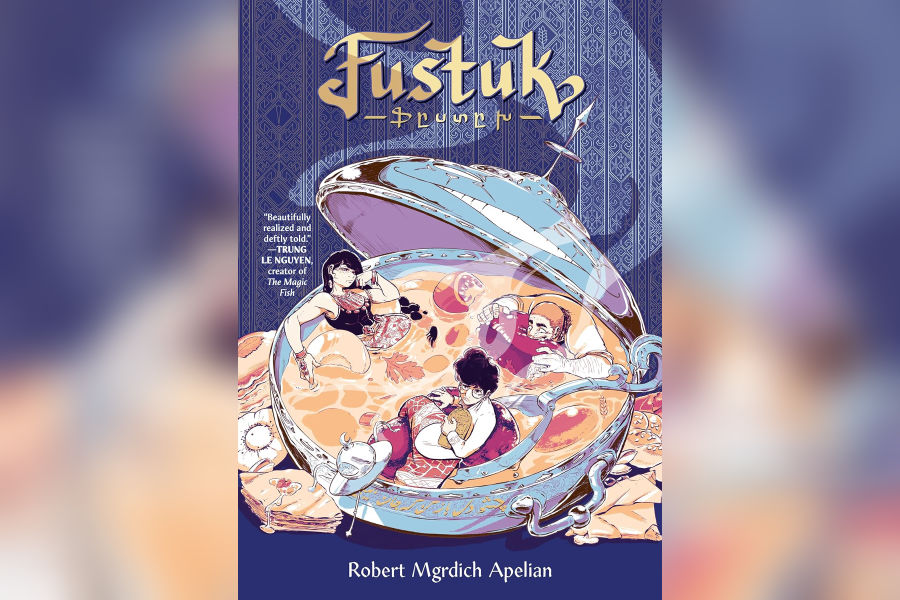
“3 siblings, 1 dish, their mother’s life on the line.” In the fantasy graphic novel, Fustuk, the young Katah Fustukian is the only non-chef in his family. His siblings, Noori and Garo, take after their late father, a legendary Hye chef who’d made a name for himself in the Pars Empire, while Katah feels out of place. Desperate to save their mother, now at death’s door, Katah searches for any way to help me — and in doing so, the family’s history begins to unravel.
Fustuk is a wholesome and compassionate story, beautifully crafted for the medium, blending visual art and literature. The author and illustrator, Robert Mgrdich Apelian, is an avid reader of indie comics and seinen manga and is especially passionate about pushing the boundaries of comics as a storytelling medium. A primary goal of his work is to celebrate the diversity and cultural richness of the Middle East and to portray it as something more than tragic and war-torn.
While Apelian’s love for the form is clear, and he draws inspiration from works such as the Witch Hat Atelier manga series, the visual references — material symbols, paneling and illustrative style — are built from his own family home and research. The visual language is rich with detail, while the text balances humor with heavier narrative threads without losing sight of the overarching plot.
Each character brings their own ingredients to the story, literally and metaphorically. Apelian employs the “story within a story” technique, shifting visual style when exploring history or magic. He also intentionally integrates sound effects in Armenian and Farsi scripts, turning them into a dynamic part of the artwork.
Each element is deliberate, honoring both the traditions of graphic novels and the cultures that inspired this fantasy world.
In this book, we see a portrayal of family, place and culture that, while not divorcing itself from lived history, takes grief into a space of hope. Fantasy, as a genre, allows us to imagine beyond the entrenched discourses and the immediate defenses of politics.
In Fustuk, myths are weaved together in a timeless space. The narrative could unfold 500 years ago or today within Apelian’s world. The magical systems of jadoo and the div again draw on familiar cultural symbols — a beshkan snap, creatures and ornaments fashioned from household items, tattoos inspired by poetry — with the poems themselves carefully chosen in collaboration with anthropologist Amir Sayadabdi to align with each magical skill, echoing the intricate systems of R.F. Kuang’s Babel.
Despite its layered cultural references and mythologies, Fustuk remains accessible to readers of all ages, languages and backgrounds. A path to coexistence runs throughout the graphic novel. Each chapter is named after a recipe drawn from Apelian’s own family, grounding the story in Arab-Armenian culture. Food is central, a tangible legacy left by their late father that shapes both Armenian and Fustukian identity. How many of us keep our family recipes, instead of Googling quick dishes or saving Instagram food trends that we’ll never look at again?
It’s an important reminder that cooking is more than sustenance or pleasure; it’s the foundation of culture and home-making. The ingredients, the story of the recipe, the importance of a certain herb or fruit — all give us an embodied connection to the people and places that shape our lives.
Language, too, is not just a part of the visual composition; it is both an inherited gift and a wound of loss. Text sometimes switches languages – at times, to keep conversation private from younger family members — and without translation, this choice also becomes meta: those who don’t understand, won’t.
Material symbols carry memories from generation to generation, and not as a uniform, monolithic design. Each family and region has its own recipes, fabrics, dyes and motifs depending on what the land grows, what ancestors left behind, what was chosen and what survived. In Apelian’s designs, the house, the fireplace, the rugs and the details of domesticity, feel both ancient and timeless. He uses ornamental paneling based on Armenian and Persian architecture and murals on khachkars and backgammon boards. Historical artifacts like incense burners, lanterns and braziers are transformed into magical creatures. Rugs from his grandmother’s house are used as references, and we see their details throughout the home.
This careful attention to material culture extends to the paradise realm of the Qaf Mountains, a vibrant, miniature world that dazzles with color and detail. As Apelian explains, “[It was] inspired by the beautiful fabrics, rugs and artifacts my family members collected, preserved and passed on to one another. Az, in particular, was originally based on a brass serving platter in my grandparents’ house that I was always fascinated by!” Az is the div, a magical creature often seen as evil in Pars communities, though the jadoo magic they wield originates from the same source.
This interplay of folklore, family history and imagination invites reflection: what survives in the brine of our mythologies and folk stories, and how do these inherited fragments shape the worlds we create?
Another prominent theme in Fustuk is the relationship between generational grief and diasporic existence. The creation of a new recipe — borrowing ingredients because they mean something to you while remaining open to discovery — mirrors this experience. In some families, this can mean traveling long distances to gather fresh ingredients and ensure the authenticity of a dish, as mine did growing up hours outside London, making the journey to the capital to complete our generational recipes.
Moments like these also reveal the oddities of cultural memory: I can’t help but laugh when racist protesters have a biryani on the way home — though, of course, fish and chips isn’t truly English either. Yet, why do people from our region fight over where baklava originated, or whose coffee it is, when we could instead appreciate the beauty of something shared, shaped by local tastes? Do you take your coffee plain or with cardamom? Frothy or not? Whether soorj, fal-e gahveh, qirāʾat al-finjān, fal, kafemanteia, our culinary traditions reflect collective memory: rich, varied and sometimes contested.
After deep wounds, generational grief can easily calcify. We cling rigidly to each ingredient, never straying from the instructions, without realizing that memory has already warped the recipe. The transition of memory — what is told, what is left unsaid and what is passed on regardless — becomes encoded, a kind of inherited trauma. “Memories that don’t belong to me,” Katah reflects, recognizing that ancestral memory is a journey to undertake. The ghosts we carry, in our psyche and in our bodies, shape up. What happened with Az, he notes, “resided firmly in the territory of things we just…don’t discuss.” This is the diasporan experience: not having lived the event, yet bearing the weight of its aftermath.
Inside ‘Fustuk’
“Three neighboring empires in conflict: Pars, Mashriq and Anatolia, and the kingdom of Van between them…collateral damage, they scatter.” The palace of the Satrap Fandoghi Amal smelled of lemons and roses, “But it tasted like home.” The siblings quarrel over how to cook: new or old, using jadoo or not, Hye or Pars. Transtemporal stories, beautifully visualized and woven together, express how memory layers itself and fractures time — just as our sense of self fractures into selves.
“Memories…are subjective, right? The bits that were important to you stay, and everything else fades.”
The genetic coding of wisdom, then, resides in us, too.
I’m glad that fantasy fans and graphic novel readers, especially young people, will have this. As someone who grew up devouring fantasy, spending hours in comic book shops searching for something familiar, discovering a story like this — without exoticism or appropriation — is both beautiful and meaningful.
Those of us in the diaspora drawn to comics, fantasy and mythology often sought reflections of ourselves in libraries dominated by American and white European tales and characters. To see ‘others’ in stories like this could open young readers to the possibility of rejecting divisive narratives.
If we can, at least, meet in fantasy worlds, perhaps we can imagine something different in our own world. Apelian writes this story for his family, “and everyone like them.” In doing so, he expands what that “like them” can mean.
Everyone gathered around to eat, it is then “that it was really home.” After all, isn’t that what home is? A table surrounded by loved ones. “We’re too small a family to be divided like this.”
Apelian doesn’t create from a place of ego or commodification; this is clearly a labor of love. In times of capitalist hellscapes, it is undoubtedly refreshing to be offered even a glimpse of his paradise.
May we all be guided by the spirits of our ancestors and lands toward better days.
May we all defy despair and dare to hope — even if it means making questionable deals with mischievous divs.


