With budgets, the devil — or at least the cuts — may well be in the details.
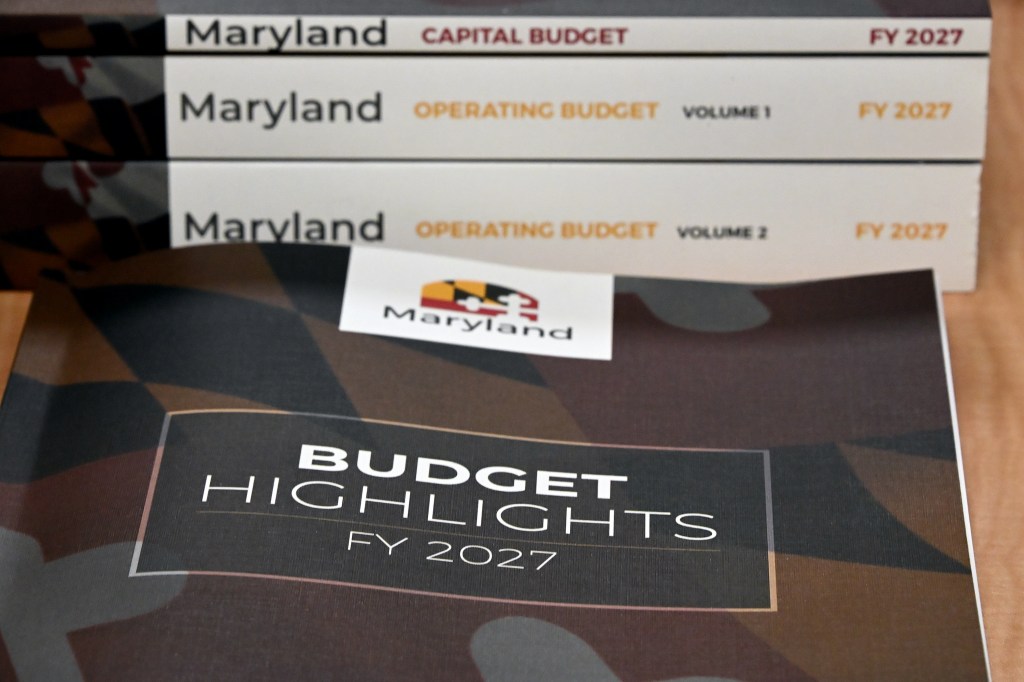
While Gov. Wes Moore’s budget increases spending at the macro state level, there are indeed cuts at the micro level — prompting some groups to promise a fight as the General Assembly begins reviewing the plan as part of its approval process. The budget, released Wednesday, closes a projected $1.4 billion shortfall by a mix of cost-shifting measures, as well as fund transfers, and in some cases by keeping spending at current levels or increasing it at lower rates than had previously been planned.
“As the 2026 legislative session gets underway and heats up over the coming weeks, we will be on the frontlines advocating for what is in the best interest of all of our members across the state,” said Kenya Campbell, president of the American Federation of Teachers union Maryland affiliate.
Moore’s budget calls for “adjusting” the state’s share of the retirement costs for teachers, community college staff and librarians to save $39 million, shifting more of it to local governments.
A program that provides mental health services for students also took a $20 million hit this year, following an earlier reduction. The governor’s plan allocates $80 million to the Consortium for Community Services Support, which helped more than 136,000 students across the state last year. But when the consortium was first created as part of Maryland’s ambitious education reform plan, Blueprint for the Future, it was supposed to receive $130 million a year by now.
“This is incredibly disheartening, at a time when the need for mental health care is more needed than ever,” said Dan Martin, chief public policy officer for the Mental Health Association of Maryland. “These services are what’s helping us bend that corner on the youth mental health crisis.”
Martin said advocates will fight to restore funding as the budget undergoes legislative review.
“This is an area, mental health services for children and youth, where there’s bipartisan support,” he said. “We understand that there are tough decisions to be made, but we are hopeful we can work with partners in the legislature to find other ways to balance the budget.”
Moore officials said his administration has worked in partnership with local governments on aligning priorities and how to fund them. The state increased total aid to localities in the fiscal 2027 budget, said Jake Weissmann, acting budget and management secretary.
“Local government aid goes up this year in the budget,” Weissmann said. “Even with that cost shift, our local governments are receiving more money this year from the state than they did last year.”
Factors at play
Maryland is, of course, not alone in facing hard spending decisions, according to Josh Goodman, senior officer for the Pew Charitable Trusts’ state fiscal health project.
“Certainly we see this year as one of the most challenging years since the start of the [COVID] pandemic,” Goodman said.
Factors playing into that include how the federal government has passed more costs on to states, such as for the SNAP food assistance program, and the greater costs that states face for things like caring for an aging population or for handling natural disasters, he said. Additionally, previous decisions states have made, “either cutting taxes or increasing spending — those costs are coming due over time,” Goodman said.
States face the usual three options to balance their budgets, he said, increasing revenues, cutting spending or relying on reserves. They tend to be reluctant to choose the first option — “if it’s not the last resort, it’s not the first resort,” Goodman said.
Moore’s budget does not include a tax increase, which he pledged to avoid.
The governor’s budget slows down increases in spending in areas such as higher education. Maryland’s public four-year universities, for example, get a 3% increase in the plan, compared to the 9% average bump-up they received from fiscal years 2020 to 2025.
Meanwhile, the Cade formula for funding community colleges, named after the late former Senator John Cade was reduced by $21 million in the coming fiscal year. The increase for any community college will be capped at 3% for three years, which Moore’s budget calls “a more sustainable level” given the state’s expected revenues.
Daria J. Willis, president of Howard County Community College, called it “encouraging news” that the school would receive $35.8 million in direct state aid in Moore’s budget. That is almost $2 million more than college officials had projected as they developed their budget proposal and anticipated flat state funding, according to Willis.
“In a year when Maryland faces extraordinary fiscal challenges, our college has not only maintained strong state support — we have seen it grow significantly,” she said in a statement.
But there could be consequences down the road, Willis said in an additional statement to The Sun.
“The state’s capped Cade funding model is understandable in times of fiscal austerity, but we believe it may have an adverse impact in the years to come,” she said. “We are grateful that in difficult times, Gov. Moore finds value in modest growth for community colleges and the communities they serve. We hope that the budget dialogue will continue to prioritize our institutions’ contributions to industrial growth, healthier and safer communities, and Maryland’s future prosperity.”
‘We have a long way to go’
Additionally, Moore’s budget calls for reducing the higher ed personnel budget by $31.5 million “to better reflect vacancy trends.”
“The question of vacancies is an important one, and we are always evaluating open positions to see where we can tighten our budgets,” said Michael Sandler, spokesman for the University System of Maryland. “The system office and the universities will be reviewing vacant positions closely to see where we can find savings.”
Sandler said the system is “encouraged” by Moore’s proposal. “We are reviewing the details of the proposed budget to see how they affect our system office and our universities,” he said. “We know that we have a long way to go before this budget is final.”
The governor’s budget looks to save almost $27 million by maintaining rather than increasing the funding level for the “disparity grants” that the state gives to less-wealthy jurisdictions, including Baltimore City and counties including Prince George’s and several on the Eastern Shore and in Western Maryland. In 2017, then-Gov. Larry Hogan initially sought a $6 million or 3.6% cut to disparity grants, but ultimately dropped the proposal.
Local governments will take on an increased share of retirement costs of some employees, such as teachers and librarians, the latter of whom have increasingly unionized for better wages and protections.
“One of the few remaining incentives for public service is a stable retirement, especially when employees are required to contribute 7% of every paycheck,” said Laura Toner, president of the WPL United, Council 3318, which represents Wicomico Public Library staff.
“Shifting retirement costs from the state to local governments doesn’t solve a budget problem, it creates one, particularly for poorer counties that already pay their public employees the least,” she said. “This compounds existing inequities and forces the communities least able to absorb new costs to do exactly that.”
While lawmakers and other stakeholders are starting the review process for the upcoming fiscal year’s budget, some are already looking down the road.
While Moore’s budget touts a record $10.2 billion in pre-K-through-12 spending, it also shows that starting in fiscal 2028, the Blueprint fund will go into massive deficit without additional revenue via taxes or fees.
“Ultimately, it is a pretty stark choice,” Meyer said, “between rolling back the Blueprint, or raising more revenue.”
Baltimore Sun reporters Raquel Bazos, Josh Davis and Kiersten Hacker contributed to this article. Have a news tip? Contact Jean Marbella at jmarbella@baltsun.com, 410-332-6060, or @jeanmarbella.bsky.social.