EVERETT — Snohomish County and Western Washington experienced record-breaking floods in December 2025, but did the deluge do anything for the drought conditions that have plagued the state for the past three years?
While maybe counterintuitive, climate scientists explain that winter flooding events can hint at summer droughts in the context of warming temperatures and meager snowpack levels.
For the past three years, the Washington Department of Ecology has issued widespread drought declarations across the state. Declarations are warranted if water supplies hit below 75% of normal, meaning the average of the last 30 year period, which is currently pulled from 1991 to 2020, and if water shortages are likely to create hardship for users or the environment.
“The important thing for drought, for folks to get, is it’s not just about dryness. It’s about water supply,” said Washington Department of Ecology Drought Coordinator Caroline Mellor. “Flooding is an indication that you might see drought the following summer because, with it being so warm, that rain should have been stored in snow pack, and it wasn’t.”
December 2025 averaged as the warmest December on record, according to the Washington State Climate Office. Additionally, the month was the fifth-wettest recorded month.
On the night of Dec. 8, the first of a series of atmospheric rivers hit Western Washington, and rivers began to swell and jump their banks.
On Dec. 9, Snohomish County Executive Dave Somers issued an emergency proclamation as the second wave of heavy rain hit on Dec. 10, causing record-high flooding along parts of the Snohomish River and triggering major flooding along the Stillaguamish and Skykomish rivers.
If temperatures had been colder, higher elevations would have received snow instead of rain. The mountains would have stored some of the atmospheric river’s precipitation instead of instantly flushing the water downstream. Additionally, much of the previously accumulated snowpack was melted and washed away by the warm rain, further overwhelming the rivers and depleting critical water storage, Mellor said.
The fact that the rains hit in short, intense bursts also contributed to the situation, said Doug Chalmers, a climate scientist for the Stockholm Environment Institute.
“The ground can only absorb so much water. After a certain point, if it’s been raining a while, that water, instead of going into the ground, runs right off into the rivers, and it causes the flash floods,” he said, comparing the atmospheric river events to long, gradual drizzles. “That water will more often be able to seep into the ground where it can kind of stay there and re-emerge in the summer as base flow, so it can recharge the aquifers.”
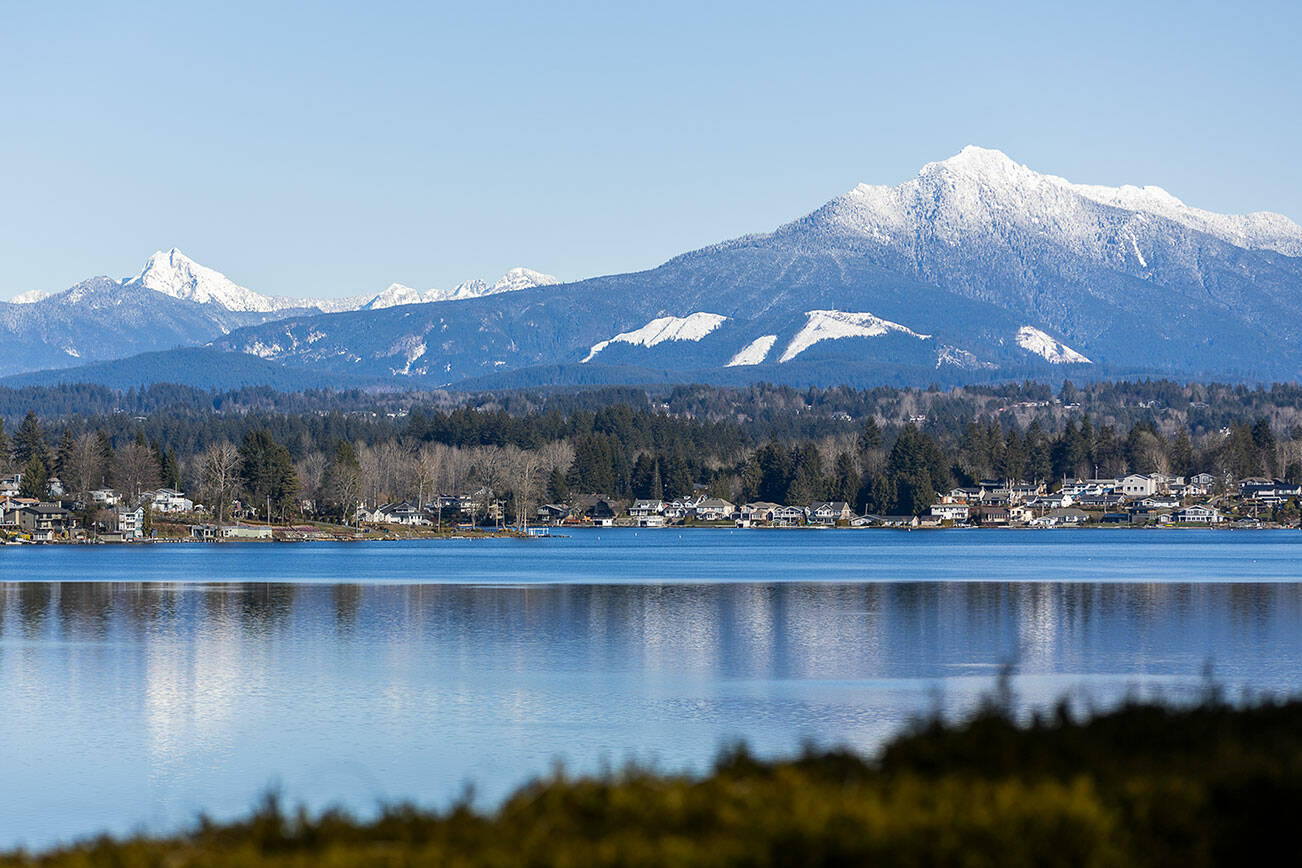
As of Jan. 12, the state’s snowpack was at 73% of its average for this time of year, based on data from 1991-2020, but even that number is deceiving due to a few rare spots where there’s abundant snow right now, Mellor said.
The data points are measurements of Snow Water Equivalents — a ratio used to determine the depth of liquid water stored in a given depth of snow.
The Stevens Pass station is hitting right at the state average of 73%. Two areas around Mt. Baker are measuring at 53 and 58% of average, and areas around Mt. Rainier are even lower, measuring at 47 and 47%, according to the National Water and Climate Center.
As winter inevitably transitions to summer, the little snow stored in the mountains will melt off, determining how much water resource managers have to work with to get the state through until late fall when the rains return.
April 1 is often thought of as a time of peak snowpack, Mellor said, meaning that the state still has some time to catch up. But with drought conditions becoming more prominent, Mellor suggested changes that individual residents can make to help conserve water.
For people who garden, it could be as simple as choosing drought-tolerant plants and vegetables, or changing a grass lawn to native plants, she said.
Eliza Aronson: 425-339-3434; eliza.aronson@heraldnet.com; X: @ElizaAronson.
Eliza’s stories are supported by the Herald’s Environmental and Climate Reporting Fund.
Gallery
Floodwater from the Snohomish River partially covers a flood water sign along Lincoln Avenue in December 2025 in Snohomish. (Olivia Vanni / The Herald)