When Oklahoma lawmakers passed the Survivors’ Act last year, they said it would give abuse victims something they had never truly had in the criminal justice system: a way to explain how years of domestic violence shaped the decisions that landed them behind bars.
The law promised two paths to relief. One was prospective, allowing judges to consider trauma at sentencing in new criminal cases. The other was retroactive, allowing currently incarcerated people to ask courts for a second look if evidence of abuse hadn’t been fully considered the first time. The measure passed 84-3 in the Oklahoma House and unanimously in the Senate, with broad support from prosecutors, judges, defense attorneys and survivor advocates.
But nearly a year later, the promise of the law looks different on the ground. Only a handful of petitions have been filed statewide. Many prosecutors are still unsure how they’re supposed to evaluate them. District courts have taken divergent approaches. Meanwhile, victims inside Oklahoma’s prisons say they are struggling to access legal help, court records, or even a clear explanation of the forms they’re required to file.
A review of hundreds of pages of filings, interviews with survivors, district attorneys, tribal officials, law enforcement, and lawmakers, along with analysis of state domestic-violence data, shows a system improvising its way through one of the largest changes to sentencing policy Oklahoma has attempted in years, often unevenly and sometimes not at all.
A Law Written to be Simple — Implemented in Ways No One Anticipated
The Survivors’ Act began as a short, straightforward bill. Sen. Julie Daniels, R-Bartlesville, introduced it after several high-profile cases involving battered women who received long sentences for crimes connected to their abuse. The intent was not to create a new defense, but to allow courts to revisit sentences when abuse played a meaningful role in the offense.
But behind the scenes, the law’s trajectory hinged on a different figure: then–House Majority Floor Leader Jon Echols.
Echols, who is now running for attorney general, said he became involved because he believed the criminal justice system routinely failed to identify and contextualize trauma in cases involving both women and men whose experiences did not fit the public narrative of victimization.
“This law is gender-neutral,” Echols said. “If somebody is a survivor of domestic abuse and that abuse is connected to the offense, then they should have the right to be heard. Period.”
Echols said lawmakers deliberately chose broad language to avoid closing the door on people whose cases might not fit narrow statutory definitions.
“If we had tried to list every scenario, we’d have left out half the people who needed this,” he said. “The whole purpose was to empower courts to look at abuse that genuinely caused or contributed to the offense.”
In the Senate, President Pro Tempore Greg Treat carried the bill and described it as an overdue correction to practices that routinely ignored trauma.
“I viewed it as a justice and fairness issue,” Treat said. “But we also wanted to make sure this didn’t become a catch-all for people who just didn’t like their sentence. It had to be tied to actual victimization.”
Treat confirmed that lawmakers chose not to require prosecutors’ consent before petitions could proceed, a decision he said was central to the bill’s purpose.
“We didn’t want prosecutors to be gatekeepers in these cases,” Treat said. “We wanted judges to have the discretion.”
A Sweeping Promise — But Almost No Procedural Guidance
For all the clarity lawmakers say they provided, the statute left major operational questions unanswered. The law does not tell courts:
- How courts should evaluate and weigh different types of corroborating evidence
- How directly the abuse must relate to the offense to qualify as a contributing factor
- How judges should apply the clear-and-convincing standard in practice when weighing trauma-related evidence
- How burdens of proof and rebuttal are allocated between petitioners and prosecutors
- What constitutes a required sentencing or evidentiary hearing under the Act
- How petitions should be handled when prosecutors object
- When and under what circumstances incarcerated survivors are entitled to appointed counsel
Nor does the statute define what is in the interest of justice, multiple district attorneys said, leaving the phrase — which ultimately governs whether a judge may resentence someone — to judicial interpretation.
For judges, the law’s broad language has left critical terms open to interpretation. The Act requires the violence or abuse to have been a ‘substantial contributing factor’ in the later criminal conduct.
District Judge Susan Stallings of Oklahoma County, who has presided over Survivors’ Act petitions, said the statute’s use of the word “substantial” is doing much of the work and causing much of the strain.
The term is not defined in the law, Stallings said, leaving courts to determine on a case-by-case basis whether abuse actually caused or meaningfully contributed to the offense. “You can’t just have the horrible life,” she said. “You have to show that the horrible life contributed to the crime.”
In her view, that causal link is the statute’s crux — and its weakest point — because judges are left to decide what qualifies as “substantial” without guidance from lawmakers.
According to responses from multiple district attorneys, counties have taken differing case-by-case approaches to the Survivors’ Act in the absence of statewide guidance. Prosecutors described looking for corroborating records and assessing how closely alleged abuse related to the offense, with some noting hesitation in cases where abuse had already been addressed earlier in the proceedings, even though the statute does not expressly limit petitions to newly raised claims.
Even legislators now acknowledge the ambiguity.
“We knew there would be implementation challenges,” Echols said, “but we thought the courts and prosecutors would work through them collaboratively.”
Instead, implementation has diverged sharply across the state.
Different Counties, Different Rules
In Tulsa County, District Attorney Steve Kunzweiler said he supports the Act in principle but is concerned about fraudulent claims. He has instructed his office to examine petitions carefully, comparing allegations to existing case files, witness statements, and prior police reports. “My job is to seek justice, not to rubber-stamp every petition,” he said.
Payne County District Attorney Laura Thomas, in written responses, said her office has not yet seen a petition and is preparing for when the first one arrives. She said it remains unclear how courts will weigh trauma in cases where abuse occurred years before the offense.
In some rural counties, prosecutors say they face more basic problems. They are not certain who is responsible for notifying victims of resentencing requests. They expressed concerns over access to trauma-informed evaluators or domestic-violence experts capable of assessing long-term coercive control.
Even basic information about how the Survivors’ Act is being used remains difficult to obtain. The court administrator’s office in Tulsa County said petitions are processed like other post-conviction motions and are not tracked separately, making it difficult to determine how often the law is invoked or how petitions are resolved across judges.
How Domestic Violence Cases are Misread at the Start
Those gaps do not begin at resentencing. Advocates say they are often baked in at the earliest moments of a case, when trauma is misread, documentation never forms, and charging decisions are made before courts ever see the full context.
Angela Beatty, vice president of programs and engagement at YWCA Oklahoma City, said survivors who have just experienced violence often present in ways that are easily misunderstood by law enforcement and courts. Trauma can manifest as dissociation, flat affect, or frantic behavior, while abusers may appear calm and credible.
“They don’t necessarily present well on the scene,” Beatty said. “They may be hypervigilant or detached, while offenders are often very skilled at presenting as reasonable.”
Beatty said those early misinterpretations frequently determine what evidence exists later. Many survivors never have the opportunity to create the documentation courts expect in post-conviction review. Phones are broken, transportation is controlled, and attempts to seek medical care or police help are actively interfered with by abusers. Others delay disclosure because it is not safe to speak while coercive control is ongoing.
“There are many survivors we work with every day who never had the chance to generate that paper trail,” she said.
Beatty also said outcomes often depend on geography as much as facts. Prosecutorial practices vary widely across the state, shaping how domestic violence cases are charged and how survivor histories are weighed.
“There are 77 counties and 77 ways of doing business,” she said.
For women now incarcerated at Mabel Bassett, those early decisions and missing records are not abstract failures, but the background against which their own cases were charged, tried, and judged.
A system built for theory, not for the reality of survivors’ lives
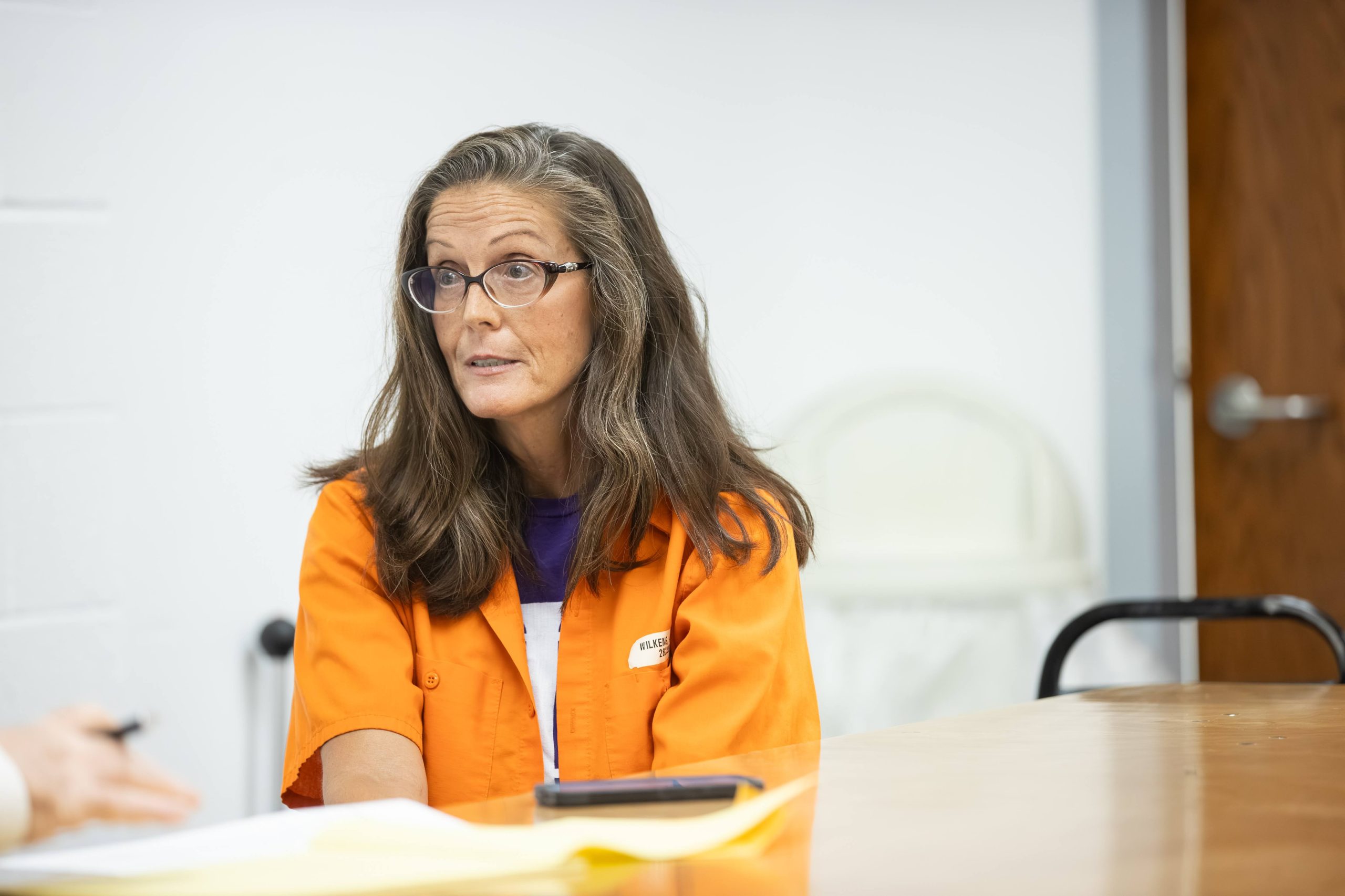
“It is clear that the courts are going to have to catch up with the Legislature in terms of understanding domestic violence,” said April Wilkens, an incarcerated survivor whose Survivors’ Act petition has been denied and is now on appeal.
Inside Mabel Bassett Correctional Center, the largest women’s prison in the state, the gap between legislative intent and lived experience is stark.
In multiple interviews, incarcerated survivors described chronic obstacles: lack of legal assistance, difficulty obtaining old case files, and confusion over statutory language.
Although the statute allows survivors to request court-appointed counsel, those interviewed said representation has largely come from nonprofit legal advocates or law school clinics, not public defenders, and is not consistently available.
Others said they hesitated to file because they believed their prosecutors would contest their petitions and use their abuse histories against them, just as they felt happened in their original trials.
All the incarcerated survivors interviewed described difficulty obtaining police or court records documenting past abuse. In several cases, the records were never introduced at trial and could no longer be located years later.
Tyesha Long, an Oklahoma City woman incarcerated at Mabel Bassett Correctional Center, said she attempted to obtain police reports from incidents the court had never heard about, only to learn that the local police department no longer had the files.
“The court never heard about it,” she said. “When I tried to get the police reports later, they told me they didn’t have the files anymore.”
Wilkens described a different but equally insurmountable barrier. Her abusive partner has since died.
“If the person who abused you is dead,” she said, “how do you prove what they did to you?”
These are not edge cases. They reflect common logistical barriers for incarcerated survivors. Those patterns are well documented in domestic-violence research and in Oklahoma’s Fatality Review Board reports.
And yet lawmakers expected the system to adapt.
“If somebody is a survivor of domestic abuse and that abuse is connected to the offense, then they should have the right to be heard. Period.”
Jon Echols
Echols said he assumed prosecutors and defense attorneys would work toward a shared understanding of the statute.
“I believed everyone would want to get this right,” he said. “It shouldn’t matter where in Oklahoma someone is incarcerated. The law should mean the same thing.”
Treat echoed that sentiment.
“This shouldn’t be a patchwork,” he said. “The whole point was to create consistency.”
But consistency is not what Oklahoma has now.
What the state has is a statute with broad moral promise operating in a system strained by uneven resources, unclear expectations, and the absence of statewide standards.
At Mabel Bassett Correctional Center, where most of the state’s incarcerated women are held, the Survivors’ Act arrived not as a legal breakthrough but as a confusing set of expectations no one inside the prison felt prepared to meet. Interviews with multiple survivors show a consistent pattern: women who qualify for relief under the law often have no meaningful path to pursue it.
Several incarcerated women said they did not learn about the Survivors’ Act until other prisoners mentioned it or advocacy materials circulated inside the facility. Others recalled brief visits from public defenders who distributed forms but could not provide individualized guidance.
With the exception of one who was directly involved in advocacy for the act’s passage, none said they received a clear explanation of what evidence courts would require, how judges interpret the law, or what happens procedurally after a petition is filed.
“We’re supposed to prove abuse that nobody believed the first time”
Keabreanna “Keke” Boyd, a Norman woman serving time for a violent offense she says occurred after years of severe domestic abuse, described the situation bluntly.
“Everybody tells you there’s a process, but nobody tells you what the process is.”
Boyd said she was beaten, strangled, isolated, and threatened repeatedly by a partner whose violence escalated for years before the offense that sent her to prison. She said the prosecutor in her case rejected her abuse claims outright, and her original sentencing did not reflect that history.
“No one explained what kind of proof I’m supposed to have now,” she said. “The police reports don’t exist anymore. The people who saw what he did to me don’t want to be involved. But the abuse still happened.”
These experiences mirror what domestic-violence researchers have long documented: most survivors do not report abuse while it is happening, often because doing so increases their danger. The state’s Domestic Violence Fatality Review Board has repeatedly found that abuse is frequently undocumented or poorly documented, even in cases where survivors sought help. But incarcerated survivors say that reality has not been reflected in how the Act functions in court.
Multiple women at MBCC said public defenders came to the facility shortly after the law passed to provide informational packets and one-page forms to request court-appointed counsel. But several women reported that those appointments are rarely granted because the petitions are considered post-conviction matters, not criminal cases. Attorneys explained that public defenders could distribute forms but were generally unable to provide representation unless a judge appointed counsel, leaving women to file petitions on their own.
Fear of the Original Prosecutor is Widespread
April Wilkens said she feared her petitions would be handled by the same prosecutors who originally tried her case.
“They’re not going to suddenly believe me now,” Wilkens said. “It feels like putting myself right back in front of the same people who didn’t care what he did to me.”
Keke Boyd is shown during an interview at the Mabel Bassett Correctional Center in McLoud on Dec. 9, 2025. (Brent Fuchs/Oklahoma Watch)
Some survivors said prosecutors treated their abuse histories as legally insufficient, acknowledging the violence while arguing it did not meet the Survivors’ Act’s requirement of being a substantial contributing factor. In Wilkens’ case, state filings opposing relief repeatedly emphasized her procedural and strategic choices in presenting evidence, arguing that any failure to establish causation rested with her rather than the court or the statute.
Survivors emphasized that these dynamics influence whether they feel safe filing petitions at all.
“It’s not just about a sentence,” Boyd said. “It’s about whether they’re going to say the abuse doesn’t matter — again.”
Case files are missing, incomplete, or inaccessible
Court records, interviews, and prior filings show that survivors who may be eligible for relief face significant practical barriers, including:
- Police departments often purge records after a set number of years.
- Hospitals may no longer have medical files.
- Witnesses may be unavailable or unwilling to speak.
- Court transcripts can cost hundreds of dollars.
- Some women said they never received complete copies of their discovery materials and, years later, had no way to obtain them without outside financial help.
These challenges are not theoretical. They appear repeatedly in survivor interviews and are reflected in patterns documented by courts and statewide domestic-violence reviews. In many cases, survivors’ original experiences of abuse were never fully investigated, leaving little to present under the Act unless courts accept nontraditional forms of evidence, something counties have handled inconsistently.
The April Wilkens Problem
No case demonstrates the tension between legislative intent and practical barriers more clearly than that of April Wilkens.
Wilkens was convicted in 1999 of killing her fiancé, Terry Carlton, whom Wilkens and multiple witnesses described in court records as violently abusive. Her court records contain substantial evidence of long-term physical and psychological abuse, including medical reports, witness statements, recordings, and documented patterns of coercive control. Domestic-violence experts have since cited her case as a classic example of “intimate terrorism.”
Yet Wilkens remains incarcerated more than 25 years later.
In interviews and follow-up correspondence, Wilkens said she repeatedly raised concerns during her trial about coercion, surveillance, threats, and sexual violence she experienced. She said jurors were never told that an expert had documented the severity of the abuse, and that evidence of Carlton’s prior violence was limited or excluded. She said prosecutors minimized evidence of Carlton’s violence and, through pretrial rulings, limited what jurors heard about his prior conduct, including an active arrest warrant that was never presented at trial.
Her case is frequently cited by domestic-violence advocates as a test of whether the Survivors’ Act can function as intended for women whose abuse was evident but dismissed in court.
Wilkens said she has been unable to obtain several key records, including trial transcripts she says have not been provided despite multiple requests. She said she worries that, even under the Act, her petition could be denied because the system that failed to recognize her trauma the first time has not fundamentally changed.
The Survivors’ Act does not guarantee relief, but it was explicitly written for cases like hers, in which the connection between abuse and the offense was misunderstood or improperly weighed.
Her situation raises a larger question: if a woman whose case has been documented, analyzed, and discussed publicly for decades cannot easily navigate the Act, what chance do survivors with no records, no advocates, and no legal assistance have?
The forms are simple. The process is not.
The document women at Mabel Bassett received was short — one page, with a signature line. Survivors say the simplicity is misleading.
“You can fill out the form in five minutes,” Boyd said. “Everything after that is what nobody tells you.”
Survivors said the lack of representation left them dependent on prison staff and informal guidance to navigate the process. Several reported that Department of Corrections staff could not answer questions about the Survivors’ Act because they are not permitted to provide legal advice. Some said they received outdated or incorrect information from staff who did not understand how the Act differs from other resentencing statutes.
Others said they were told to file petitions through their original trial judges rather than through the district court’s general docket, adding confusion to an already opaque process. Once petitions were filed, survivors said they often did not know whether prosecutors had responded. Mail delays inside DOC facilities sometimes stretched for weeks. Some women said court notices arrived too late to act on. Others said they never received them at all.
Women emphasized that they were navigating a complex legal process with none of the resources courts typically assume petitioners have.
The Gap Between Legislative Promise and Prison Reality
Lawmakers intended the Survivors’ Act to be accessible and survivor-centered. The lived experience inside MBCC is neither.
The law assumes survivors:
- have access to records
- understand legal terminology
- know how to file motions
- can gather evidence
- can communicate with courts
- can afford transcripts
- can obtain counsel
Inside prison, those assumptions collapse.
While the statute places the burden on courts to consider evidence, survivors say the burden falls on them to prove their histories again — sometimes decades after the abuse occurred.
The result is a stark mismatch: a law designed to correct past failures is replicating them because the survivors who need it most are the least equipped to use it.
When lawmakers passed the Oklahoma Survivors’ Act, they offered what sounded like a uniform promise: if abuse drove a survivor to commit a crime, the justice system would finally take that trauma into account.
But across Oklahoma’s 27 judicial districts, the promise of the law varies dramatically. A year into implementation, the difference between freedom and a continued prison sentence often depends less on the facts of a survivor’s case than on which county she was convicted in and which prosecutor now controls her fate.
How Survivors’ Act Petitions Are Decided
In Oklahoma’s two largest counties, Oklahoma and Tulsa, Survivors’ Act petitions move through established court procedures. Survivors file petitions. Prosecutors file formal written responses, as required. Judges decide whether the statutory standard has been met based on the record before them. Defense attorneys and advocates say that while the process remains difficult, survivors in those urban jurisdictions at least encounter a predictable procedural framework.
Prosecutors interviewed for this story emphasized that the Survivors’ Act functions alongside other constitutional obligations, including victims’ rights under Marsy’s Law.
The law, named after Marsalee “Marsy” Nicholas, a California college student murdered by an ex-boyfriend, is a constitutional amendment approved by Oklahoma voters in 2018 that guarantees crime victims specific rights in criminal proceedings.
“I have to make sure that while I support the Survivors’ Act, I’m also paying attention to upholding Oklahoma’s constitutional rights for victims,” Tulsa County District Attorney Steve Kunzweiler said. “Marsy’s Law is embedded in our Constitution. Victims’ voices have to be heard. I can’t just say I’ll follow one law and disregard another.”
Kunzweiler said that once a petition is filed, the process itself requires participation from both sides.
Tyesha Long is shown during an interview at the Mabel Bassett Correctional Center in McLoud on Dec. 9, 2025. (Brent Fuchs/Oklahoma Watch)
“The only question at that stage is whether a sentence should be modified,” he said. “That requires making sure the court has all the facts, while also ensuring the rights of victims are respected under Marsy’s Law.”
For women incarcerated at Mabel Bassett Correctional Center, that balance often feels abstract. Survivors must meet the burden of proof decades after abuse occurred, respond to formal opposition, and assemble records they may not be able to access. While the statute directs courts to evaluate evidence, survivors say the practical burden of navigating those constitutional and procedural requirements remains theirs.
Data Tells the Same Story Survivors are Living
Even without comprehensive statewide reporting, the limited data that does exist points in a single direction: resentencing under the Survivors’ Act has been rare.
In all but one known case statewide, Survivors’ Act petitions have not resulted in a sentence modification, even in cases involving extensive, well-documented histories of domestic violence. The sole exception is Lisa Moss of Seminole County, who was released in January after a judge reduced her life-without-parole sentence to time served under the Survivors’ Act.
Attorneys and advocates say that outside of cases like that of Moss, many Survivors’ Act petitions never advance to an evidentiary hearing. Instead, they often end at preliminary eligibility review, meaning courts never reach the central question the law was designed to address: whether documented abuse materially shaped the offense.
Advocates working with incarcerated survivors say that while hundreds of cases appear potentially eligible statewide, only a small subset meet the law’s narrow standards, and even fewer overcome barriers to filing decades later.
The Oklahoma Domestic Violence Fatality Review Board has repeatedly warned that survivors in rural counties are more likely to be criminalized for acts tied to self-defense and less likely to have a documented history of abuse. Its reports describe cases in which women sought police protection but were arrested themselves, leaving records that later worked against them in court or disappeared entirely.
OSBI Backlog Compounds the Inequity
Another obstacle cited by survivors and attorneys is the difficulty of locating decades-old records needed to support Survivors’ Act petitions.
Most documentation required under the statute — police reports, 911 recordings, arrest records, medical files, and prior domestic-violence complaints — is created and maintained by local law enforcement agencies and emergency dispatch centers. Retention practices vary widely by jurisdiction, and many records from the 1980s and 1990s were lawfully destroyed long before the Survivors’ Act existed.
The Oklahoma State Bureau of Investigation is not the primary custodian of police or court records and is often asked to assist only after survivors and attorneys have exhausted other avenues. An OSBI analyst said the agency works to help when possible but staffing limits and reliance on records held by other agencies often slow responses, sometimes for months. When documentation could not be located, attorneys said petitions often stalled before reaching an evidentiary hearing.
For women like Wilkens, whose abuse occurred in the 1990s, the passage of time itself has become a barrier. Several key pieces of evidence referenced at trial, including police reports documenting earlier strangulation attempts and stalking, are no longer available in agency archives.
“Even when law enforcement knew what he was doing, they didn’t keep the files,” Wilkens said. “Now I’m supposed to prove something the state already had and lost.”
Advocates say the Survivors’ Act’s uneven outcomes reflect a deeper limitation: access to relief often depends less on the substance of abuse than on whether a paper trail still exists.
A Jurisdictional Divide
The contrast becomes clearer outside Oklahoma’s state court system.
For Native survivors, the Survivors’ Act often stops at the courthouse door. The law applies only to state convictions, leaving many Native victims whose cases now fall under tribal or federal jurisdiction without access to its resentencing provisions.
Since the U.S. Supreme Court’s 2020 ruling in McGirt v. Oklahoma, criminal jurisdiction in much of eastern and southern Oklahoma has shifted away from the state. Tribal courts and, in some cases, federal courts now handle a growing share of domestic violence cases involving Native citizens.
The consequences of that divide are not abstract.
The divergence is not just a policy disagreement. It is a matter of life and death. According to the Oklahoma Domestic Violence Fatality Review Board, Oklahoma remains one of the most dangerous states in the nation for women, especially Native women, whose homicide rates are disproportionately high. When survivors who fought back are unable to secure relief, it reinforces a message tribal leaders say they have battled for generations: that Native victims are expendable.
In interviews, tribal justice officials described systems that approach domestic violence through a markedly different lens.
“Victims don’t just relive the trauma once. They relive it every time they move through the system.”
Brian Wahnee
Brian Wahnee, a Bureau of Indian Affairs Office of Justice Services victim specialist who has worked in tribal policing, child welfare, court administration, and victim advocacy, said many tribal courts are structured to respond to trauma as a central fact of a survivor’s experience rather than an afterthought.
“Victims don’t just relive the trauma once,” Wahnee said. “They relive it every time they move through the system. If the system isn’t built to recognize that, it can end up harming them again.”
Wahnee said his role is often to help survivors navigate overlapping jurisdictions and locate services when records, funding, or authority are fragmented across tribal, state, and federal lines. The Bureau of Indian Affairs does not prosecute cases itself, he said, and it does not maintain comprehensive investigative files in the way state agencies do. Instead, victim specialists often work as connectors, helping survivors access tribal resources, protective orders, transportation, and emergency support while cases move through court systems that vary widely in capacity.
Some tribal courts have moved more quickly to adopt trauma-informed practices. At the Kickapoo Tribe of Oklahoma, court officials said the tribe recently relaunched its domestic violence program and embedded victim services directly within the court system, allowing advocates to coordinate with judges, law enforcement, and service providers throughout a case.
Justice Program Coordinator Toni Smith said the goal is to prevent survivors from being retraumatized by the legal process itself.
“Court shouldn’t be another trauma,” Smith said in an email response. “It should be where healing can start.”
Advocates and tribal officials said these approaches developed out of necessity. Native women in Oklahoma experience domestic violence at disproportionately high rates, and jurisdictional confusion has historically left many cases unprosecuted or unresolved.
The result is a widening gap. While the state struggles to operationalize the Survivors’ Act, some tribal courts are already applying trauma-informed frameworks to sentencing, supervision, and victim support. For Native survivors whose cases no longer fall under state authority, those systems may be the only place where their experiences are fully considered.
That contrast underscores a central tension as the law enters its next phase.
Why the Disparity Matters Now
As the Survivors’ Act enters its second year, judges are beginning to interpret its vague language in real cases, while prosecutors shape informal norms around how petitions are handled. Tribal nations are moving forward with their own reforms. Meanwhile, dozens — perhaps hundreds — of women at the Mabel Bassett Correctional Center are still waiting to learn whether their stories will ever be heard.
For the three women interviewed at Mabel Bassett, the law’s promise feels fragile. Each said the Survivors’ Act was presented as a path to justice, but described a process that stalled long before any court could weigh their abuse or its impact. The law was sold as a course correction, acknowledging that the justice system had ignored the realities of domestic abuse for too long. For many, it has yet to function as one.
Limits of the Survivors’ Act
Legally, the Survivors’ Act created a new mechanism allowing incarcerated survivors to seek sentence reductions tied to past abuse. But it includes no enforcement provisions. Courts are not required to reopen cases. Prosecutors are not required to explain objections. No agency is obligated to help locate decades-old records without a subpoena, leaving many petitioners to navigate a complex process from prison without guaranteed representation.
In practice, the Act created a pathway to relief on paper while leaving its gatekeeping in the hands of prosecutors who brought the original charges.
Prosecutors have described the Survivors’ Act as a narrow tool, relevant only when new evidence emerges, a view sharply at odds with findings from the Oklahoma Domestic Violence Fatality Review Board.
That framing is sharply contradicted by a decade of findings from the Oklahoma Domestic Violence Fatality Review Board. The Board reports that domestic violence in Oklahoma has increased significantly in recent years, remains substantially underreported, and is routinely misunderstood by law enforcement and courts.
The DVFRB has documented case after case in which women who acted under duress or in self-defense were charged harshly, while their abusers faced little scrutiny. In some instances, the abusers were law enforcement officers themselves. Advocates say those dynamics further reduce the likelihood that early reports of abuse will be taken seriously or preserved in official records.
What’s at Stake for Women Still Behind Bars
As Oklahoma lawmakers begin interim studies and prosecutors craft internal guidelines, the women at Mabel Bassett are watching. Some do so with hope. Many do so with resignation.
For April Wilkens, time is running out. She has already served more than two decades. Some of the evidence that could support her petition is lost or locked away in old case files she cannot access, she said. Her supporters argue that if someone with such an extensively documented history of abuse remains stalled by the process, the statute’s failures are structural rather than situational.
For lawmakers, the coming year presents a choice: whether to leave the Survivors’ Act largely unchanged, accepting uneven access to relief, or to revise it so the process functions consistently for incarcerated survivors with the fewest resources.
The Survivors’ Act was intended to address a long-standing failure in Oklahoma’s justice system: the inability to account for how domestic violence shapes not only victims’ lives, but sometimes their crimes. Lawmakers promised a system that would finally see abuse for what it was, and what it caused.
What was written as a statewide remedy now functions as a county-by-county experiment.
For women at Mabel Bassett, the gap between legislative intent and lived experience remains a daily reality. Some have managed to file petitions. Fewer have seen a courtroom. None of the women interviewed felt they received the fair treatment lawmakers promised.
Ed. Note: This story was updated on Jan. 11, 2025 to correct several items.
Stephen Martin is an Oklahoma City-based journalist and contributor to Oklahoma Watch. Contact him at smartin0170@gmail.com.
MORE FROM OKLAHOMA WATCH
Long Story Short: Judge Allows Attorney General to Intervene in State Farm Hail Lawsuit
Oklahoma Watch · Judge Allows Attorney General to Intervene in State Farm Hail Lawsuit Keaton Ross reported on a settled dispute over Oklahoma’s medical parole statute. Paul Monies looked into the Oklahoma State Department of Health and its policy in not sharing measles cases by county. On Dec. 30, Oklahoma County District Court Judge Amy Palumbo issued an important ruling in Attorney General Gentner Drummond’s motion to intervene in cases involving State Farm. J.C. Hallman has been covering the story for weeks now. Ted Streuli Hosts
January 8, 2026January 8, 2026
Oklahoma Ranks Third for Caregiver Burden as Families Struggle with Eldercare
Chloe Flanagan spent nearly a decade caring for her grandmother while working full-time, reflecting Oklahoma’s ranking as third nationally for caregiver burden. With limited resources, high costs, and information gaps, the state’s 835,000 unpaid caregivers contribute $6.6 billion annually while struggling with mounting strain.
January 6, 2026
Support our publication
Every day we strive to produce journalism that matters — stories that strengthen accountability and transparency, provide value and resonate with readers like you.
This work is essential to a better-informed community and a healthy democracy. But it isn’t possible without your support.
Republish This Story
Republish our articles for free, online or in print, under a Creative Commons license.