
“If I had the chance to take one photograph in Artsakh right now, I would probably… photograph my feet on the ground. The end.”
There was an unusual calmness in the sentence — quiet, yet resolute. When Knar said it at the end of our conversation, I understood for the first time that this was a movement: a return, the body’s memory, an irreplaceable connection to the land.
Feet on the ground.
Not with symbolic weight, but simply a person standing in their natural element. That simplicity became the beginning of this story.
A story that begins with soil, passes through war and villages steeped in the past, travels roads burdened with memory and moves through photographs that preserve the documentary traces of a miraculous land and her people.
This slideshow requires JavaScript.
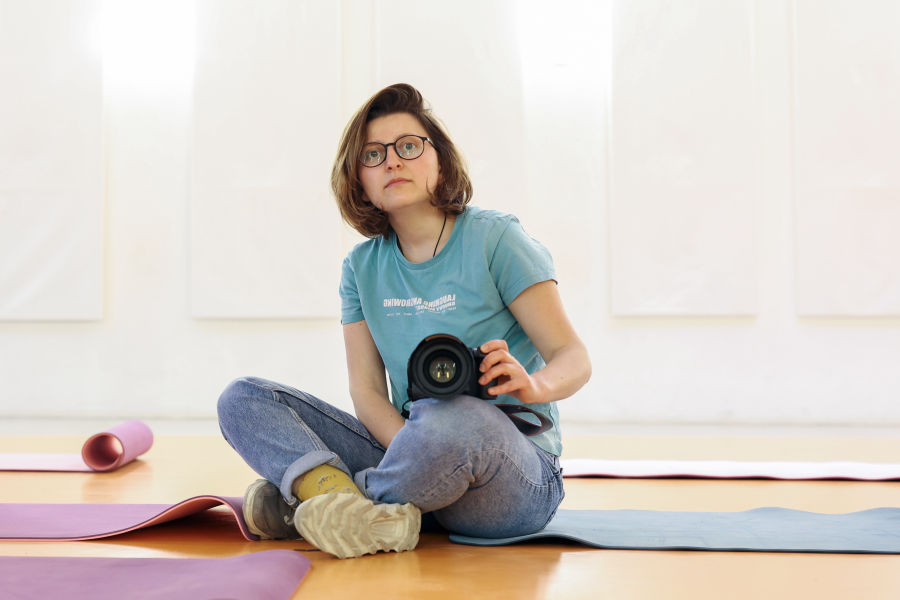
Knar Babayan is a journalist, documentary photographer and documentary filmmaker. She was born in the town of Martuni and her roots trace back to the village of Gishi. During the years of the first Artsakh war, Knar lived with her mother and sister while her father served on the front line.
Those days — interwoven from peace and war, waiting and fear — became the inner map of her childhood.
What followed was a sequence of departures and returns: Stepanakert to Yerevan, back to Stepanakert, then to Yerevan again. Each place brought a new opportunity, a new ending, a new room. Sometimes the moves were forced, sometimes for the pursuit of knowledge or simply for survival.
Mira Avagyan, from the village of Ashan, was the youngest and most cheerful of the women working in the tobacco fields. For her and dozens of other village women, this seasonal labor was their only source of income.
“I wanted to become a doctor; or rather, everyone wanted me to become one,” she said, laughing. In it, a small shade of childhood crept out — the unrealized dream of her grandmother, Knarik, which somehow passed down even through Knar’s name.
But then one day it became clear that chemistry and biology did not speak her language. Film and photography did.
“There were photographs everywhere at home,” she recalled. “My father had a photo lab.”
What began as an accidental choice became the vocabulary of her world. She first pursued photography in Armenia, then continued her studies in Georgia. At the Caucasus Authors’ Course (CAC), often referred to as CAC-School, Knar became the first student from Artsakh.
In 2015, the HALO Trust, a UK-based charity that cleared mines in Artsakh, began hiring women alongside men. Marine Barseghyan, a mother of six, was among the first female deminers.
“What I love most in journalism is telling people’s stories,” she said. “At first, I did it through text, later through photography and film. Truly listening to someone — and then retelling their story — has always inspired me most.”
During the April War of 2016, Knar realized one thing very clearly: she was not a war correspondent. “That was my home. I didn’t know what was what. It could have been dangerous for others.”
In 2015, the Kristapor Ivanyan Military Sports School in Stepanakert, for the first time in its 16-year history, admitted female students. One of the 11 girls enrolled, Arevik, planned to continue her studies at the school.
Even so, she traveled through the regions daily with Hetq editor Edik Baghdasaryan. She photographed little of combat but much of life: soldiers’ faces, tank operators’ exhausted smiles, the trembling silence of roads.
“People remember those four days of April,” she reflected. “But there were even harsher days afterward. We visited nearly all the regions.”
“It is very difficult to be professional when you cover what is happening in your own home.”
Nurse Loretta Poghosyan, who fled her native village of Chaylu during the First Artsakh War, settled in Nor Aygestan alongside dozens of villagers. During the Second Artsakh War, all residents were forced to flee.
Journalism demands objectivity, yet Knar believes objectivity begins with a subjective choice: “You choose what to talk about and what to leave out. Absolute objectivity doesn’t exist. But I’ve tried to be honest.”
During the 2020 war, she was not in Artsakh. Afterward, everything closed: the subject, the photography, even the ability to tell the story.
It was not a refusal. It was pain, and the instinct to protect oneself from returning too soon.
This slideshow requires JavaScript.
Opening a new map in Armenia
In 2019, Knar received an invitation to work at the Children of Armenia Fund (COAF) as a photographer. The offer instantly felt right. It was the work she had been longing for — work that would allow her to discover Armenia. She knew it would mean traveling to villages across the country, and that alone shaped her decision to move.
What followed was unexpected. She began to learn Armenia not through maps, but through roads.
Tavush, Lori, Armavir, Aragatsotn, Shirak.
Villages, people, fields, voices.
“I love understanding the country I live in through its people, its roads, its fields,” she explained. “This is how I discovered my beautiful homeland.”
During the April War of 2016, Stepanakert’s street sweepers continued cleaning the city despite the shelling. They maintained the streets and tended to green spaces up until the final days before the forced displacement.
After Knar moved to Yerevan, the blockade of Artsakh began.
She often received letters and photographs from family members who remained in Artsakh. When sharing them on Facebook, she always wrote the same caption: “Postcards from home.”
Her photo exhibition in Yerevan this past fall carried the same title. The idea emerged from a proposal by the Artas Foundation.
90-year-old Nora Dadaian, a World War II veteran, was among many Armenians who fled Baku in the late 1980s. In recent years, she lived alone in her apartment in Stepanakert.
The exhibition featured a series of 12 portraits of women: working women, a Great Patriotic War veteran, a deminer, a tobacco picker.
The 13th story, however, was not a portrait at all. It was a mirror.
Written across it were the words: “You are part of this story, too.”
“Unfortunately, I do not know the fate of many of them,” Knar said. “These photographs are postcards from home — with the faces of strong and gentle women whose presence reminds us of home, and ourselves at home.”
Lernoohi Isoyan, from Kovskan, lost an arm and a leg in the 1990s when she shielded an explosive device with her body, saving the lives of her two young children. Despite her injuries, she worked in the school library.
I asked her how she earns people’s trust when the stories are so personal.
She smiled.
“I don’t have a formula. People trust me easily. Maybe because I’m sincere. I always tell them to share only as much as they feel is right. My goal is to listen, not to harm.”
After fleeing Baku with her mother in 1989, Greta Abrahamyan settled in the village of Nngi in Artsakh’s Martuni region. She was brutally beaten by Azerbaijanis during the Baku massacres, leaving her with serious physical and psychological injuries.
And this reveals a truth: people who live with pain want their story to be remembered. They want their loved ones to remain in someone’s memory.
The soil, then, is no longer just soil. It becomes childhood turned into a border. A yard carrying the scent of that childhood, with the mixed breath of war and peace. The voice of a grandmother, with the anticipation of a father’s return.
And for this reason, that photograph — feet on the ground — is no longer simply an image. It is a demand for return, a proof of existence, something a person keeps inside even when the world has changed and home has become just a line on a map.
Because there are places that cannot be taken from you, even when you are no longer there.
This is Sirun Balayan, from the village of Mokhrenes in the Hadrut region. With a frozen stare, she grasps the photographs of her son Aznavour, killed in the Four-Day April War, and her husband, killed in the First Artsakh War.
There are stories that do not fall silent, even when their doors are closed.
And there are lands that continue to live within you, even when your feet no longer touch them.
This is where the strongest photograph is born: a person’s feet on their land. An image no one can ever take.
For more of Knar Babayan’s work, follow her on Facebook or check out her reporting in Hetq and Chai Khana.
All photos are courtesy of Knar Babayan unless otherwise noted.


