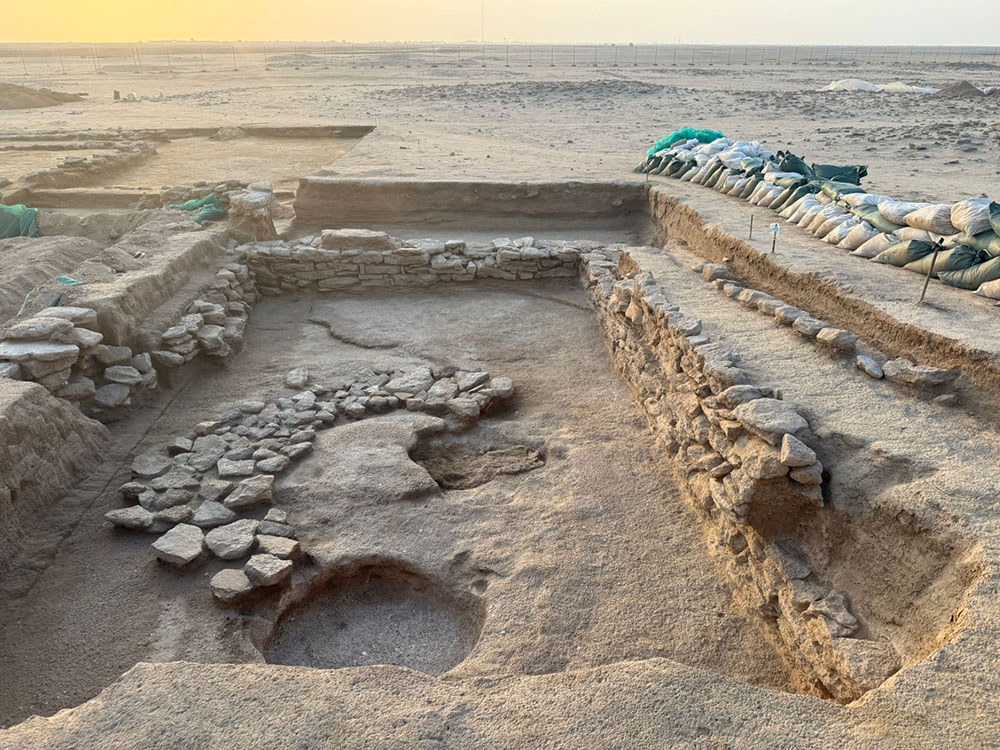
The National Council for Culture, Arts and Letters (NCCAL) announced on Wednesday the discovery of significant archaeological finds at Al-Qusur Monastery in the center of Failaka Island, including pottery inscribed with Syriac writings and evidence dating to the Umayyad and early Abbasid periods.
The Acting Assistant Secretary-General for Antiquities and Museums Mohammad bin Redha told KUNA that the joint Kuwaiti-French mission uncovered large architectural remains, early examples of artificial basalt, and pottery bearing Syriac script, indicating the presence of a Christian community that likely followed Eastern Syriac traditions.
Excavations, ongoing since 2011, have documented a monastic settlement dating from the mid-7th to mid-9th centuries CE. Professor Hassan Ashkanani of Kuwait University described the discovery as a landmark for Failaka Island, shedding light on the transition from the Christian period to early Islam.
The finds include Syriac and Persian inscriptions on ostraca, coins, an ornate perfume bottle, and food-processing installations, offering rare insight into daily, economic, and religious life on the island more than 1,200 years ago.
French mission supervisor Dr. Julie Bonneric said the site includes a monastery with a large church, refectory, and extensive food-preparation complex, highlighting evidence of Christian-Islamic coexistence during the early Islamic era.
She added that the current excavation season-the 12th-began on Nov. 17, 2025, and focuses on the monastery’s earliest phase and the daily lives of its monks. Members of the Kuwaiti archaeological team Saif Al-Batti Boutaiban, Ahmad Al-Thawadi, and Anwar Al-Tamimi, said that among the most notable discoveries was a food-processing building opposite the church. The team uncovered a flour mill featuring two low mud-brick pillars designed to support rotating grinding stones.
They explained that part of the grinding equipment was made from local stone, likely sourced from Failaka Island, while other grinding stones were produced from artificial basalt. Although this material closely resembles natural basalt rock, it was manufactured from clay and sand and fired at extremely high temperatures in large kilns. This advanced process, known as “pyrotechnology,” involved melting and recrystallizing materials to replicate the mechanical properties of volcanic basalt. – KUNA