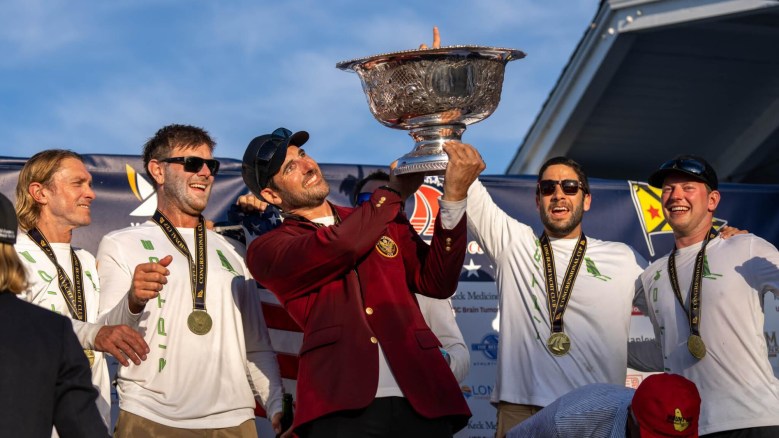
Wearing the winner’s Crimson Jacket, Chris Poole takes a good look at the Congressional Cup trophy after he and his crew sailed to the prestigious match race championship April 22 in Long Beach, California. (Photo by Ian Roman)
Falmouth native Chris Poole is already an elite sailor on the global stage.
Now Poole is embarking on the greatest navigational challenge of his career: charting a way to raise at least $30 million by Jan. 31, 2026, to fund his bid to be the CEO and helmsman of an America’s Cup challenger team.
“It’s my team and hopefully we get there and I get to be an America’s Cup skipper and hopefully one day be a winning America’s Cup skipper,” Poole told the Press Herald.
The America’s Cup is the sport’s most prestigious regatta. The Louis Vitton 38th America’s Cup will be held in Naples, Italy, in 2027.
Poole, 36, first cut his sailing teeth maneuvering bathtub-shaped dinghies in Casco Bay as a preteen. If he can raise what he termed the “barebones” minimum to fund a full campaign, then his Riptide Racing team will be the only American entry.
If Poole falls short, the America’s Cup won’t have an American vessel for the first time in the regatta’s 175-year history.
“I don’t want to see the America’s Cup happen without an American team,” Poole said. “Even with a tight timeline I believe we can find $30 million and people want an American challenger.”
Poole has until Jan. 31 to pay the $8 million entry fee and become an official challenger.
Falmouth native Chris Poole after winning the 2023 Congressional Cup regatta.
Emirates Team New Zealand is the three-time defender, having won in 2017 (Bermuda), 2021 (New Zealand) and 2024 (Spain). The British syndicate Athena is the challenger of record. On Monday, those teams were officially joined by confirmed challengers Luna Rossa (Italy), Tudor Team Alinghi (Switzerland), and K-Challenge (France). Together the five teams are part of the newly announced America’s Cup Partnership. The ACP’s stated purpose is to create a (somewhat) cost-conscious, biennial competition that still promotes the top sailors and nautical innovations.
Other challengers, like Poole’s Riptide Racing, have until Jan. 31 to enter.
WHY NOW?
Poole has long wanted to compete in the America’s Cup.
The door of opportunity swung open when previous U.S. challenger, American Magic, announced in early November that it would not return in 2027 after unsuccessful challenges in 2021 and 2024.
The regatta also became more accessible when changes to the competition protocols, set by defender Team Emirates, slashed the estimated cost of a fully funded campaign from $150 million to $50 million, Poole said.
“It’s still a huge number but compared to what it was just a cycle ago, now this is attainable,” Poole said.
Poole has picked up significant deals with equipment suppliers such as Pindar by Manuport Logistics, a leader in marine industry shipping and logistics, and Harken, Inc., which will be Riptide’s official hardware supplier.
Poole thinks Monday’s America’s Cup Partnership announcement will help him reach his fund-raising goal.
“It will allow investors more return on investing in the America’s Cup,” Poole said. “Before, the Cup would enter a limbo phase after a cycle. Now it will keep going with teams, much like (Formula 1 auto racing) having control over the direction and economic value.”
WHY CHRIS POOLE?
Poole has been the top-rated match racer in the world, according to SailWorld, since 2022 and has held that spot continuously over the last three years.
He lives in Oyster Bay, New York, with his wife, Alicia Martorella Poole, and their 5-year-old daughter Aurora, with Seawanhaka Corinthian Yacht Club as his sailing home and a supporter of his Cup bid.
A major breakthrough came in 2023 when he won his first Congressional Cup, the top U.S. regatta held annually in Long Beach, California. Poole became the first sailor to win with a perfect record, going 24-0. Poole repeated as the Congressional Cup winner in 2024.
Chris Poole of Riptide Racing
Match races are contested in identical sailing vessels. The type of boat changes with each regatta, thus the crew size and the skills that are prioritized also change.
“He’s good at analyzing his team’s needs,” said Michael McAllister, the executive director of SailMaine.
A 2007 graduate of Falmouth High, Poole went to Maine Maritime, competing on the college sailing team and graduating in 2012. He moved to Oyster Bay specifically to begin his career as a professional sailor.
McAllister was one of Poole’s coaches on a SailMaine high school team. He believes Poole can build a group of sponsors to support an America Cup challenge.
“There are people who want a challenger from America. And they want to support someone who is good, like him,” McAllister said. “He’s been the world match racing No. 1 for four years. People believe in that skill.”
A HUGE DIFFERENCE
The America’s Cup, first contested in 1851, has always been about innovation, said James Gale, a professional sailor from New Zealand who has lived in Falmouth for the last 20 years.
“It’s really a design race, not a sailing race,” said Gale, who sailed on four America’s Cup teams, including the winning New Zealand boat in 1995. “Historically, someone is faster and they win and normally win pretty dominatingly.”
The boat design for the 38th America’s Cup is essentially the same as what was in play in 2024. Called AC75s for their 75-foot length, the monohull crafts are capable of speeds of 60 mph (50-plus knots). They have movable hydrofoils, one on each side. When sailing at top speed, the hull is completely out of the water, with the boat balanced on one or both foils, producing the visual effect of a futuristic hovercraft.
Poole has never sailed such a boat. That’s not surprising since the AC75s and their smaller cousin AC40s are designed specifically for America’s Cup races and training. He has driven the AC40s on simulators.
“You’re still powered by the winds. You can still tip over if you don’t trim the sails,” Poole said. “To get six tons to fly above the water at highway speeds, purely powered by the wind, is an incredible feat of engineering.”
Poole will need to purchase an AC75, an AC40 for training, and other essential inventory from previous America’s Cup teams, including American Magic. Training would likely happen in Pensacola, Florida, where American Magic had its base of operations.
Gale has known Poole for about 15 years and has tracked the young sailor’s career. Gale also believes there is an influential contingent in the U.S. sailing community that will put their support behind Poole — hopefully for many years to come.
“If you look at America’s Cup teams, it generally takes two, three cycles to be competitive,” Gale said. “It took the Kiwis three cycles to win.”
Gale said he’s sure Poole has the talent to sail the AC75s and build an America’s Cup program capable of competing at sailing’s highest level.
The bigger challenge is the first step — securing the funds to get to the starting line.