- In October, a wholly owned subsidiary of West Africa Blue, a Mauritius-based company, signed a “blue carbon” offsetting deal with the 124 communities on the island of Sherbro in Sierre Leone.
- The agreement will reward the communities financially for conserving and restoring their mangroves, which act as a carbon sink.
- The funds will be generated by selling offsets on the voluntary carbon credit market, with revenues shared between West Africa Blue, the communities and the government of Sierra Leone.
- Though carbon offsetting projects have been subject to criticism in the past, community members on Sherbro say they’re optimistic about the improvements to their livelihoods that the project could bring.
See All Key Ideas
BONTHE, Sierra Leone — On the island of Sherbro in Sierra Leone, as in much of the country, there’s limited access to vital services needed to make ends meet.
“Here our people only rely on fishing and a few on agriculture and have nothing else to occupy our children, our youths,” Nenneh Sumaila, the chief of Gbomgboma, a village of about 300 people on the island, told Mongabay. “There are no good roads, no proper health facilities, there’s poor housing, electricity is a dream and the standard of living is poor.”
One of the ways to make ends meet in Gbomgboma is by cultivating oil palm trees. But to process the fruit into palm oil, they need fuel for fire, which often comes from mangroves — one of many local uses for the wood.
Cutting mangroves unsustainably turns them from a carbon sink into a source of greenhouse gas emissions and hurts their ability to foster biodiversity and provide other ecosystem services. “Blue carbon” projects aim to reverse this trend, and one called the Sherbro River Estuary Project has just been launched with more than 124 communities there.
A wholly owned subsidiary of West Africa Blue, a Mauritius-based company, reportedly signed a deal with the communities in October that will reward them financially for conserving and restoring their mangroves. Company representatives told Mongabay that the funds will be generated by selling offsets on the voluntary carbon credit market, with revenues shared between West Africa Blue, the communities and the government of Sierra Leone.
Like others on the island, Sumaila, who is one of only a few female chiefs there, expressed optimism about the project.
“Now we are being promised money for our communities that we can do meaningful developments,” Sumaila, 52, said. “I am hopeful that this project will make at least some meaningful changes.”
Nenneh Sumaila, the chief of Gbomgboma, a village of about 300 people on Sherbro Island. Image by Mohamed Fofanah for Mongabay.
Part of a global trend
Carbon offsetting began with terrestrial forests, and the model was later applied to blue carbon projects, a term for carbon captured and stored by marine ecosystems such as the mangrove forests that straddle the border between land and sea in tropical and subtropical areas. Mangroves grow rapidly and hold carbon in their salty, waterlogged soils, and are recognizable for their twisted, densely layered root systems; some of the dominant types in West Africa are from the Rhizophora genus.
Compared to terrestrial carbon projects, only a small number of blue carbon projects have gotten underway worldwide. The first one, Mikoko Pamoja, launched in Kenya in 2010. That project is conducted under a standard set by Plan Vivo, a U.K.-based NGO. Organizations such as Plan Vivo that certify projects for the voluntary carbon market determine methodologies for setting emissions reduction targets, as well as overseeing audit reports and setting other rules. Another blue carbon project, much larger in scale, launched in Colombia’s Cispatà Bay in 2021, under a standard set by Verra, a U.S.-based NGO, which is also being used in the Sherbro project.
The Sherbro project has four focus areas, and the October agreement was for the first area, which covers about 13,000 hectares (32,100 acres) and involves 124 communities, according to John Stelzer, a partner with the company who spoke to Mongabay. West Africa Blue expects to sign agreements with the communities in the three other areas, including some not on Sherbro Island but on the nearby mainland, in 2026, Stelzer said. Once those areas are included, the project will cover roughly 94,000 hectares (232,300 acres) and has the potential to reduce or remove more than 3 million metric tons of CO2 equivalent over its life, he said.
People celebrate the signing of an agreement between 124 communities and West Africa Blue in October 2025. Image courtesy of West Africa Blue.
Hanging Site, a village on Sherbro Island in Sierra Leone. Image courtesy of West Africa Blue.
According to Stelzer, Sherbro communities will receive 40% of the gross revenues from the sale of carbon offsets, while West Africa Blue will receive 45-52.5% and the government of Sierra Leone will receive 7.5-15%. Stelzer said West Africa Blue believed in revenue sharing as the ethical approach because profit sharing can be “problematic” given companies’ accounting methods; profits also take longer to materialize, he said.
Verra, which dominates the voluntary carbon market, having certified roughly three-fourths of global credits to date, has been the subject of criticism in the past. Academic and journalistic work, including a 2023 exposé in The New Yorker and multiple investigations published in The Guardian that year, found that terrestrial projects certified by Verra were not in fact providing climate benefits. Verra responded in writing to both outlets, strongly disputing The Guardian’s findings and pointing to a 2022 study in the journal Conservation Biology that found that carbon offsetting projects reduced deforestation by 47% over their first five years. A recent study of the voluntary carbon market in the journal Annual Reviews found that “many of the most popular offset project types feature intractable quality problems.”
On Dec. 16, Verra announced an updated standard that was designed with input from civil society groups, a development that those involved with the Sherbro project watched closely.
“We are tracking the reviews of Verra’s methodologies closely and appreciate the changes Verra has already made to improve accuracy,” Stelzer told Mongabay as part of an emailed response to a question about why West Africa Blue chose Verra. “Furthermore, we have proactively included several adjustments to our application of the methodology, taking a very conservative approach, to address previous methodology shortcomings.”
West Africa Blue, which was formed four years ago to pursue this flagship project in Sierra Leone, plans to sell the first carbon credits by the end of 2026. Per the October agreement, according to Stelzer, communities will receive their share of revenues within 45 days of any sale, and all financial terms will be fully transparent, with receipts shared with communities showing the price and the buyer of the credits. The October agreement is for 50 years, with the possibility of extension, Stelzer said.
Sherbro Island off the coast of Sierra Leone in West Africa. “Instance 1” is the first project area for the Sherbro River Estuary Project, a “blue carbon” offsetting project for which an agreement was reached in October between 124 communities in the area and West Africa Blue, a Mauritius-based company. The “Leakage Belt” is an area outside the project area that’s designated as in need of monitoring to ensure that deforestation in the project area isn’t simply moving elsewhere. Image courtesy of West Africa Blue.
NGO involvement
The Sierra Leone chapter of Namati, a U.S.-based nonprofit that trains and deploys grassroots legal advocates, helped guide Sherbro communities through discussions with West Africa Blue over the last three years.
Daniel Sesay, Namati Sierra Leone’s program director, told Mongabay that community members were “initially worried” about the idea of losing access to mangroves — they have long used them to construct houses, for example — but “we came in and built the confidence” that more mangrove management would have broad benefits, he said.
Abdulai Tommy, a Namati Sierra Leone program officer, said the NGO also serves a watchdog role.
“If the company wants to do anything that is inconsistent with the agreement or best practices, we will be there to check them,” Tommy told Mongabay.
Isa Mulder, a policy expert at Carbon Market Watch, a Belgium-based NGO, told Mongabay that the involvement of Namati, which is the central organizer of the Grassroots Justice Network, bodes well for the project, though she cautioned that there are never any guarantees that projects will be implemented in keeping with initial agreements, even if well designed.
A hut constructed out of mangrove wood on Sherbro Island. Image by Mohamed Fofanah for Mongabay.
Criticisms of offsets projects include not just misrepresenting emissions reductions but ethical considerations as well. Justice-oriented critics argue that projects can threaten local peoples’ land rights and access to resources such as wood, and that they can launder the reputations of polluting corporations that buy the credits — “the less pretty side of the projects,” Mulder called it.
Sesay said Namati and West Africa Blue have facilitated the process of free, prior and informed consent (FPIC) with Sherbro communities, including educational engagements on climate change and mangrove ecosystems, as well as a series of meetings with communities to discuss the proposed project and provide input. He said it was a “bottom-up approach,” and that one key point of discussion was who would be in charge of the incoming money. Ultimately, all parties agreed that the finances would be managed by a “Community Benefit Organization” made up of three community representatives, three West Africa Blue representatives and three independent members who are jointly approved.
On the sales end, West Africa Blue has a “buyer selection framework” that ensures that corporations or institutions that buy the offsets share West Africa Blue’s values and have a genuine plan of action toward “ambitious emissions reductions targets,” Stelzer said. There is no explicit exclusion of fossil fuel companies in the framework, he said, though that’s one of the “carbon justice principles” that the Grassroots Justice Network pushes.
Mangroves on Sherbro Island. Image by Mohamed Fofanah for Mongabay.
A grievance and accountability box placed in a Sherbro village by West Africa Blue. Image by Mohamed Fofanah for Mongabay.
The local situation
Ishmael Kain, chief of Mania, a fishing village in Sherbro, said it took a while to get local people to support the project.
“When they started we didn’t understand some of the big words they were using, but gradually we started getting the sense of what they were saying,” Kain, 62, told Mongabay. “They started employing our own people as coordinators and trained them and they were able to explain to us in our own languages, Mende and Sherbro. And we understood properly what the whole project was. They also engaged us in town meetings on many occasions.”
Some interventions are already being piloted on the island, including the use of more efficient cookstoves that need less fuel than traditional methods. Kain said “almost every household” in Mania now has a cookstove.
“We have discovered that it really uses less firewood to cook and this in turn has helped reduce the mangrove cutting significantly,” he said.
However, he said that ovens for drying fish have not yet been provided in Mania and are sorely needed, as drying fish is the only way they have to preserve them. So for now, people still burn mangrove wood to do so. (Stelzer said more ovens would be rolled out in the future.)
In Gbomgboma, the people want larger cookstoves so they can use them for processing the kernels of oil palm fruit, Sumaila said. For now, that requires mangrove-fueled fires, though people are using the newly constructed cookstoves for daily cooking, she said.
A woman named Aminatta sits by a cookstove in Hanging Site. West Africa Blue has facilitated the distribution of more than 2,500 cookstoves across Sherbro Island so far, according to the company. The cookstoves’ efficiency helps reduce the use of mangrove wood. They’re built using local materials like sand, clay, ash and sawdust. Image courtesy of West Africa Blue.
In the years following Sierra Leone’s civil war, which ended in 2002, there were many land grabs by foreign corporations along with failed projects, Sesay said. This led to some skepticism of foreign-led interventions. But Sherbro residents said they’re hopeful the Sherbro River Estuary Project will be successful and beneficial.
“We have seen many NGOs come with big promises but exploit us, but we are hopeful for this project,” Foday Kpana, 26, a Sherbro youth leader, told Mongabay. “They have been with us for a long time now before we signed the agreement. We hope for the best. We have started seeing solutions so we are optimistic.”
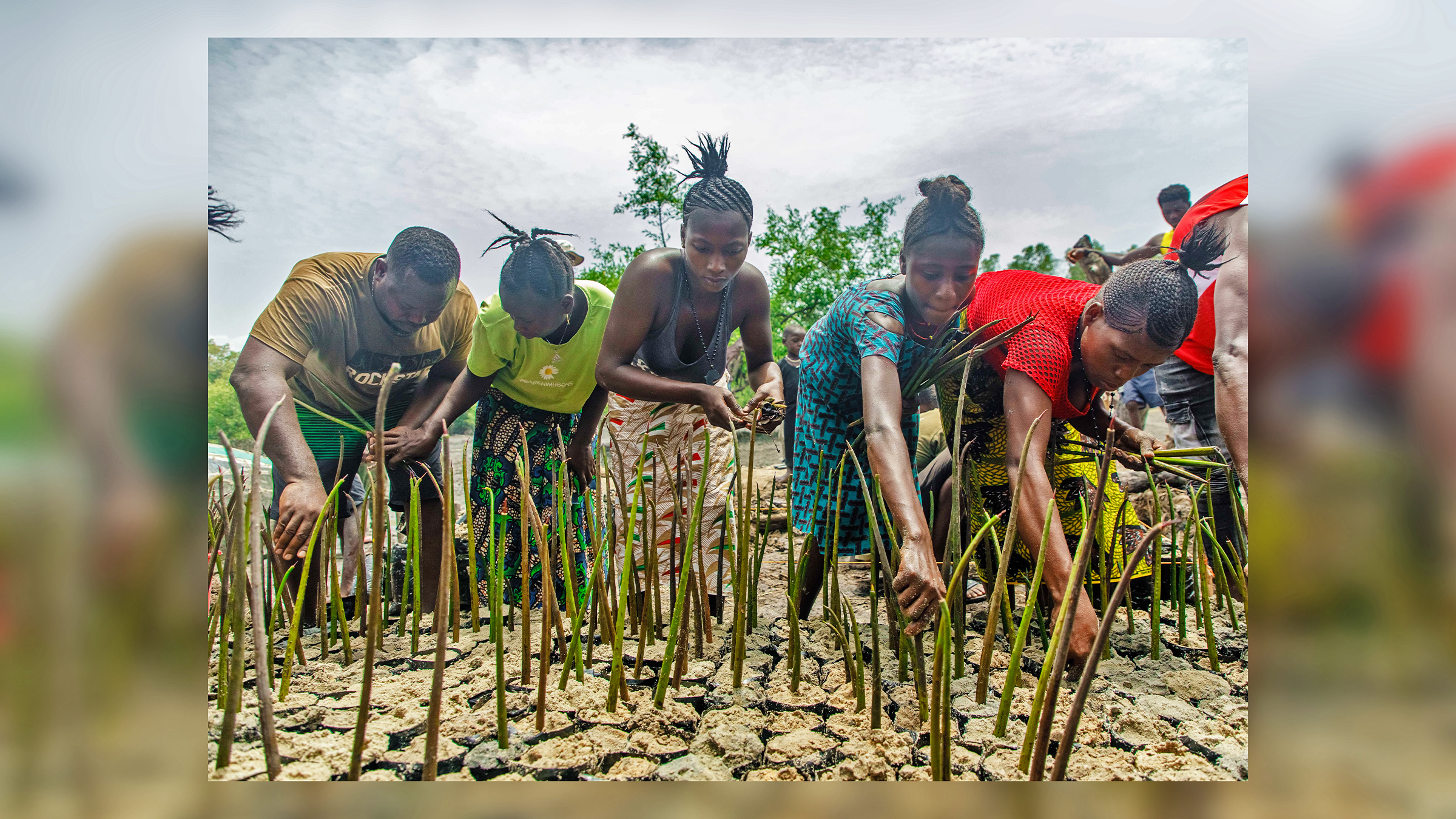
Banner image: Community members plant red mangrove (Rhizophora mangle) propagules in Hanging Site as part of a restoration effort. Image courtesy of West Africa Blue.
‘Independent’ auditors overvalue credits of carbon projects, study finds
Citations:
Guizar‐Coutiño, A., Jones, J. P., Balmford, A., Carmenta, R., & Coomes, D. A. (2022). A global evaluation of the effectiveness of voluntary REDD+ projects at reducing deforestation and degradation in the Moist tropics. Conservation Biology, 36(6). doi:10.1111/cobi.13970
Romm, J., Lezak, S., & Alshamsi, A. (2025). Are carbon offsets fixable? Annual Review of Environment and Resources, 50(1), 649-680. doi:10.1146/annurev-environ-112823-064813
Feedback: Use this form to send a message to the author of this post. If you want to post a public comment, you can do that at the bottom of the page.