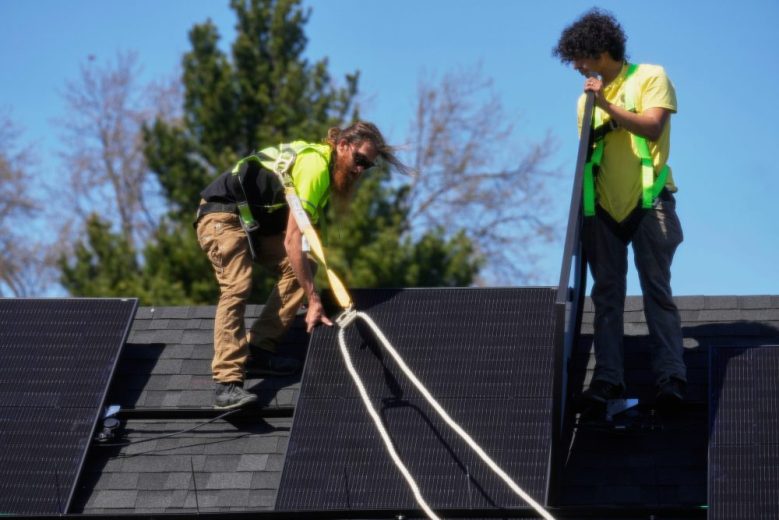
Theodore Tanczuk, left, and Brayan Santos, right, of solar installer YellowLite, work to put panels on a home in Lakewood, Ohio, April 16, 2025. (Sue Ogrocki/Associated Press)
I have written about the solstice many times. But, a recent discussion with a friend gave me a new perspective on the changes in the light. Our discussion wasn’t purely centered on the solstice itself, but rather the shift in light through the seasons — the differences in the angle of the sun in the summer versus the winter, for example.
The discussion centered around solar panels and the way that technology now allows us to see how much energy different panels are absorbing at each time of day. The gist is that, in the summer, the sun’s arc is much greater so that, in sum, it is in the sky for more hours of each day. From its rising in the morning, it travels up much higher in the sky until the middle of the day and then descends that same amount through the afternoon until sunset. In the winter, the sun’s arc shortens, meaning that it travels up to a lesser height. If you’ve ever been to latitudes in the extreme north, you may have seen the odd phenomenon of the sun seeming to rise and set in the same place.
What you see in the solar panels’ energy measurements is a neat illustration of the change in the size of the sun’s arc. In the summer, panels on one side of a house, for example, might get blasted with sunlight in the morning while those on the other side are in the darkness. This reverses in the afternoon. In the winter, however, the lower arc means that all of the panels get a more even exposure throughout the day. As someone who doesn’t have a solar roof, and doesn’t live in an open field where it is easy to see this difference from season to season, the place that I have noticed it most clearly is over the water.
Sunrises and sunsets over the water are often dramatic, particularly in the winter, and, for that reason, many people go to the shore at those times of day. The low light over the water magnifies the brightness and the colors — two things that are welcome in the coldest months of the year. One interesting thing to notice, if you have a favorite place on the water, is the difference in where the sun rises and sets in summer versus winter. That’s a perfect way to illustrate winter’s shortened arc.
This shortened solar arc means fewer hours of sunlight, and that means colder temperatures due to the reduction in radiant heat to warm water and land. The shallower angle of light also means that it doesn’t penetrate the water as deeply as it does during the summer months. The plants and animals that live under the water are incredibly well adapted to frigid temperatures.
As I have written about in several previous columns, they do everything from simply slowing down to moving to deeper (and ironically warmer water), to producing an internal version of antifreeze. These creatures have evolved to survive severe seasonal shifts.
Humans, too, have adopted ceremonies and traditions around the changing of the seasons and the shifting in the light. From the Swedish practice of “hygge” which involves things like gathering by the fire and drinking spiced drinks to drumming performances common in both Celtic and Native American cultures, we have found ways to notice and honor, if not exactly
adapt, to the shifting light. And we can take comfort in the fact that each day going forward, there will be just a few more minutes of sunlight — and hopefully warmth. If you have a favorite seaside place, take notice of the change in the location of the sunrise and sunset as we gradually head into spring.
Susan Olcott is the director of strategic partnerships at Maine Coast Fishermen’s Association.