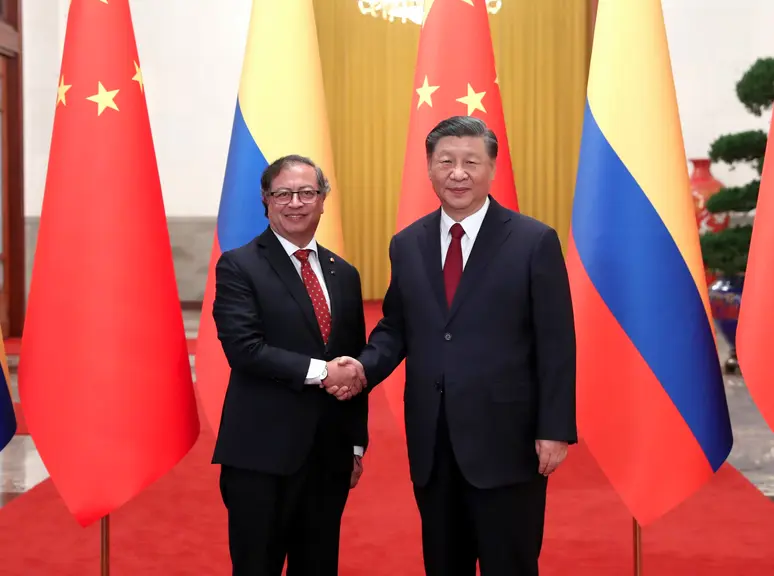
(Analysis) Colombia closed 2025 by formalizing a new chapter with China after joining the Belt and Road Initiative (BRI), a move President Gustavo Petro framed as a historic shift in foreign policy and development options.
Supporters sell it as a faster path to ports, rail, energy grids, and cheaper logistics. Skeptics see a high-risk bet: more leverage for Beijing, more debt exposure, and more geopolitical friction with Washington.
What Colombia actually signed up to
BRI is not a single loan, and it does not automatically fund projects. In most countries it starts with a cooperation framework, then governments and firms propose specific projects that still need financing, permits, and procurement.
This is why the real test is not the announcement. It is the project list, the contract terms, and who carries the financial risk.
Why Bogotá is interested: infrastructure and a lopsided trade relationship
Colombia’s core problem with China is not lack of commerce. It is the composition and balance of that commerce. In 2024, Colombia exported about $2.377 billion to China and imported about $15.931 billion, leaving a deficit of about $12.391 billion.
Exports were concentrated in crude oil, thermal coal, and ferronickel. Imports were dominated by manufactured goods, including smartphones and data-processing machines.
Colombia has also run more than 80 anti-dumping investigations involving Chinese-origin products since the mid-1990s, with a subset of measures still in force.
Colombia’s 2025 China Turn: What Joining the Belt and Road Really Changes. (Photo Internet reproduction)
That backdrop explains why officials and business groups keep stressing that “joining” should translate into concrete projects and better market access, not only ceremonies.
A key point: Chinese firms were already present before BRI
BRI did not begin China’s footprint in Colombian infrastructure. Chinese contractors have already been involved in large, high-profile projects, especially around Bogotá.
At the same time, the financing picture often remains mixed, with Western-led multilateral lenders still central in major deals.
One example reported in late 2025 was Bogotá Metro Line 1, which secured $1.06 billion in financing through loans from the World Bank and the Inter-American Development Bank, alongside existing support from the European Investment Bank.
That detail matters because it shows Colombia is still leaning heavily on multilateral finance even as it expands ties with China.
The “new lenders” track: AIIB and the BRICS bank
BRI also sits alongside a broader strategy by Petro’s government to widen Colombia’s financing options.
In November 2025, the Asian Infrastructure Investment Bank said its Board of Governors approved Colombia’s membership application, with membership completing after required procedures and the first capital payment.
Separately, Colombia was admitted to the BRICS’ New Development Bank in June 2025 after applying during the same China trip when it pursued the BRI step.
Together, these moves signal a push to diversify funding sources, even if most large projects will still live or die on feasibility, governance, and local politics.
The non-propaganda view: the upside and the hard risks
The plausible upside is simple. If Colombia uses BRI as a bargaining tool, it may attract more bidders and more capital for ports, logistics corridors, transmission lines, and industrial projects.
Better infrastructure can lower transport costs and raise productivity over time. The risks are also simple. Big “strategic” projects can become expensive mistakes if they are rushed, opaque, or structured so the public absorbs downside while private partners keep upside.
A second risk is diplomatic: deepening alignment with China can complicate relations with the United States, which remains Colombia’s most important strategic partner and a major trade and security counterpart.
What people were saying on social platforms in 2025
Public debate has been polarized and highly online. Pro-engagement messaging highlighted “opportunities,” implementation workshops, and business matchmaking. Critics focused on transparency, national-interest tests, and the fear of debt traps or political leverage.
Some discussion also centered on whether “BRI membership” is mostly symbolic unless Colombia names specific projects with clear financing plans and public oversight.