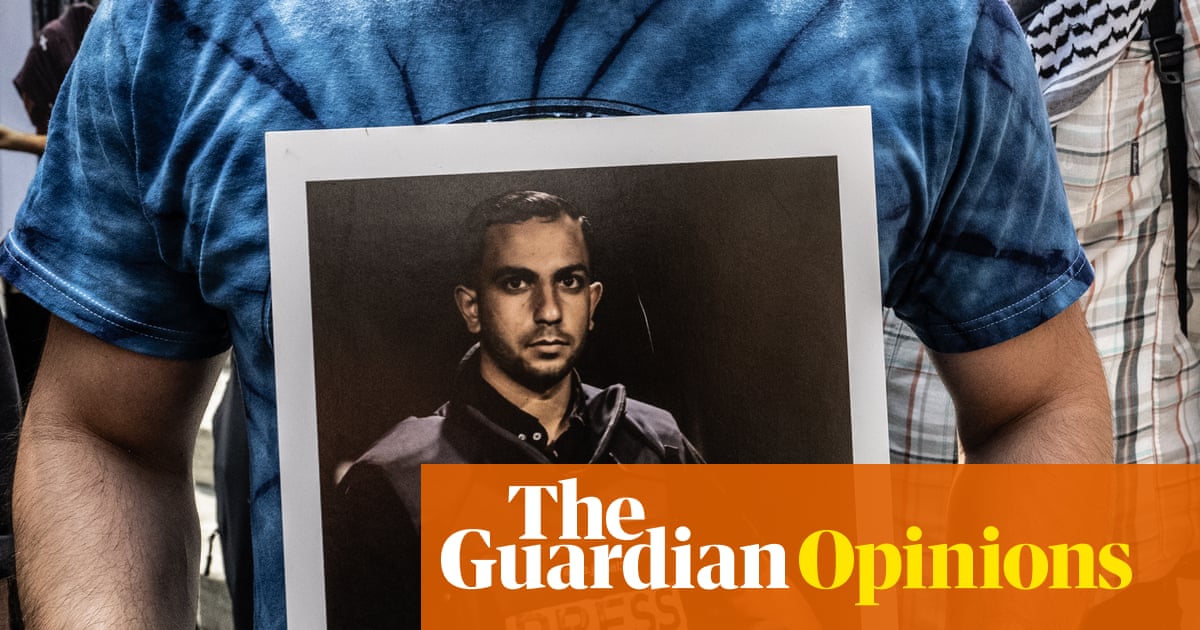
In January this year, Anas al-Sharif was filmed being lifted into the air after taking off his helmet and flak jacket to celebrate a ceasefire that would prove all too temporary in Gaza. This summer, the Palestinian journalist broke down while reporting on starvation in his home town that is now a war zone. A bystander told him: “Persist, Anas, you are our voice”.
But al-Sharif’s popularity in Gaza made him a target. In July, international agencies warned of the danger he was in as the Israel Defense Forces stepped up online attacks, falsely labelling him a Hamas terrorist. His employer, Al Jazeera, insisted he restrict his reporting to the more protected al-Shifa hospital after his father and many colleagues were killed. In August, a few months short of his 29th birthday, al-Sharif and six others were killed in a direct attack on a media tent next to the hospital. In a posthumous post he said: “If these words reach you, know that Israel has succeeded in killing me and silencing my voice.”
Anas al-Sharif is just one of 67 media professionals who were killed in 2025 while doing their jobs, identified by press freedom advocates Reporters Without Borders (RSF) in its annual report on journalists’ safety. The International Federation of Journalists (IFJ) goes even further – they found 111 journalists have been killed in 2025, nearly half in Gaza.
Each one of these deaths is a tragedy, an abuse of the right of journalists to bear witness. Yet it is worth remembering the story of al-Sharif, not least because he became one of the highest profile examples of the tactic of discrediting journalists by accusing them of bias.
The Israeli military confirmed that it targeted al-Sharif, claiming he led a Hamas terrorist cell and was “responsible for advancing rocket attacks against Israeli civilians” – somehow doing all of that while spending so much time on air. He had denied these accusations many times and none of the main press freedom advocacy groups – the Committee to Protect Journalists (CPJ), IFJ and RSF, nor the UN special agencies – have found any evidence that the allegations were true.
Irene Khan, the UN special rapporteur for freedom of opinion and expression, said: “On the one hand, Israel refuses to allow any international journalists to enter Gaza, and on the other, it ruthlessly smears, threatens, obstructs, targets and kills the few local journalists remaining as the only eyes of the outside world on the ongoing genocide.” In August 2024, the CPJ called on Israel to stop making unsubstantiated terrorism allegations to justify its killing and mistreatment of Palestinian journalists.
Fiona O’Brien, UK director of RSF, told me the young journalist’s story was a “very strong example of the way the Israelis are trying to discredit journalists without producing any credible evidence. It’s a very deliberate tactic.”
It is a tactic that is working. Under an international press ban that Israel is refusing to lift – an appeal was due back in an Israeli court on 21 December – international journalists are barred from Gaza except on escorted military trips. The ban makes telling the sort of human stories that engage the public and lead to direct political action much harder.
O’Brien tells me that not only has the ban made it harder for press freedom organisations such as RSF to provide support and safety equipment for journalists under fire, the lack of eyewitness accounts also makes it easier to discredit local journalists. In a confused world in which claim and counterclaim are spread on social media, allegations are sometimes all it takes to sow seeds of doubt. And this at a time when trust in journalism worldwide is already receding at an alarming rate.
More than 240 Palestinian journalists have been killed since the Hamas attack on 7 October that started the war. Many of them, including the prominent Palestinian-American Shireen Abu Akleh, were killed by Israeli snipers while wearing a press vest. Jon Williams, executive director of the Rory Peck Trust, which supports independent journalism, said: “Palestinian journalists in Gaza have been the world’s eyes and ears and they have paid a terrible price. Many of them were not journalists at the start of the war but, as one has fallen, the other has picked up their camera and continued their work.”
Abdullah Ali, head of international communications for the Qatari-owned Al Jazeera, told me that the network had been able to replace all of the journalists killed in Gaza this year with other Palestinian journalists. In early December, the media group moved al-Sharif’s wife and two very young children to Doha.
Not long after the attack on journalists outside the al-Shifa hospital this August, the RSF filed its fifth complaint against Israel at the international criminal court, alleging war crimes for its treatment of Palestinian journalists. Yet they continue to be killed with impunity. And there are signs that things are getting worse.
Just four years after two journalists – Maria Ressa and Dmitry Muratov – were awarded the Nobel peace prize for holding the powerful to account, the world’s most powerful nation is led by someone who has made no secret of his antagonism towards his critics in the media. Since taking office in January, the Trump administration has sued media organisations, including the BBC, for billions of dollars. He has banned reporters from less favoured organisations from White House briefings and cut funding for public service media. He has recently restricted visas for foreign journalists.
As he welcomed Mohammed bin Salman into the Oval Office he shrugged off the killing of Saudi journalist Jamal Khashoggi by saying “things happen”.
Things do happen, including the very worst atrocities and unlawful attacks on civilians and those protected by the law. With all apologies for a miserable year end message, unless journalists continue to be able to report on such terrible things, 2026 will be no better than 2025 – and it could be much worse.