The following is a translation of Nelli Saakyan’s short story, Tolma, from the original Russian by Artsvi Bakhchinyan.
Tolma by Nelli Saakyan
The grapes will ripen in about a month and a half, but grapevine leaves are already abundant all over the market. Piles rolled into tubes. Now, it’s time for minced meat, rice, onions and herbs. We sit down, filling carefully washed vine leaves with meat, and fill a large pot to the brim. How delightful is handwork among loved ones! Tolma (meat wrapped in leaves — one might even say, swaddled meat) is a delight for the eyes and the senses.
“Surely, you’ll describe all of this?” smiles my cousin.
“Absolutely. Ancient food is sacred. How can one not revere the sacred?”
“Wrap it like you fold your fingers; the leaf has three lobes (secretly five, if you count the offshoots),” my sister instructs me.
We place the pot on the fire (fire itself is sacred and also ancient). I take my portion, and my thoughts begin to wander. Where to? To antiquity, to the point where tolma was born. And this isn’t just antiquity — it is immemorial, Neolithic antiquity.
So, it all began some 12,000 years ago. Not somewhere far off, but right in the region where my sister’s family and I now cook tolma. Perfect. No deviation over a venerable stretch of history. The easternmost, oldest part of Asia Minor, later called Anatolia (the western wing of the Armenian Highlands). Tens of thousands of years before the Neolithic revolution, hunters and gatherers roamed here — our great-great-great ancestors. They ate what could be plucked by hand or knocked down with an obsidian-tipped stick. They were still wandering, not yet settled. Wild grains, fruits, non-poisonous greens, vegetables. Not very nutritious, but still nourishing, especially since the local grains were high in protein — perhaps the highest protein grains on the planet. The dry climate of the elevated highlands — elevated, that is, slightly cool even in summer. Without humid vapors or suffocating heat. The climate was somewhat sharp (harshly continental), yet still refreshingly healthy. Internal valleys, settlers on southern foothills. The southern foothills, protected from cold, were life-giving. Also, the land was equidistant from three internal seas (Mediterranean, Black and Caspian). Warm seas, internal valleys — all contributing to the golden mean. I would even say, a gold-bearing one. Western mountainous Iran with the oasis of Shiraz — similar. Something was bound to arise here…
And it did. Humans stopped wandering. The Neolithic revolution — the great discoveries, the advent of agriculture and animal husbandry. Ancient hunting and gathering tribes became farmers and herders. The land could immediately sustain hundreds, thousands more people. This was the Neolithic explosion.
From this great development sprouted cultivated plants. According to [renowned Russian botanist and plant geographer] N. I. Vavilov, the Armenian Highlands are the earliest homeland of wheat and rye, as well as the birthplace of grapes, pears, plums, cherries, pomegranates, walnuts, quinces, figs, almonds and major fodder plants. In Armenia, wild grapevines, called toli (from uduli — grape), still grow. This is where tolma got its name.
The memory of hunting and gathering, along with the advent of agriculture and domesticated animals, naturally gave rise to a dish like tolma. All three main components — meat, vine leaf, and grain — came together like in a focus. For many millennia, tolma used cracked wheat (dzavar). Rice arrived from China and Iran only 300 years ago. It was an imported crop and costly to transport, which is why it was valued. The original tolma with dzavar was much more authentic and nutritious: grains are rich in protein. The local vines were superb. After all, the country is volcanic; volcanic ash is very useful for future grape harvests. Add to that the appearance of fire for early humans. Why? Their teeth were already small, making it difficult to tear raw meat (as in hunting times). Homo sapiens learned to cook. The ancient Chinese even had a deity who taught them to boil and steam food (frying, especially in a pan, was reluctantly adopted). Clever people.
The tonir (underground clay oven) and the smoke from the yerdik (smoke hole) — these represent the fiery crater of a volcano. The tonir walls glowed red-hot like the hellish belly of a volcano. All taken from nature. Why in our oikoumene did it all begin simply? The soils here spontaneously ignited, gas seams reached the surface. Unlike the Persians, Armenians were not so much fire-worshipers as sun-worshipers.
Much later (much, much later!), after learning to wrap meat in vine leaves, our ancestors encountered cabbage leaves via the Romans (origin of cabbage: Italy). Tolma blossomed with new ingredients. Van Armenians also wrapped meat in large sweet green peppers, eggplants and later, when tomatoes arrived in the highlands (after Columbus brought them from Mesoamerica), tomatoes were included. This was summer tolma. In Van, pasuts tolma (lent tolma) also emerged.
But the original national tolma is made only from vine leaves. Dzavar has long been replaced by rice. Yet the leaves, meat and vitamin-rich herbs remain.
Another innovation appeared: the meat grinder. Ancient humans lacked such tools. How did they mince meat? They simply pounded it until it became soft and almost liquid. Thus, kololak (kufte) was born.
The Turks, disregarding reality, claim tolma (as they say, dolma) as their national dish. Absurd, since they entered Asia Minor 10,000 years after the Neolithic revolution and could not have participated in the origin of this dish. Yet, appropriating others’ dishes is their specialty. Armenians and Greeks know well this conquering habit!
Our tolma boils. We sit together around the table, a low wide bowl of matsun (yogurt) and garlic in the center. An equally ancient and important component: meat must be softened and seasoned with sour milk. Why? Our wise ancestors understood that old peoples’ livers were already genetically burdened, so it should not be overloaded. Digestion serves vitality; all exertion should be moderate. How many keen observations did the gray antiquity and our ancestors bestow upon us!
Suddenly, my sister says:
“You say the Chinese had a god who taught them to boil or steam food, never fry. Notice that tolma is boiled food, the healthiest? So, our ancient god knew everything.”
I noticed. Pouring dark green small balls of matsun with garlic, armed with lavash, I devoured what our ancestors bequeathed. They found a perfect combination; successive generations preserved it with pleasure, passing it down to us. We continue the journey.
When my plate emptied, I pictured the boundless span of history when our ancestors imagined combining magnificent vine leaves with roaming animals (meat), healing aromatic herbs and sour milk, beneficial for the stomach. Did anyone have this thought? Or were guesses added atop guesses, accumulating new elements? Most likely, it all began with the vine leaf… Was it silky and sweet? Perhaps. Long ago, someone in distant millennia examined the leaf, turned it over, caressing the veins… A provincial moment, of course. One thing is clear: ancestors chose the essentials before their eyes — the vine leaf, grain and meat. Ritual traditional food never elevates the secondary. Secondary things do not survive millennia.
By the way, the homeland of all three main components — grapes, wheat and meat (domesticated animals) — is here in Eastern Anatolia.
When I voiced this to those at the table, I got seconds. A kind of reward!
About the author
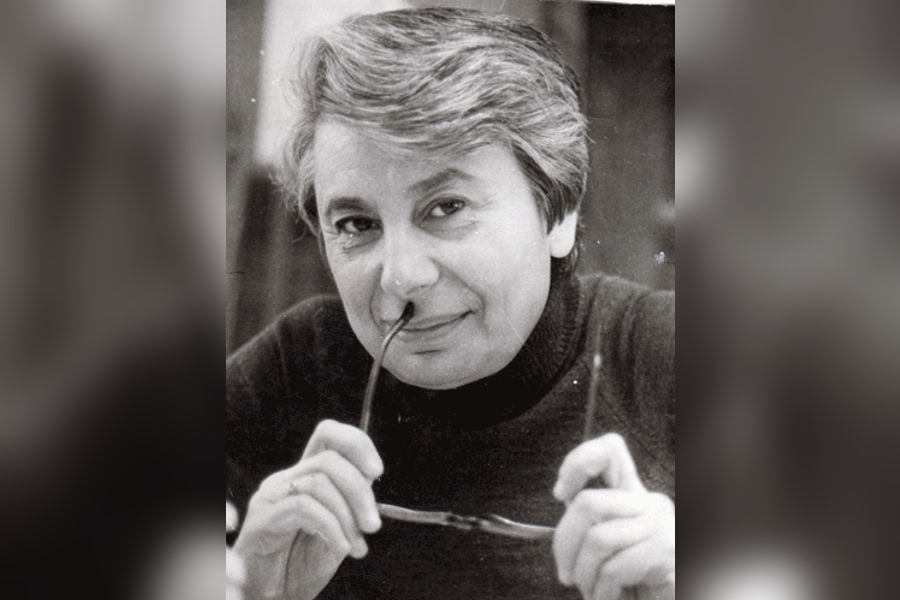
Nelli Saakyan (born 1937, Armavir, Russia) is an Armenian poet and essayist writing in Russian. Her ancestors were from Shushi. Since 1955, she has lived in Yerevan. After graduating from university, she worked in journalism, serving in the editorial offices of Russian-language newspapers. She is the author of numerous poems, essays and short stories published in Armenian and foreign newspapers and journals. Her published books include Quiet Poems (1982), The Armenian Highland (1990), The Armenians (1997), My Gallery (1997), The Mountain of the World (2004), Heavenly Star (2004), Anthropo-Études (2007), My Gallery (2010), Journey through Armenia (2011), The Ignition of the Spirit (2013) and others.