- Belgium is trialing “dune-by-dike” systems as a nature-based defense against storm surges and sea-level rise, using engineered sand dunes in front of existing dikes to create a double buffer along vulnerable stretches of coast.
- There are four dune-by-dike pilot sites in Belgium, including a 750-meter site in Raversijde, a neighborhood in the coastal city of Ostend, which Mongabay visited in late November.
- The Raversijde dune-by-dike project was established in 2021 with grids of vegetation that collected sand as the wind blew, helping build up the dunes.
- While experts said they believe dune-by-dike systems could protect large portions of the Belgian coast, they said building and maintaining the dunes relies on dredging sand from the sea to replenish adjacent beaches.
See All Key Ideas
OSTEND, Belgium — In late October, Storm Benjamin blew across Belgium and other parts of Western Europe, bringing strong winds and rain that knocked down trees and damaged homes. Powerful waves pummeled Belgium’s shoreline, eroding some parts. Jagged, cliff-like formations appeared on certain beaches. Eventually, contractors reshaped the sand to prevent further erosion and to keep the public safe.
Yet some stretches of the Belgian coast fared far better. Among these was a 750-meter (2,460-foot) strip of beach in Raversijde, a neighborhood in the coastal city of Ostend, where a series of constructed dunes stand seaward of a promenade that doubles as a dike.
I drove to Raversijde on a rainy afternoon in late November to visit these dunes, which are part of a “dune-by-dike” system. The dunes and dike are meant to work in tandem to create a double buffer between the sea and the coastline: The dunes form a soft barrier that dissipates wave energy, while the preexisting dikes play back-up as a hard barrier, should the dunes succumb to a storm. This particular site is a project of a Flemish government initiative called Living Labs.
Nieuwpoort, West-Vlaanderen, Belgium, October 25th, 2025, rough waves crashing onto shoreline under heavy storm clouds. Image courtesy of Bjorn B/stock.adobe.com
After parking along the sand-swept road, I crossed the tram tracks that run along the coast to reach the promenade. There, I met Toon Verwaest, a coastal engineer at the governmental agency Flanders Hydraulics Research, who helps coordinate the Raversijde dune-by-dike project. With him was Dries Bonte, a spatial ecologist from the University of Ghent, who coordinates DuneFront, a research project that studies nature-based coastal protections, including Belgium’s dune-by-dike systems.
Verwaest told me Storm Benjamin had caused “no dune erosion” at the Raversijde site since the waves only reached the very front of the dunes. It remains to be seen if they would withstand a stronger storm. Another dune-by-dike site, developed by the Knokke-Heist municipality several kilometers northeast of Raversijde, did experience some erosion, he and Bonte said. They attributed this mainly to Knokke-Heist’s location near Zeebrugge, a major port that is more susceptible to erosion due to the harbor development and tidal currents. According to Bonte, the dunes there — especially the ones with vegetation — still did their job by stopping Storm Benjamin’s waves, when compared with other parts of the beach that lack dunes.
Although Living Labs and DuneFront are still gathering data on the effectiveness and resilience of dune-by-dike systems, the results so far appear promising, Verwaest and Bonte said. Both suggest the systems could be suitable for most parts of the Belgian coast that don’t already have natural dunes.
Some parts of the Belgian coastline are vulnerable to erosion and generate “nuisance sand.” Image courtesy of Agentschap Maritieme Dienstverlening en Kust.
Protecting Belgium’s coast
The small Western European nation of Belgium, like its neighbor the Netherlands, is particularly vulnerable to storms and the surges they bring due to much of its land lying at low elevation. Beyond damaging storms, which are expected to worsen with human-induced climate change, the country faces a growing threat from sea-level rise, another climate change effect. According to the European Environment Agency, global sea levels have already risen about 21 centimeters (8.2 inches) since 1900. Compounding this risk, parts of Belgium are also slowly sinking due to subsidence, which is partly caused by acidic rainwater dissolving limestone bedrock, as well as by historic mining activity.
In 2011, the Flemish government unveiled a coastal defense plan to protect its 67-kilometer (41.6-mile) coastline from flooding that could ensue from a so-called 1,000-year storm, one so severe it’s statistically likely to occur only once per millennium. The plan also accounts for sea-level rise of up to 30 cm (11.8 in) above current levels. The plan follows the Flemish principle zacht waar het kan, hard waar het moet, which roughly translates to “soft where possible, hard where necessary.” In practice, this means the government prioritizes softer, more nature-based approaches such as beach nourishment and dune restoration, while recognizing that more rigid measures, such as dikes, seawalls and even storm barriers, are sometimes necessary. Around half of Belgium’s coastline already has hard infrastructure; some dikes date back to 1800, according to Verwaest.
The plan details a number of coastal defense strategies that have either already been implemented or are in the process of being implemented. Among them: a major beach nourishment at Knokke-Heist, the renovation of the sea dike promenade at Ostend-Centrum and the construction of a storm surge barrier at Nieuwpoort harbor.
Aerial view of the dune-by-dike system at Raversijde, which was established in 2021. Image courtesy of Toon Verwaest.
The coastal defense plan suggests that existing infrastructure is sufficient to protect Belgium through 2050. However, the Flemish government is also looking further ahead. Another plan, known as Belgium’s “coastal vision,” considers three possible futures, depending on how humanity manages global greenhouse gas emissions: sea-level rise of up to 1, 2 or 3 m (up to 9.8 ft) over current levels. This is where the dune-by-dike project at Raversijde comes into play. The project is testing whether nature-based solutions can adequately protect Belgium’s coast, which is almost entirely sandy beach, and also examining whether and how engineered dunes can sustain themselves naturally over time.
Belgium still has natural dune systems along roughly a third of its coastline, and some are robust enough to protect the shore without the need for dikes, Bonte said. But other stretches of the coast have become urbanized and lost their dunes entirely, leaving infrastructure vulnerable to storm surges. In these places, dune-by-dike systems — like the one I was standing in front of — could be indispensable. The same goes for diked areas where “the dike height does not have a lot of reserve against the accelerating sea-level rise, Verwaest said.
In addition to the dune-by-dike pilot projects in Raversijde and Knokke-Heist, there’s another one in Spinoladijk, in another part of Ostend; and one in the municipality of Middelkerke. All were launched in 2021, except for Knokke-Heist’s, which was launched in 2023.
‘A dune has enormous resilience’
The Raversijde site was established with sand dredged from offshore banks and pumped onto the beach. Verwaest told me that engineers consider natural site conditions when designing each dune system, with the ultimate goal of the dunes integrating into nature as seamlessly as possible.
“If you want to design a new dune you have to start from the boundary conditions of the ecosystem such as the beach profile, the native vegetation, the tides and waves in the area, sand availability,” Verwaest explained later by email. “Because you want, as much as possible, to fit your design of a dune with what would have been developed by nature itself without human interference.”
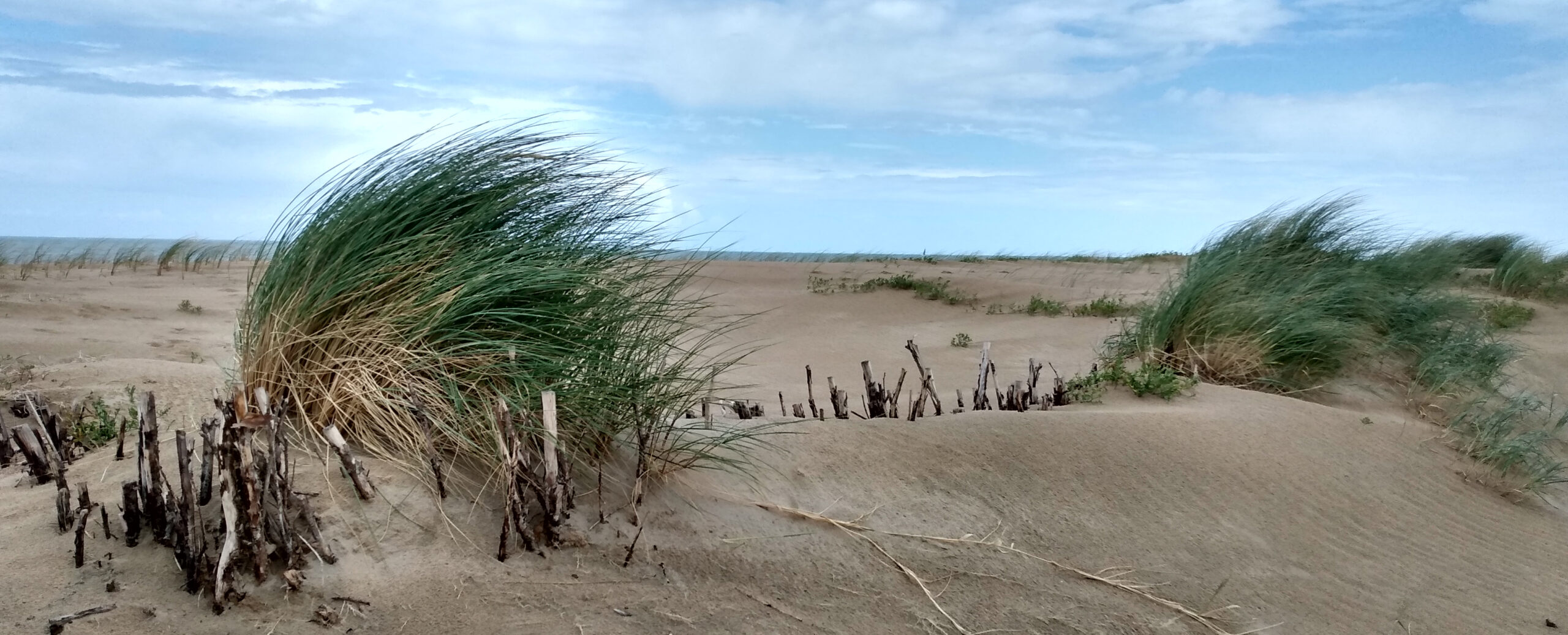
The towering dunes at Raversijde looked convincingly natural to me, with no obvious sign of engineering. But beneath them are carefully designed grids of willow (Salix spp.) branches, which were placed on the once-near-flat beach in 2021, a few months after a major sand nourishment. Within each plot, marram grass (Ammophila arenaria) was planted. The branches and grass trapped and retained sand as the wind blew. Initially, a 1-m trench was also dug between the dike and beachgrass area to act as a sand trap — but the willow branches and marram grass soon took over this role of trapping sand.
Marram grass at the dune-by-dike project at Raversijde traps and retains sand, helping the dunes grow. Image by Toon Verwaest.
While the other dune-by-dike sites were created in different ways, they all used vegetation to help establish the dunes. According to a Flemish government report, all four sites experienced “substantial accretion” of sand in the first year, which quickly established the dunes. Sand accumulation slowed down at Raversijde in the second year, likely due to “diminished sand availability” after the 2021 nourishment, as well as differing wind conditions and sand covering the marram grass, the report said. To help the dunes continue to grow, the Living Labs team replanted marram grass on the sand at the Raversijde site in 2023.
Since then, the Raversijde dunes have continued to accumulate sand, becoming self-perpetuating, similar to natural dunes. From nearly flat beach in 2021, the dunes have now reached 2.5 m (8.2 ft) tall, Verwaest told me. And he said they should keep right on growing as sea levels increase, although not necessarily matching the water’s height.
“The basic principle is to let the dune grow with sea level rise,” Verwaest said. However, he added it was also important to “maintain your coastline,” by continuing to dredge sand offshore and deposit on the beach or shoreface, not only to keep the dunes growing, but also to protect against erosion. The Flemish government typically performs beach nourishments every 5 years and spends around 8 million euros ($9.4 million) annually on these measures.
“What we have learned … is that a dune has enormous resilience,” Verwaest said. “Once you have it, you only need to combine it with coastline preservation” — meaning dredging and nourishment — “and you’re safe for sea level rise until eternity. Well, that’s a little bit exaggeration, but that’s very important to know.”
Bonte shared Verwaest’s optimistic outlook, but he acknowledged some challenges to implementing dune-by-dike systems widely. For one thing, he said dredging sand may not be the best long-term solution, as offshore sandbanks play a crucial role in protecting the Belgian coast.
“One of the advantages that we have here on the Flemish coast is that we have a very shallow coast,” Bonte said. “So we have these sandbanks, and they’re already breaking a lot of the energy of the waves.”
Toon Verwaest (left), a coastal engineer at the governmental agency Flanders Hydraulics Research; Dries Bonte (right), a spatial ecologist from the University of Ghent; and Luna the dog. Image by Elizabeth Claire Alberts for Mongabay.
The dune-by-dike project at Raversijde in November 2025. The dunes are now 2.5 m (8.2 ft) tall. Image by Elizabeth Claire Alberts for Mongabay.
Not only that, but Verwaest said there might only be about 50 years of sand left on these offshore banks for dredging purposes. Moreover, dredging and beach nourishment can negatively impact the environment, generating habitat and biodiversity loss.
There are also social barriers, according to Bonte: people who own ground- or first-floor apartments near the coast may lose their sea views. “They have to accept, in a way, that there’s no other solution,” Bonte said. “We need to communicate to them to make clear what the benefits are of the system.”
Even so, Bonte said he’s encountered strong interest from some communities eager to launch local initiatives modeled on the system. He pointed to a dune-inspired proposal that the municipality of De Panne has already presented to the city council.
As I walked along the beach with Bonte, the coastline looked fortified and healthy to my eye, with no obvious signs of erosion. Then we traversed a stretch of beach without dunes. While the beach was broad, thanks to sand nourishment, Bonte said this area — and others like it — is more vulnerable to erosion and can also generate what he called “nuisance sand.”
“It’s blowing on the tracks; it creates obstruction for tramways,” Bonte said, referring to the Kusttram that runs along the entire Belgian coast.
Coastal protection isn’t the only benefit of these engineered dune structures — they’ve also become a haven for biodiversity. Plants have colonized them, according to a report, including some pioneer species like sea rocket (Cakile maritima), rush wheatgrass (Thinopyrum ponticum) and sand oats (Avena strigosa), which are considered “rare” along Belgium’s coast. Bonte also said the dunes have attracted an array of insects, including blue-winged grasshoppers (Oedipoda caerulescens), dune tiger beetles (Cicindela hybrida) and grayling butterflies (Hipparchia semele). And while Bonte said the sites are still “too small” to attract many birds, they may one day.
The willow branch grids in an early stage of the dune-by-dike project at Raversijde. Image by Dries Bonte.
Sea rocket (Cakile maritima) growing on the dune-by-dike project at Raversijde. Image by Charlotte Taelman.
Beyond Belgium, dune-based projects are gaining momentum in the Netherlands, France, Germany and Portugal. The DuneFront initiative is studying about a dozen sites, including a dune-by-dike system in Dunkirk, France, and a mega-beach nourishment in the Netherlands called the Zandmotor (Dutch for “Sand Motor” or “Sand Engine”). Bonte said researchers are still synthesizing their findings, but he hopes the results will help inform decision-makers as they determine how best to protect Europe’s coastlines.
For Belgium, Bonte said he believes dune-by-dike systems could have what it takes to fully protect the nation’s coastlines, especially as climate change accelerates.
“I think a lot of problems are coming,” Bonte said in reference climate change, “but sea-level rise is a very tangible problem.”
“At least locally,” he told me as we stood in front of the Raversijde dunes, the wind blowing sand around our shoes, “I have the impression that we can fix things.”
Elizabeth Claire Alberts is a senior staff writer for Mongabay and was recently a fellow with the Pulitzer Center’s Ocean Reporting Network. Find her on Bluesky and LinkedIn.
Banner image: Dune-by-dike system in Raversijde, Belgium. Image by Charlotte Taelman.
Citation:
Saengsupavanich, C., Pranzini, E., Ariffin, E. H., & Yun, L. S. (2023). Jeopardizing the environment with beach nourishment. Science of The Total Environment, 868, 161485. doi:10.1016/j.scitotenv.2023.161485
Sea level rise looms, even for the best-prepared country on Earth
U.S. East Coast adopts ‘living shorelines’ approach to keep rising seas at bay