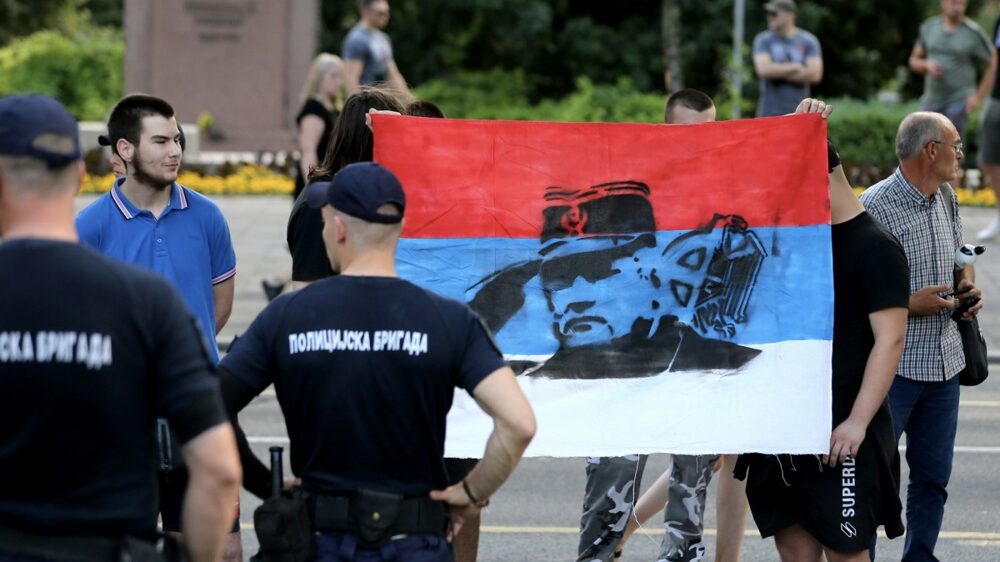
In mid-August, Matija Nikolic, a student in the southern city of Nis, was taken by police for questioning as he left a shop.
Officers asked him various questions about the protests and how they were being organised; some two-and-a-half hours into the interrogation, Nikolic said the police officers informed him they were going to take away his phone and other items he had on him; he signed a record listing the items but refused to unlock his phone or provide the unique International Mobile Equipment Identity, IMEI, number for the device.
“They were like, ‘you know we won’t return your phone if you don’t tell us’,” Nikolic said.
The phone was out of his sight for roughly 40 minutes and was returned, along with the other items, just before he left the police station.
El Sarag said it is common practice in Serbia for police to ask a person in for questioning, not as a suspect in a crime but ‘in the capacity of a citizen’, i.e. to provide information, and then pressure them to allow officers access to their phone. Often, she said, a person is reclassified as a ‘suspect’ in the course of questioning.
“The biggest mistake they make is that they don’t know that they don’t have to unlock the phone,” she told BIRN.
If a phone is confiscated, it can be kept until a case reaches its conclusion; if no charges are brought, however, the phone must be returned immediately.
Nikolic sold his, fearing it might have been tampered with, and el Sarag said it was advisable not to use a phone confiscated by the police.
“It is always recommended not to use these devices, because you just don’t know if someone put something on that phone or not,” she said, alluding to documented cases of spyware being applied to phones in Serbia belonging to journalists and activists.
Serbia’s own software, NoviSpy, is able to access call logs, contacts and SMS messages, as well as track the phone’s location, make screenshots and activate the device’s mic and camera.
Another individual BIRN spoke to described being taken in for questioning and his phone being removed.
Even though his lawyer had not arrived, the man said he was questioned by two inspectors while his phone was on the table in front of him, turned off. At one point, he recalled, one of the officers “nonchalantly” picked up the phone and left the room with it.
“He took the phone, put it in his pocket and went outside,” he said. The officer returned, but left again with the phone on at least two more occasions.
The officers said nothing about the phone, which the man did not have access to for roughly 40 minutes. After his lawyer arrived, the man was released.
Serbia’s interior ministry did not respond to a request for comment.