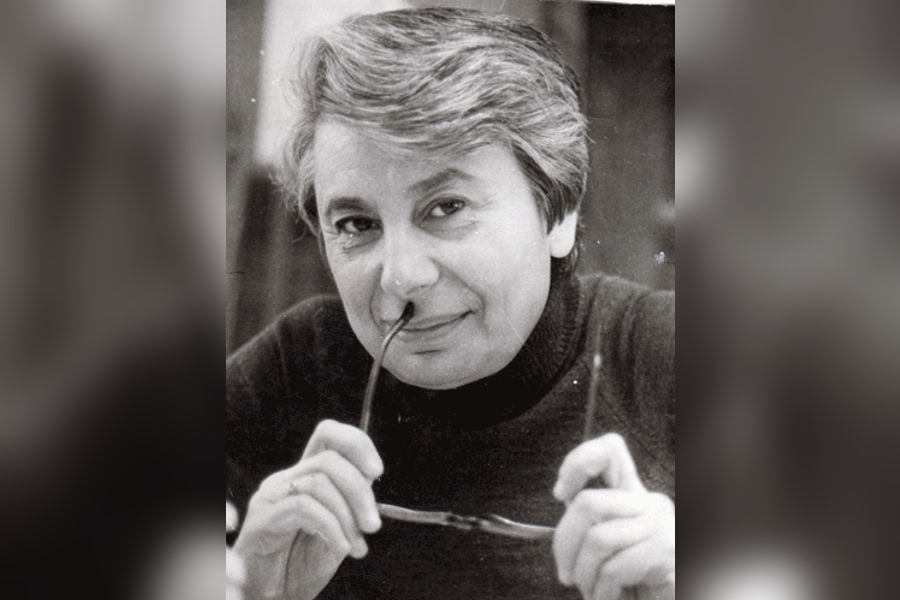
Brilliant figures such as Sergey Nikitovich Mergelyan (1928-2008) defined the 20th century as an era for extraordinary mathematical discovery. Mergelyan was best known for his contributions to approximation theory, especially Mergelyan’s theorem, and became the youngest person in the Soviet Union to earn a doctorate of science in mathematics.
Beyond pure theory, he played a pivotal role in founding the Armenian school of computer science and in developing the first Soviet semiconductor-based computers. His career uniquely bridged abstract mathematics and applied sciences.
Born 1928 in Simferopol, Crimea, Mergelyan came of age during a period of political and social unrest in the Soviet Union. His father, a railway worker, was deported during Stalin’s purges, forcing the family to relocate to Armenia during World War II. Although Mergelyan faced hardships in his early life, he continued to display a remarkable aptitude for mathematics.
At just 16, he enrolled at Yerevan State University, completing a five-year curriculum in only three years. His achievements quickly attracted the attention of leading Soviet mathematicians. In 1947, he was accepted to the Steklov Institute of Mathematics in Moscow, then a leading center for mathematical research in the USSR. Under the mentorship of Mstislav Keldysh, Mergelyan began his groundbreaking work in complex approximation theory.
Approximation theory before Mergelyan
What is approximation theory? It concerns the problem of representing complex or irregular functions using simpler, more easily computed objects. According to the University of Manitoba’s mathematics department, the field studies how functions, curves and surfaces can be approximated using various mathematical tools, with applications ranging from signal processing to image compression.
The field traces its roots to the 19th century, most notably with the Weierstrass approximation theorem (1885), which showed that any continuous function on a closed and bounded interval can be uniformly approximated by polynomials. In Russia, mathematicians such as Pafnuty Chebyshev further advanced uniform approximation theory. Later contributions by Andrei Markov and Sergei Bernstein extended approximation methods under specific constraints.
However, extending these ideas to functions of a complex variable posed major challenges. The question of whether every continuous function on a compact subset of the complex plane could be approximated by polynomials remained unresolved. Partial results had been obtained by Bernstein and M.A. Lavrentiev, but the complete solution was missing.
Mergelyan’s theorem
Between 1947 and 1951, Mergelyan resolved this problem by proving what is now known as Mergelyan’s theorem.
Theorem (Mergelyan, 1951): Let K be a compact subset of the complex plane C with connected complement. Then, every function f that is continuous on K and holomorphic* in its interior can be approximated uniformly on K by polynomials.
For additional context, a holomorphic function is a complex-valued function that is complex-differentiable in a neighborhood of every point in its domain.
Mergelyan’s result provided a complete characterization of when uniform polynomial approximation is possible in complex analysis. It subsumed earlier results as special cases and opened the door to later developments in harmonic analysis and several complex variables.
The theorem was significant because it generalized the Weierstrass approximation theorem to complex functions and established precise conditions under which polynomial approximation holds.
In recognition of this work, Mergelyan received the Stalin Prize in 1952 and defended his dissertation at age 20, becoming the youngest doctorate recipient in Soviet history.
Soviet computing
In the mid-1950s, Mergelyan made a dramatic shift toward computer science. In 1956, he was appointed director of the Yerevan Scientific Research Institute of Mathematical Machines (YerNIIMM) by Armenian physicist Viktor Ambartsumian. Though trained as a pure mathematician, Mergelyan proved to be a visionary organizer and scientific leader.
Under his direction, YerNIIMM became a major contributor to Soviet computing. The institute initially worked on the Moscow-developed M-3 computer, but soon began producing original designs, including the Aragats and Razdan series, named after Armenia’s highest mountain and second-longest river, respectively.
The Razdan-2, completed in the early 1960s, was especially notable as the first Soviet computer fully based on semiconductor devices rather than vacuum tubes. A semiconductor device can act as both a conductor and an insulator of electricity, depending on operating conditions.
This technological shift aligned Soviet computing more closely with developments in the West during the Cold War era.
YerNIIMM eventually employed thousands of scientists and engineers and emerged as one of the USSR’s leading computing centers.
Today, it is known as the Mergelyan Institute.
International recognition and later works
After his leadership in Soviet computing, Mergelyan eventually returned to pure mathematics, continuing research in approximation theory, harmonic functions and boundary value problems. He also held senior administrative roles, including vice president of the Armenian Academy of Sciences.
Despite political constraints of the Soviet era, Mergelyan received international recognition. During a visit to the United States in 1959, he met Norbert Wiener, who praised his work in approximation theory. He later spoke at the International Congress of Mathematicians in 1970. His reputation remained strong in both Eastern and Western academic circles throughout the Cold War.
Legacy
Mergelyan’s contributions to pure mathematics remain foundational to complex approximation theory and are taught in graduate programs worldwide. At the same time, his work helped lay the foundations for computing in Armenia and the broader post-Soviet region.
His life exemplifies intellectual versatility — a mathematician who moved seamlessly between theory and application without diminishing either. Mergelyan stands as a model of how abstract thought can directly shape technological progress.
Though his name may not be as widely recognized as figures like Pythagoras or Fibonacci, Sergey Mergelyan occupies a central place in modern complex analysis. His influence extended far beyond academic journals, shaping both mathematical theory and technological infrastructure.
Mergelyan left a lasting mark on both mathematics and society’s technological infrastructure. For Armenians in Armenia and the diaspora, he remains an inspirational figure in the fields of mathematics and applied science.
His career stands as enduring proof that mathematics thrives at the intersection of theory and application — and that a small nation has produced thinkers whose contributions rival those of more widely celebrated names.