- The number of people killed by flash floods after Cyclone Senyar made landfall over Sumatra on Nov. 26 increased to 1,059 on Dec. 18. In Pidie Jaya district, on the north coast of the semi-autonomous region of Aceh, officials assigned a team of four rescue elephants, veterans of the recovery operation after the 2004 Boxing Day tsunami that killed more than 200,000 people in Aceh.
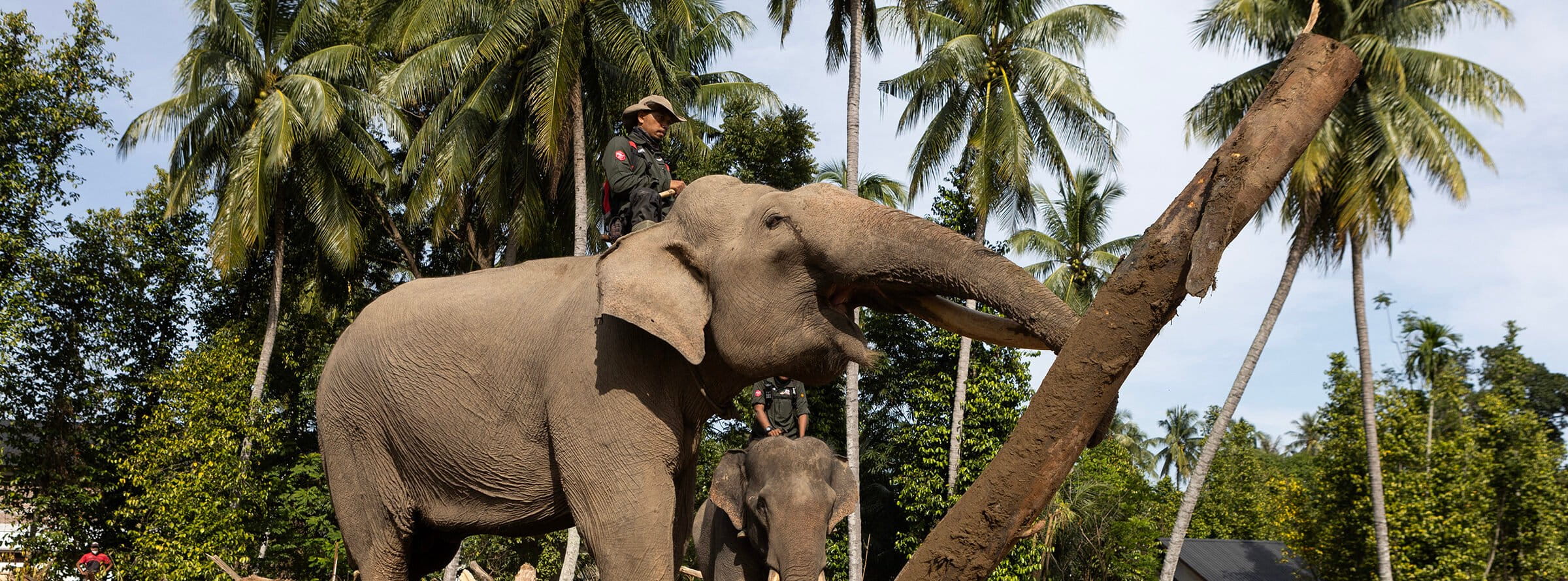
- The Aceh conservation agency said the elephants were uniquely able to help remove fields of logs carried down valleys by the worst flash floods to hit the region in years, with the scale of debris fields impassable to heavy machinery.
- “They are trained and experienced elephants,” the head of Aceh’s conservation agency told Mongabay, while emphasizing that officials went to great lengths to ensure the Sumatran animals’ welfare.
- At least one Sumatran elephant was presumed killed in flash floods caused by Cyclone Senyar, after residents in a village neighboring the rescue elephants’ workplace discovered the animal’s body Nov. 29.
See All Key Ideas
PIDIE JAYA, Indonesia — A group of specialist Sumatran elephants have joined recovery operations in Aceh following the catastrophic landfall of Cyclone Senyar in late November — two decades after the veteran responders supported rescuers after the 2004 Boxing Day tsunami.
“They’re guided by mahouts who know very well the characteristics of the elephants,” said Ujang Wisnu Barata, head of the Aceh conservation agency, the BKSDA.
Rescuers in Indonesia’s westernmost region seconded the experienced squad of four to clear heavy debris in the coastal district of Pidie Jaya in semiautonomous Aceh, as recovery operations continued for a third week across much of the north and west of Sumatra Island. Many affected villages remain cut off due to extensive debris and landslides.
Cyclone Senyar arrived over northern Sumatra in the early hours of Nov. 26 with 3-hour precipitation accumulation exceeding 130 millimeters (5 inches), meteorology data showed, which is more rain in three hours than the U.K. usually receives through its wettest month of the year.
The number of people killed here in Pidie Jaya district stood at 29 on Dec. 18, with the total death toll rising to 1,059 people across three provinces (Aceh, North Sumatra and West Sumatra) amid the worst disaster to hit Indonesia in years.
Male elephants Abu, Ajis and Midok, working together with Noni, a female Sumatran elephant (Elephas maximus sumatranus), received the assignment in Pidie Jaya district from their base at the Saree Elephant Training Center, which is located in nearby Aceh Besar district.
A community settlement in Pidie Jaya district destroyed by flooding. Image by Junaidi Hanafiah/Mongabay Indonesia.
The heavyweights have accumulated extensive experience in humanitarian operations, local authorities said, including time combing through the devastation after the 2004 tsunami killed 170,000 people on the west coast of Aceh.
Abu, Ajis, Midok and Noni spent days in areas of Meureudu in Pidie Jaya subdistrict, removing heavy debris, mostly timber, from residential areas and enabling vehicle access to the disaster zone.
“They’ve been tasked with pulling large logs stuck in residents’ homes and opening up roads blocked by floodwater,” Ujang told Mongabay Indonesia, adding that the elephants were able to access debris fields beyond the reach of heavy machinery.
Captive elephants were routinely put to work in infrastructure and military operations by the Aceh Darussalam Sultanate, which ruled this western region of Sumatra Island from the late 15th century until Dutch colonial invaders annexed Aceh in 1903.
“Elephants were used to break through enemy defenses, destroy gates and exert psychological pressure in ground combat,” said Iskandar Norman, an Acehnese writer.
Ahmad Faisal Pasaribu, Pidie Jaya district police chief, said the elephants possessed needed technical skills to expedite the recovery operation and had provided some therapeutic support to children struggling to comprehend the destruction around them.
“Their presence brings joy and it lowers the tensions,” Ahmad said.
However, contemporary employment of animals, even in humanitarian emergency, presents ethical challenges, a factor acknowledged by the conservation agency in Aceh and Daniel Johan on a parliamentary committee overseeing forestry. Daniel has emphasized the elephants’ status as a protected species.
“We care deeply about their welfare,” conservation agency lead Ujang said.
Tame Sumatran elephants were brought in to help clean up flood-affected residential areas in Aceh’s Meunasah Bie village. Image by Junaidi Hanafiah/Mongabay Indonesia.
This tame Sumatran elephant has extensive experience in humanitarian operations. Image by Junaidi Hanafiah/Mongabay Indonesia.
Tusk-oriented
The interior of Pidie Jaya where Senyar made landfall over Sumatra on Nov. 26 is home to a large population of wild Sumatran elephants. Around 40% of the remaining Sumatran elephants are believed to live in forests here in Aceh.
The most recent assessment by the Indonesian Elephant Conservation Forum (FKGI), which Mongabay obtained in 2022, estimated a total remaining wild population of 924-1,359 Sumatran elephants. Although, that is based on field surveys conducted two decades ago.
Anecdotal testimony backed by records of elephant killings show human-elephant conflict with Sumatran elephants is growing in Aceh amid habitat loss for agricultural and plantation land.
In 2024, Mongabay reporting from Aceh’s Peusangan River Basin, around 60 kilometers (37 miles) southeast of Meureudu, revealed farmers were installing high-voltage electric fences to prevent elephants accessing human settlements and farmland.
In February, Mongabay Indonesia reported on the death of an elephant caught in an electric fence in Aki Neungoh village, an hour’s drive from the scene where the four rescue elephants were helping to open access roads.
The catastrophic flash flooding has killed more than 1,000 people, injured at least 7,000 and destroyed almost 200,000 homes.
Cyclone Senyar has also impacted the Leuser ecosystem in Aceh, home to elephants, orangutans, rhinos, tigers and sun bears. Primatologists also fear damage in South Tapanuli district may have wiped out a subpopulation of Tapanuli orangutans (Pongo tapanuliensis), the world’s most endangered ape, after one of the animals was found dead from a landslide.
Climate change will likely make tropical cyclones less frequent but more intense in the future, climatologists say.
The welfare of elephants remains paramount as they help transport wood left over from the flood. Image by Junaidi Hanafiah/Mongabay Indonesia.
A rice field covered in mud due to flooding in Meurah Dua, Pidie Jaya. Image by Junaidi Hanafiah/Mongabay Indonesia.
Coverage in Indonesia of the heavy lifting carried out by rescue elephants Abu, Ajis, Midok and Noni has also pointed to a telling case of deforestation destroying elephant habitat and likely worsening flash flooding, while the same animals are supporting communities recover from a disaster possibly fueled by land use change.
“The area where the elephants cleared the wood waste was impassable by heavy equipment,” said Hamdani, who stood with her three children near a home under a meter of mud carried down from the upland. “The wood was so large it couldn’t be lifted by hand.”
At least one Sumatran elephant was killed in flash floods caused by Cyclone Senyar. Local residents discovered the body of an elephant face down in mud surrounded by logs in Meunasah Lhok, a neighboring village to the site where the four rescue elephants worked to remove logs and debris.
Banner image: The presence of Sumatran elephants is intended to help transport wood left over from the flood. Image by Junaidi Hanafiah/Mongabay Indonesia.
This story was first published here in Indonesian on Dec. 11.