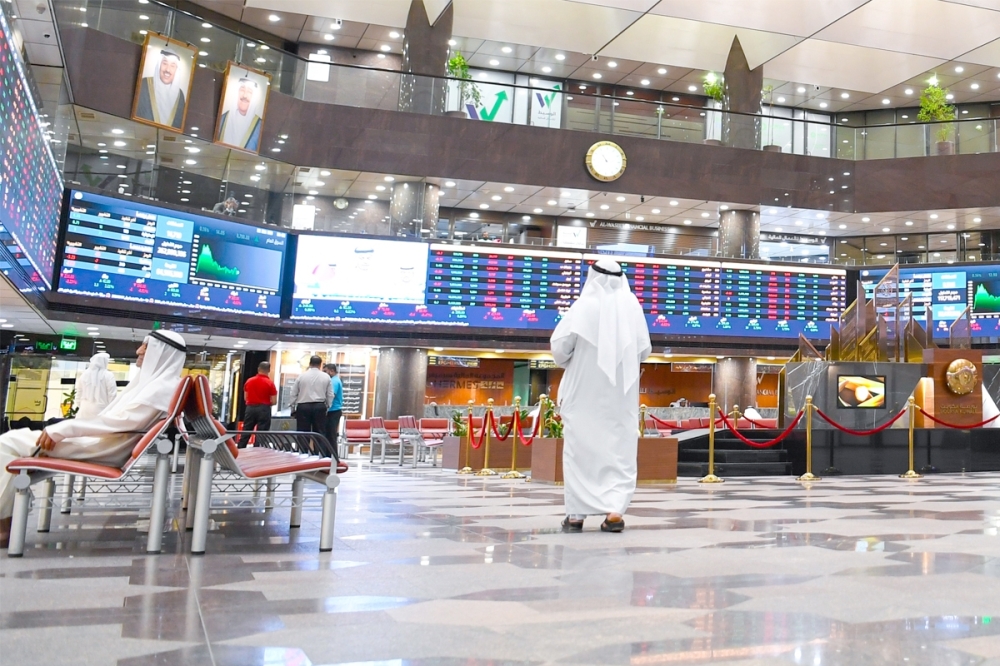
The Kuwait Stock Exchange (KSE) closed the week with a negative performance across all indices, losing approximately 679.6 million dinars in market capitalization, which fell to 53.28 billion dinars from 53.96 billion dinars at the previous session on the 11th of this month, a decrease of 1.25 percent.
The First Market Index declined by 1.69 percent (164.8 points), while the Main Market Index fell by 0.62 percent (51.64 points), resulting in an overall market index drop of 1.5 percent (137.2 points), reports Al-Jarida daily.
Traded liquidity also fell 10.9 percent to 468.2 million dinars, compared to 525.6 million dinars in the prior week, with the First Market accounting for 70 percent of liquidity. Trading volumes decreased 25.9 percent to 1.621 billion shares, and the number of transactions dropped 15.6 percent to 103,184.
In the final session of the week, the KSE underwent its last annual review by Standard & Poor’s and FTSE Russell, which resulted in collective gains for the indices despite fluctuations throughout the trading period.
Liquidity during the session rose to 108.8 million dinars, up 35.1 percent from the previous session, with the First Market representing 78 percent of trades.
Among sector performances, energy led gains with a 2.56 percent rise, followed by basic materials at 0.75 percent. Conversely, the technology sector fell 1.44 percent, and consumer services declined 0.89 percent, while utilities remained stable.
Top-performing stocks included Al Khaleej (+9.98%), Al Mu’addat (+9.91%), Nabisco (+8.27%), Hotels (+7%), and Aayan (+5.68%), while leading decliners were Arabiya (-6.01%), Osool (-5.49%), Portland (-5.11%), Tamdeen A (-4.14%), and Upack (-3.47%).
In terms of value, Kuwait Finance House (KFH) topped trades at 16.9 million dinars, followed by National Bank of Kuwait (NBK) at 16.6 million dinars, Warba Bank 5.1 million dinars, Aayan 4.9 million dinars, and Gulf Bank 3.9 million dinars.
The week highlighted a mixed performance across the market, with some notable stock gains offsetting broader declines, signaling cautious investor sentiment heading into the year-end review.