Why did they let him be showered with hugs and birthday wishes? They mocked him in front of the entire country. / Granma
The president used quotes from Fidel Castro to denigrate the person who was his right-hand man in the government.
Por Yunior García Aguilera (14ymedio)
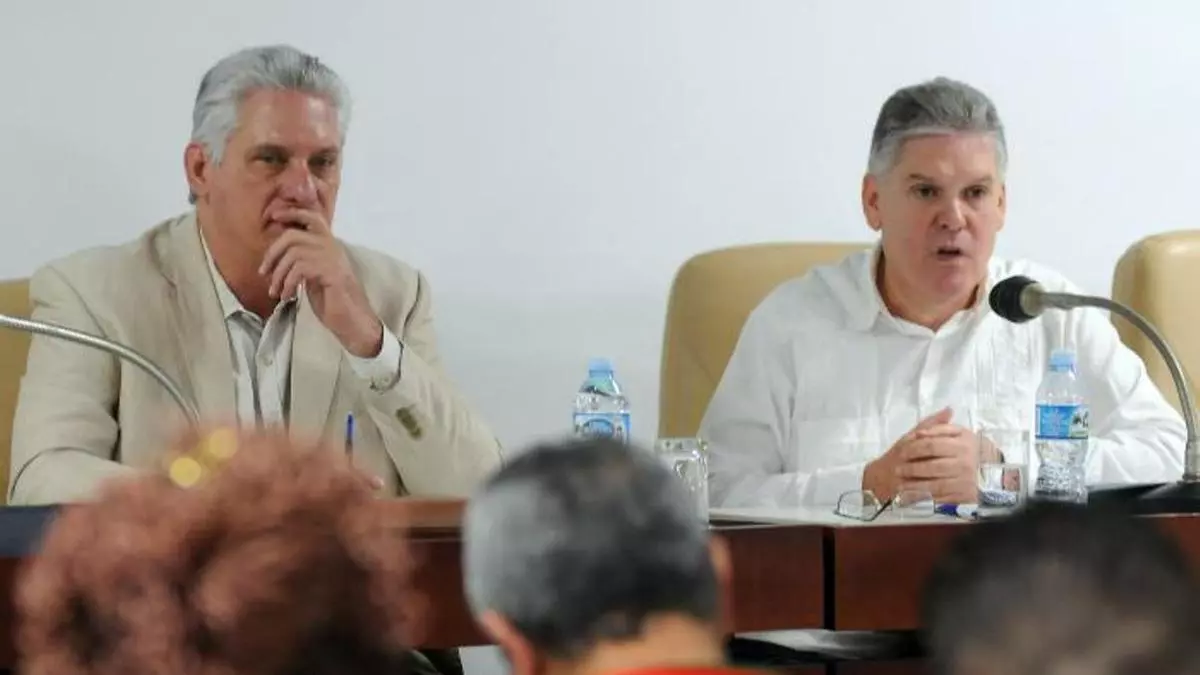
HAVANA TIMES – At the recent meeting of the Communist Party Central Committee, Miguel Diaz-Canel had a privileged opportunity to offer explanations about one of the biggest political and judicial scandals of his government: the life sentence for espionage, in addition to a 20-year sentence for other crimes, that a court has just imposed on his former Minister of Economy, Alejandro Gil.
But instead of detailing facts, responsibilities, failed control mechanisms, or institutional lessons, the president chose a different path. With evident dyslexia, he read five paragraphs of moralizing rhetoric, quotes from Fidel Castro, and metaphors about traitors and patriots. The result was a speech laden with adjectives but devoid of concrete information about how and why one of the men he trusted most ended up becoming, in his view, a “great traitor.”
The close relationship between Díaz-Canel and Gil was also evident in the academic sphere. The president was the principal advisor for the then-Minister of Economy’s doctoral thesis. This endorsement implied a bond of trust and made Diaz-Canel the intellectual guarantor of Gil’s economic vision. That same thesis has been cited by critics and relatives of the former minister as a symbol of the extremely close relationship between the two.
For years, Gil was the public face of Díaz-Canel’s government’s economic policy and one of its most highly promoted figures. Even after his dismissal, the president showered him with praise and public embraces. However, he then agreed to serve as a prosecution witness during the closed-door trial against the former deputy prime minister.
And now, in the Communist Party meeting, he presented Gil as the prototype of those who “sell out the nation.” This abrupt shift only holds up if the official narrative manages to isolate the case, transform it into an individual moral drama, and avoid any difficult questions about the political responsibility of the inner circle that elevated him. This is where the phrases Diaz-Canel chose for his speech, and their underlying subtext, come into play.
The president began to paint a picture of Gil without naming him: “There appear those who profit from needs and shortcomings, those who obstruct the path and delay progress, and others capable of selling out the nation that once elevated them to the highest offices.” Diaz-Canel is attempting to reinforce Gil’s image as an internal enemy, shifting the discussion from the technical-economic sphere to absolute morality. There is no talk of design flaws, but rather of “those who obstruct the path,” as if the system were a smooth highway and the problem were simply a fallen tree trunk.
Díaz-Canel, aware of his limited authority, immediately invokes the late Fidel Castro: “The enemy is well aware of the weaknesses of human beings in their search for spies and traitors.” On the surface, the message points to the enemy, more than external, the eternal CIA, but at the same time, it erases any personal responsibility by praising the “capacity for sacrifice and heroism” of the majority (among whom he seems to include himself). The system, he repeats, is not the problem; the problem is the rotten potatoes.
Fidel’s second quote is even worse, speaking to us of the Revolution as a great battle that teaches us who are “those who aren’t even good enough to fertilize their land with their blood and their lives.” We all witnessed how some Castroist fanatrics, including those on the program ” Con Filo,” campaigned for Gil’s eventual execution. And now Diaz-Canel insinuates that his former friend wasn’t even good enough to waste the bullets of a firing squad on.
Even so, Díaz-Canel didn’t hold back his verbal attacks against Gil, bluntly lumping him in with those “made of selfishness, ambition, disloyalty, betrayal, or cowardice.” While reciting this catalog of vices, the television cameras focused on Humberto Lopez, a star propagandist and master of the stage, who was also close to the ousted former minister.
The third image of the late Castro completes the operation: “In a revolution, everyone has to take off their mask; in a revolution, the altars collapse. Those who have tried to live by deceiving others, those who have tried to live posing as virtuous or posing as decent people, or posing as patriots, or posing as brave. That is what the Revolution teaches us, it teaches us who the true patriots are, and where the great traitors come from.”
This clip is the closest thing I’ve ever seen to a fit of rage. Diaz-Canel is portraying himself as a fooled husband, ridiculed by all his colleagues. How could the powers that be have let him make a fool of himself for so long? If they already knew about Gil’s infidelities, why did they let him mentor him, thank him on Twitter for his efforts, promise him new tasks, shower him with hugs and birthday wishes? They mocked him in front of the entire country.
After this indulgence in Fidel’s rhetoric, Díaz-Canel concludes: “I don’t think there are more accurate phrases to describe the actions of Alejandro Gil, from whose disgraceful case we must draw experiences and lessons, making it clear, first of all, that the Revolution has zero tolerance for such behavior.”
Here, finally, the former minister’s name appears, but only to fit into the already constructed category: traitor, selfish, ambitious, disloyal. Gil doesn’t exist as a political actor with concrete decisions, but rather as an abstract synthesis of all the vices enumerated.
What doesn’t appear in any of these paragraphs is what many “revolutionaries” were hoping to hear: how the alleged spy network was discovered, which structures were compromised, which control mechanisms failed, who was politically responsible for keeping him in office for so long, or what guarantees exist that there aren’t other “little altars” still standing. Diaz-Canel, like a priest on Sunday, turns the case into a moral lesson and a disciplinary warning to the apparatus.
The toxic relationship between Gil and Diaz-Canel, after this speech, takes on the air of a soap opera. The relentless persecution of the convicted man, the opacity surrounding the case, the attempt to isolate and silence the family, and the lack of clarification in the Communist Party session demonstrate that, more than “zero tolerance,” what abounds is “zero transparency.” Díaz-Canel’s speech was the typical lament of a betrayal. All that was missing was the stab in the back behind closed doors, without anyone noticing.
Translated by Translating Cuba.
Read more from Cuba here on Havana Times.