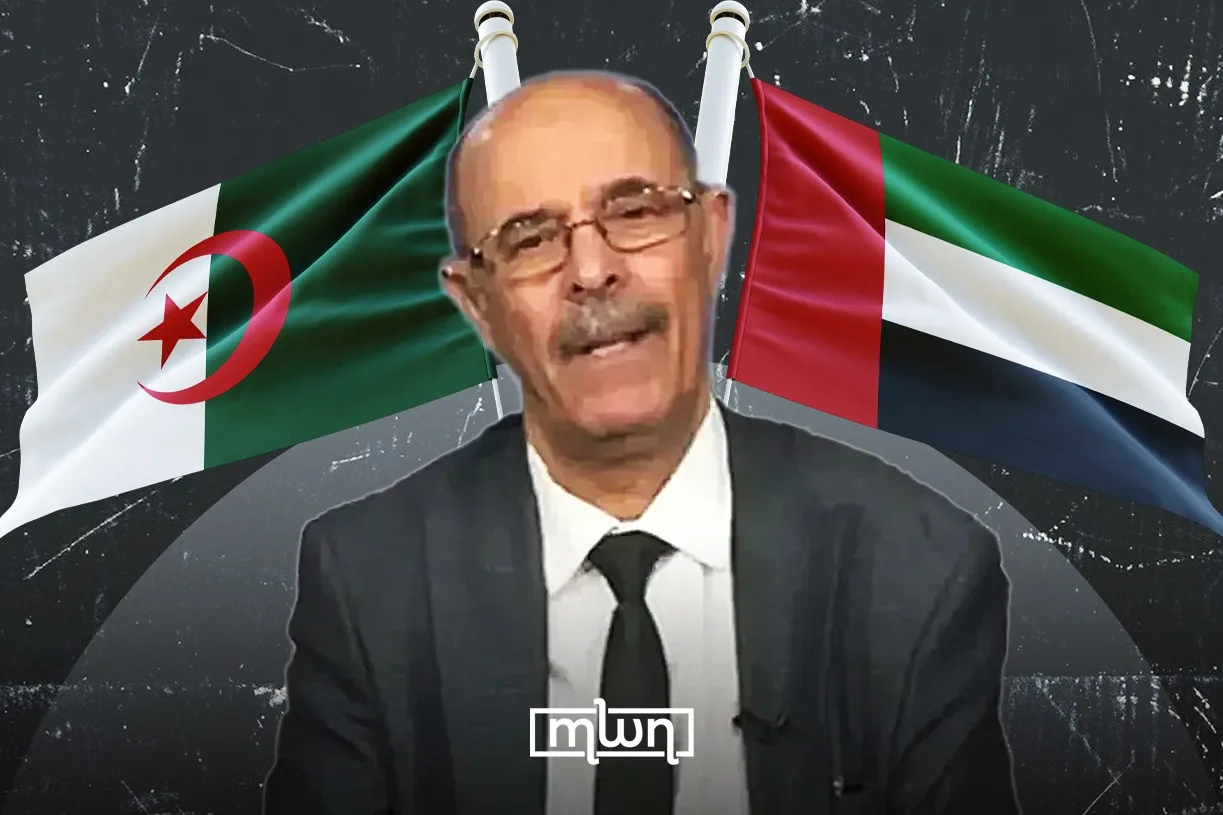
Marrakech – Algerian President Abdelmadjid Tebboune has granted a full presidential pardon to controversial historian Mohamed Amine Belghit, abruptly ending the remaining portion of his prison sentence after a case that exposed deep contradictions within Algeria’s state-managed identity politics and its increasingly erratic diplomatic posture.
In a statement issued Monday, the Algerian presidency announced that Tebboune had signed a decree granting Belghit a total remission of his remaining sentence. The decision comes barely weeks after Algeria’s Supreme Court rejected Belghit’s appeal, rendering his conviction final and underscoring the suddenness – and political nature – of the pardon.
Belghit had been sentenced in October by the Algiers Court of Appeal to five years in prison, including three years served and two suspended, on charges of “undermining national unity” and “inciting racial hatred.”
His prosecution followed widely circulated remarks made during a May interview with Sky News Arabia, in which he described Amazigh identity and language as a “Franco-Zionist ideological project” – statements that ignited nationwide outrage and reopened long-simmering fault lines over Algeria’s indigenous identity.
This denunciation of Amazigh identity did not emerge in a vacuum; it echoed decades of institutional denial, historical revisionism, and the systematic marginalization of Algeria’s indigenous plurality.
His imprisonment was thus not about justice. It was instead about damage control once the rhetoric spilled beyond the regime’s comfort zone and detonated diplomatically, particularly with the UAE.
The case quickly evolved from a judicial matter into a diplomatic embarrassment. Belghit’s comments, broadcast on an Emirati channel, coincided with a sharp deterioration in Algeria-UAE relations, triggering a hostile media campaign by Algerian state outlets and culminating in unusually aggressive rhetoric against Abu Dhabi.
What the Algerian authorities initially framed as a defense of “national constants” soon became an uncontrollable liability – internationally humiliating and internally destabilizing.
A pardon that admits failure and confusion
Algeria’s decision to pardon is not an act of clemency. It is a confession of incoherence, of strategic panic, and of a regime trapped in the contradictions of its own ideological engineering.
After elevating an anti-Amazigh polemicist into a mouthpiece of state orthodoxy, the Algerian presidency now retreats, abruptly and unconvincingly, from a crisis it carefully staged and spectacularly mishandled.
Belghit himself was hardly an outsider. Long promoted by regime-aligned media, he functioned for years as an unofficial custodian of a rigid, exclusionary historical narrative that denied Amazighity as a foundational component of Algerian identity.
Belghit was never a rogue intellectual. He was a regime-produced artifact. Once nurtured by state media, he was recycled through official platforms and deployed to police identity debates in line with Algeria’s arabo-Islamist monoculture.
His sudden incarceration merely exposed a familiar Algerian paradox: a state that manufactures ideological hardliners, deploys them to enforce orthodoxy, and then disowns them the moment their discourse backfires.
The presidential pardon now completes this cycle of contradiction. Far from signaling reconciliation, the move reads as an implicit admission of political miscalculation – an attempt to quietly defuse a crisis that the authorities themselves helped create.
The timing suggests a regime eager to retreat from the diplomatic and symbolic costs of a case that laid bare the fragility of Algeria’s identity management and the volatility of its foreign policy reflexes.
For critics, the episode reinforces the perception of an Algerian state oscillating between authoritarian bravado and strategic retreat, punishment and absolution, without coherent principle. In this reading, Belghit’s release is less an act of mercy than a tactical disengagement. Ultimately, it is an acknowledgment that the spectacle had become unsustainable.
Identity governed through fear
Some observers read the Belghit pardon as part of a broader pattern of selective retreat. They saw a regime stepping back, not out of principle, but when the political cost of stubbornness started to outweigh the performative value of repression.
The most recent precedent is the Boualem Sansal affair, where Algeria ultimately granted clemency after a direct request from German President Frank-Walter Steinmeier, explicitly framed on “humanitarian” grounds and tied to Sansal’s age and health, with Germany expected to facilitate his transfer for medical treatment.
But Sansal’s case mattered for more than humanitarian optics. The prosecution itself revolved around historical and territorial narration: Sansal had publicly argued – most controversially in French media – that colonial France reconfigured borders in ways that benefited what became Algeria, including facts that portions of western Algeria were historically Moroccan territory before French rule.
Algerian authorities treated this not as a disputable historical argument but as an attack on the state’s territorial integrity and “national unity,” turning a debate over pre-colonial geography and colonial boundary-making into a national-security file.
That is what makes the pardon politically legible: it did not erase the regime’s underlying logic – it simply acknowledged, belatedly, that carceral sovereignty has diminishing returns when it starts to contaminate foreign relations and amplify international scrutiny.
In other words, the state did what it often does best: it escalated to demonstrate firmness, then pivoted to clemency when, amid already brittle ties with France and a wider climate of external pressure, the case became diplomatically expensive and strategically unbearable.
Tamazight, recognized as an official language in Algeria since 2016, remains at the center of this unresolved tension. And Belghit’s case, now quietly shelved, leaves behind a deeper question the pardon does not answer: whether Algeria is prepared to confront its plural identity honestly – or will continue governing it through denial, coercion, and sudden reversals.
Read also: Algeria’s Vindictive Passport Revocation Targets Released Writer Boualem Sansal