What unfolded in Tezpur University these past months was not a routine campus disturbance caused by cars that never slow down even after hitting a student, or by a group of girls having tea and daring to question the absurdity of the in-time rule, or by yet another Assistant Registrar applicant walking out of his interview already knowing the posting would go NFS this year too.
What happened inside Jyoti–Toran this time, in a campus built on the land once shaped by Xoinik Xilpi Bishnu Prasad Rabha, was a full-scale reckoning. A reckoning against years of administrative arrogance, unchecked corruption, ideological intrusion, unaccountable decision-making, and a Vice Chancellor who treated a Central University like his personal empire.
Under the current absconding Vice Chancellor, TU did not merely decline; it decayed. He neither understood Assam nor cared to understand the students who form the backbone of this institution- students whose parents drive e-rickshaws, run tea stalls, or work multiple shifts so that their ward can dream beyond their circumstances. For them, education is not a privilege but a generational sacrifice.
And it is precisely these students that the corrupt Vice Chancellors of this University, and their entire teams (remember, not much team change happens; just the captain changes) have allegedly failed.
For years, long before the absconding VC took charge at Patna University, TU endured an atmosphere where dissent was punished, academic and campus freedom quietly contracted, and the administration perfected a culture of fear so deeply internalised that students hesitated even to step into certain rooms.
The admin building felt less like a centre for student service and more like a bureaucratic fortress. The suffocating “Sir-Sir-Sir” culture, the coldness of officials, the endless loops of paperwork for the simplest tasks, the everyday humiliations that students had to swallow; none of these were aberrations. They were the norm.
Corruption was never going to be easy to prove in a central university because the system is engineered to protect itself with vouchers that appear spotless on paper, commissions disguised as routine expenditure, decisions taken off the record, and buried in files.
But what exists beyond these white papers is an opportunity to visit the campus, where you will never see a match between what has been spent and the quality you get. The last thing you would worry about, in a campus, is to deal with everyday water crises, lack of enough Internet to work or inconsistent power to switch on your laptops.
However, these are now a regular occurrence at a University that aspires to be one of the top 50 in the world. Notably, it’s no longer within the Top 50 in the country.
Students were expected to obey, not question. They paid fees nearly equivalent to low-tier private universities but got in return silence, surveillance, and a suffocating bureaucratic machinery.
Even the ₹1,000 fine for a single day’s delay in fee payment, generally without a receipt, became symbolic of how TU operated: harsh on students, opaque about its own workings.
The decay was not just administrative. Under the current absconding VC, ideological policing seeped into campus life. A university that should celebrate pluralism was nudged into selective cultural assertion. Lighting a diya during the Ram Mandir celebration was encouraged, while many other festivals and cultural expressions were quietly curtailed.
Hinduism is, in truth, too expansive, too philosophical, too contradictory to be flattened into the narrow version projected through political Hindutva. Yet that narrowness found a willing custodian in the VC’s office. TU slowly began to feel less like a university and more like an ideological construction site.
Amidst all this, tragedies happened. Even students had died. Hostels grieved. And the very next day, the campus returned to normal as if nothing had occurred. No searching for accountability. No institutional introspection. No willingness to confront the rot.
Instead, the administration sanitised the narrative, polished its social media pages, and returned to its obsession with showcasing “achievements.” Window dressing and Press Management became the dominant management philosophy. Real issues were tucked away behind photographs of events that served no purpose for the students who paid for them.
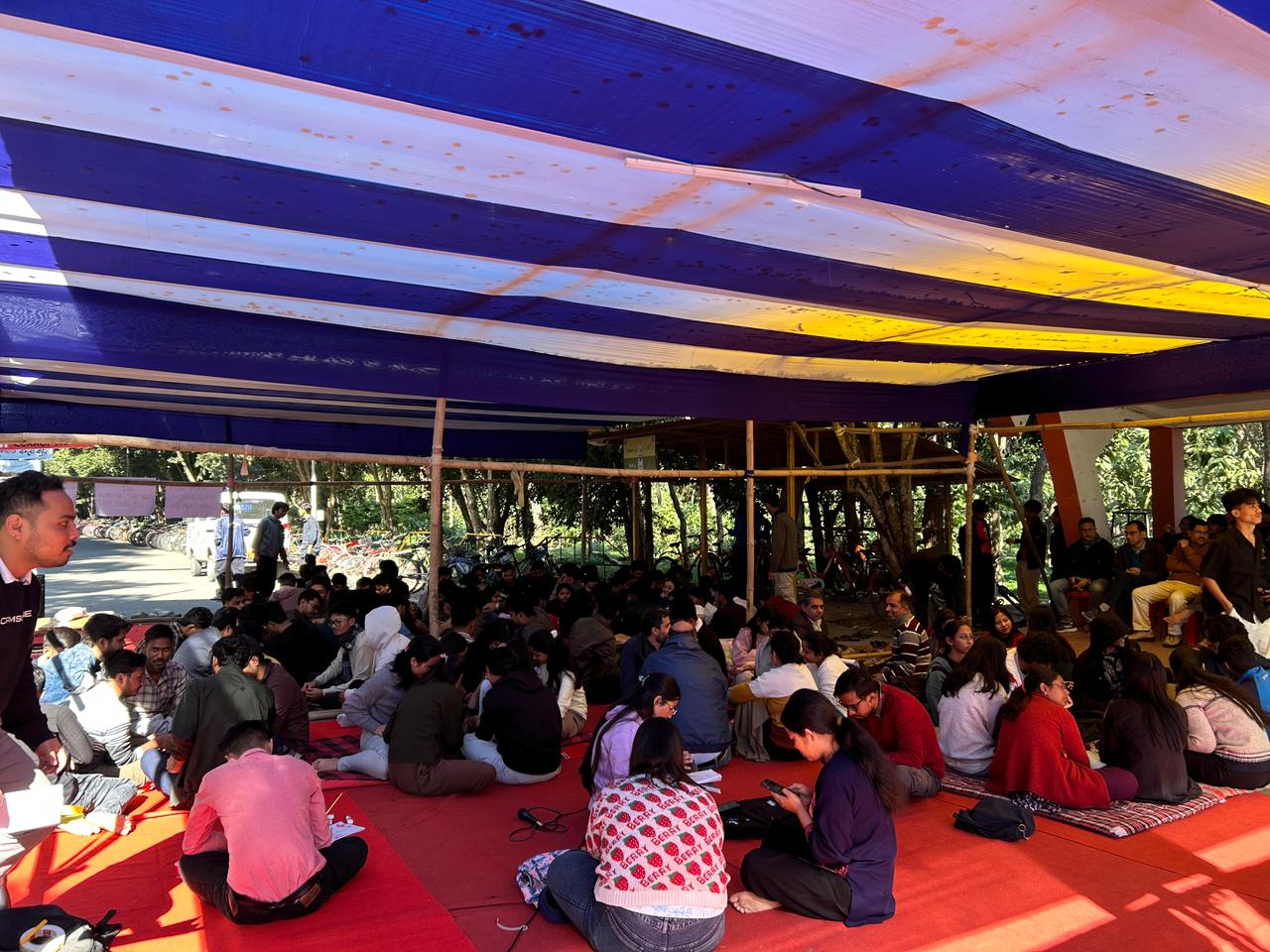
But something shifted. Fear, when stretched beyond its limit, breaks. What began as scattered frustration slowly crystallised into a collective awakening. TU finally erupted. Not recklessly, not chaotically, but with precision and clarity. It was not about politics; it was about dignity. It was not about individual grievances; it was about reclaiming a university that had forgotten it was a university.
And in that eruption, something remarkable happened: TU rediscovered its voice. Students who once whispered began to speak without trembling. Those who avoided the admin building stood outside it, demanding transparency.
Students who had been isolated in their grievances realised they were not alone. The protests did not divide the campus; they united it. They broke through departmental boundaries, community lines, and hostel identities. In short, “A campus that had long felt dead began to breathe again.”
The administration responded with fear because it finally understood what unity looks like. In a recent visit by the Joint Secretary, a full force deployment was done, as though students were an enemy to be neutralised. But not a single student lost composure. Not a single reckless act occurred.
The contrast revealed everything: authority required force; students were already a force. The force lacked female officers, and the female students of the university, who always had to sign while entering the campus even 1-minute late than their in-time, stood all strong and firm as the first line of defence, below the Jyoti-Toran.
When uniformed men stand ready for confrontation, and the students facing them remain calm, grounded and unshaken, the world can see clearly who possesses control over themselves and who does not.
There are still those who claim the protests damaged TU’s image. They are wrong. TU’s image had already been corroded by years of suppression, mismanagement, and administrative decay. What students initiated was not image destruction; it was image correction.
A university that hides suicides but advertises conferences is not respectable. A university where complaints disappear but fines appear instantly is not credible. A university where students tremble before demanding their rights is not a centre of higher learning; it is an institution in decline.
Now, for the first time in years, TU feels honest. It feels fearless. It feels like a public institution again, answerable to the people who inhabit it, not merely to those who preside over it.
The current absconding VC must go. Not solely because of what happened under his tenure, but because of what this Ozymandias-like figure represents: entitlement, authoritarianism, ideological overreach, bureaucratic suffocation, and a decades-long culture across Central Universities where administrators believe students exist to be managed, not respected.
This is not just about current-absconding VC. This is about rejecting a long line of people in authority for decades in this University, who have allegedly confused hierarchy for leadership and obedience for order, in their respective ways.
And then there are the professors who now claim they “signed letters under pressure.” There were no guns pointed at them. No threats to their safety. They chose comfort over conscience.
They chose proximity to power over responsibility to students. And now, as the tide turns and the students reclaim moral authority, they want to play safe and rewrite their roles. But students do not seek revenge. The movement has already changed TU. If it forces some professors to rethink what a university should stand for, that is a victory deeper and more lasting.
Tezpur University has been reborn. Years of suffocation gave way to a single moment of collective courage. Out of that moment emerged a campus that refuses to kneel, refuses to fear, refuses to be silent. A campus that understands its own power. A campus that finally recognises its own worth.
“Julmi jab jab sitam karega,
satta ke hathiyaron se;
chappa chappa goonj uthega
Inquilab ke naaro se.”
The echo that once belonged to the streets, to the farmers, to the trade union leaders, to the people, now finally belongs to TU.
The author is a research scholar at Tezpur University. Views expressed are that of the author and do not reflect EastMojo’s stance on this or any other issue.
Also Read: Reading Roi Roi Binale: Zubeen Garg’s last message to Assam
Related
Latest Stories