PHOENIX, Ariz. – Democratic governors are in the club everyone wants to join.
At the Democratic Governors’ Association conference last week at the Arizona Biltmore, the donors, lobbyists, operatives and journalists in attendance could have found two governors-elect who abandoned the U.S. House to win their seats, a senator hoping to join them in escaping Washington, three former high-ranking administration officials hoping to run their states and even two candidates who were still Republicans when President Donald Trump won in 2024.
As many as eight of the Democratic governors in attendance are seen as potential candidates for the presidency in 2028. Leaders of the group boldly predicted both incredible success for gubernatorial candidates in the midterms and said there was little doubt one of their ranks would ascend to the presidency in January 2029. It was all a remarkable display of bravado for a political party totally locked out of power at the federal level.
But underneath it all, there were signs of a party still searching its way through the wilderness. Yes, the governors are confident they can hammer Trump and other Republicans about the high cost of living in order to triumph in the midterms, but worries remain about proving liberal governance can both outperform conservative states and ultimately defeat the authoritarian threat posed by Trump and his acolytes.
“I’m running because we really have to deliver results,” said Sen. Michael Bennet (D-Colo.), who is trying to leave the Senate to become governor of his state, noting his state’s sky-high housing and child care costs. “I think we’re out of time on these issues, and people are feeling the economic strains and the economic pressures that, for a variety of reasons, have put us in a position nationally where we’re electing chaos and electing division.”
Kentucky Gov. Andy Beshear, the group’s chairman for 2026 and a potential presidential candidate himself, similarly said the key to continued victories was rapidly trying to address voters’ concerns.
“Make sure [voters] know that when you vote for this candidate, or the Democratic Party, that we are going to get your results,” he told reporters. “Make sure as we set up our policies that you deliver results as quickly but as safely as possible, understanding that urgency is what people who are struggling expect.”
There are some obvious reasons for the optimism. As the governors repeatedly boasted, they went two-for-two in the 2025 elections, giving them a clear taste of electoral success denied to their compatriots in Congress. And many of them are seeing legislative progress that’s simply unimaginable at the federal level.
But underlying their confidence is a remarkable turnaround. In 2017, Democrats held just 15 governorships, but back-to-back successful midterm elections have increased their ranks to 24, enough to govern more than 60% of the nation’s population. Similarly, Democratic governors were largely irrelevant in the 2020 nominating contests but will be central in 2028.
The turnaround has many causes, with backlash to Trump bringing highly educated, high-propensity voters into the Democratic coalition probably among the biggest. The governors have also maintained a focus on cost-of-living issues that other Democrats have not, and have closed a once-massive fundraising gap with the Republican Governors’ Association. (The governors of two donor-rich states — New York’s Kathy Hochul and California’s Gavin Newsom — are far more helpful to the DGA than their same-party predecessors.)
“After next year, we are going to have a majority of governor’s seats,” Beshear told reporters, promising he would match a high-water mark the party hasn’t seen since the early part of President Barack Obama’s administration.
Making Beshear’s boastful claim a reality won’t be easy.
Republicans are slightly favored to win in Kansas, where Democratic Gov. Laura Kelly is term-limited, and are also expected to mount strong challenges in the swing states of Arizona, Michigan and Wisconsin. Democrats have pick-up opportunities in Georgia, Nevada and potentially New Hampshire, but getting to a majority of governorships will likely require victories in more solidly red states like Iowa or Ohio.
Driving optimism in those states and even in redder territory like Oklahoma and Nebraska is not just the cost of living crisis, but the belief Democrats have regained their advantage on education issues following a post-COVID backlash. Republicans in many states have pushed voucher programs that Democrats believe they can run against.
Amy Acton, the Democratic nominee in Ohio, served as the state’s public health director under GOP Gov. Mike DeWine during the COVID pandemic. She credits the public schools in Youngstown with helping her survive a rough childhood and is married to an elementary school teacher. Polls have shown her competitive with investor and DOGE co-founder Vivek Ramswamy, the GOP nominee.
“We’re going to fully fund a bipartisan funding plan we have in Ohio for public schools that have been ignored,” Acton said, saying she also wanted to pass a free school breakfast and lunch program in the state. “These are the kind of pragmatic things that 95% of Ohioans want.”
One of the most significant problems the DGA faces is simply the number of candidates seeking to join their ranks in some states: There are five serious candidates in Maine, at least seven in Wisconsin, six in Georgia and eight in California.
Former Maine Senate President Troy Jackson, for instance, was encouraged to run in the state’s second congressional district following the retirement of Rep. Jared Golden, but decided to stay in the governor’s race because he believes he can have more impact tackling the state’s high cost of housing, health care and lack of nursing homes.
“I get it. I get why it’s an important race,” Jackson, who is running on a progressive platform with the backing of Sen. Bernie Sanders (I-Vt.), told HuffPost. “I could have run for U.S. Senate. Everyone wanted me to do that before Graham [Platner] got in. I just don’t see the payout. I do understand this House seat could mean flipping control. … But I can’t change the state in D.C.”
Beshear said the group will continue its long-standing practice of neutrality in primaries.
The Republican Governors’ Association did not respond to an e-mail seeking comment.
Even with the optimism about challenges in red states, many of the governors acknowledged liberal-led states need to do better in tackling their own cost-of-living problems, with the cost of housing, health care and electricity coming up constantly in conversations with governors and candidates.
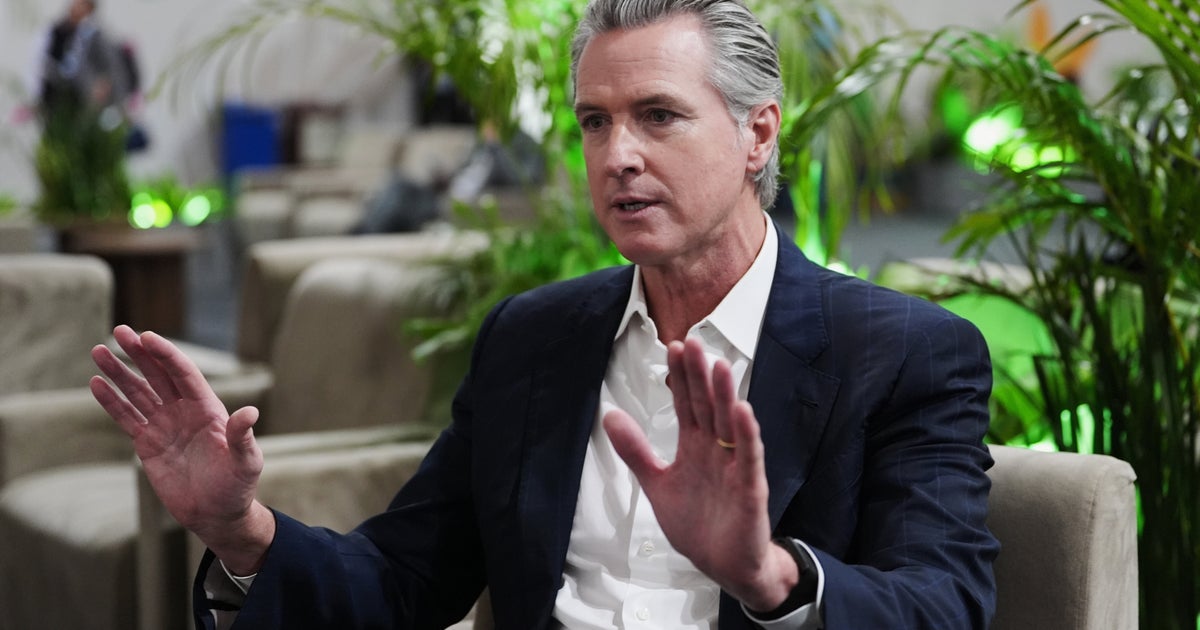
Newsom, in particular, was eager to challenge the narrative that Republican states are better-run.
“When you look at the issue of affordability, where the innovation is coming from, where the response and the solutions are coming from,” he told reporters, pointing to Democratic investments in child care and minimum wage hikes. “I don’t see it happening in the red states.”
At the same time, he acknowledged the “stubborn issues around homelessness [and] education” in his home state. “No one’s satisfied with our progress.”
Newsom noted California is often singled out for its problems with homelessness, but noted the state had a mere .5% increase in its unsheltered homeless population in 2024, compared to an 18% increase across the country.
“The lazy punditry is that it’s somehow all California,” he said. “A lot of these states are struggling with things that are very familiar to California, the difference is we’ve been ahead of the curve in terms of our policy response to them. That’s why I’m a little more optimistic about how blue states can respond.”
Newsom, who is a way-too-early frontrunner in polling for the Democratic presidential nomination, demurred when asked about his ambitions, like all the other potential candidates in attendance. (“Who knows!” Michigan Gov. Gretchen Whitmer responded when pressed about her ambitions by reporters.)
Even without two likely 2028 candidates — Gov. Josh Shapiro of Pennsylvania and Gov. J.B. Pritzker of Illinois — in attendance, much of the discussion revolved around the not-so-subtle jockeying among the governors. (Staffers for the potential candidates were often very interested in discussing the way other governors were positioning themselves, with less interest in talking about their own potential candidate’s plans.)
In this way, the DGA resembles its Republican counterpart about a decade ago. At its peak, the GOP had managed to win 29 governorships, even in solidly blue territory like Massachusetts and Maryland.
Five of its members made bids for the presidency in 2016: Texas’ Rick Perry, New Jersey’s Chris Christie, Louisiana’s Bobby Jindal, Wisconsin’s Scott Walker and Ohio’s John Kasich. All of them believed they could position themselves as the outsiders who actually got things done, in comparison to feckless senators in Washington. All of them ended up losing to Trump.
The Democratic governors, by contrast, have had their careers shaped and saved by Trump — virtually all of them won their seats in midterms defined by backlash to the president. His coming disappearance from the political scene, however, has not diminished their confidence that one of them will succeed him as president.
“My money is on a Democratic governor to be the next president,” Whitmer said.