Your support helps us to tell the story
From reproductive rights to climate change to Big Tech, The Independent is on the ground when the story is developing. Whether it’s investigating the financials of Elon Musk’s pro-Trump PAC or producing our latest documentary, ‘The A Word’, which shines a light on the American women fighting for reproductive rights, we know how important it is to parse out the facts from the messaging.
At such a critical moment in US history, we need reporters on the ground. Your donation allows us to keep sending journalists to speak to both sides of the story.
The Independent is trusted by Americans across the entire political spectrum. And unlike many other quality news outlets, we choose not to lock Americans out of our reporting and analysis with paywalls. We believe quality journalism should be available to everyone, paid for by those who can afford it.
Your support makes all the difference.Read more
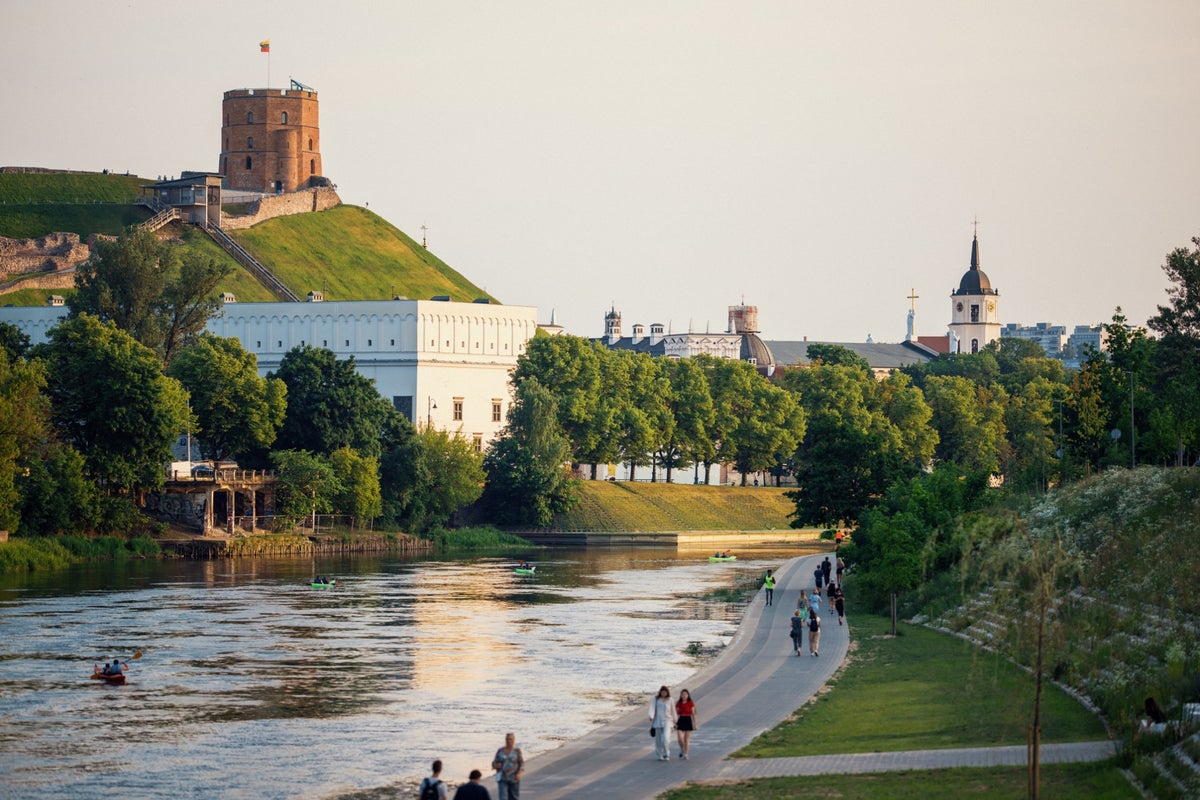
Nobel Peace Prize laureate Ales Bialiatski arrived for an interview with The Associated Press on Sunday in the Lithuanian capital, Vilnius, direct from a dentist appointment.
The 63-year-old veteran human rights advocate was experiencing a return to daily life after more than four years behind bars in Belarus. He was suddenly released on Saturday.
Medical assistance in the penal colony where he served his 10-year sentence was very limited, he said in his first sit-down interview after release. There was only one option of treating dental problems behind bars — pulling teeth out, he said.
Bialiatski recalled how in the early hours of Saturday he was in an overcrowded prison cell in the Penal Colony no. 9 in eastern Belarus when suddenly he was ordered to pack his things. Blindfolded, he was driven somewhere: “They put a blindfold over my eyes. I was looking occasionally where we were headed, but only understood that we’re heading towards west.”
In Vilnius, he hugged his wife for the first time in years.
“When I crossed the border, it was as if I emerged from the bottom of the sea and onto the surface of the water. You have lots of air, sun, and back there you were in a completely different situation — under pressure,” he told the AP.
Bialiatski was one of 123 prisoners released by Belarus in exchange for the U.S. lifting sanctions imposed on the Belarusian potash sector, crucial for the country’s economy.
A close ally of Russia, Belarus has faced Western isolation and sanctions for years. Its authoritarian President Alexander Lukashenko has ruled the nation of 9.5 million with an iron fist for more than three decades, and the country has been repeatedly sanctioned by the West for its crackdown on human rights and for allowing Moscow to use its territory in the 2022 invasion of Ukraine.
In an effort at a rapprochement with the West, Belarus has released hundreds of prisoners since July 2024.
Bialiatski won the Nobel Peace Prize in 2022 along with the prominent Russian rights group Memorial and Ukraine’s Center for Civil Liberties. Awarded the prize while in jail awaiting trial, he was later convicted of smuggling and financing actions that violated the public order — charges widely denounced as politically motivated — and sentenced to 10 years in prison.
The veteran advocate, who founded Belarus’ oldest and most prominent human rights group, Viasna, was imprisoned at a penal colony in Gorki in a facility notorious for beatings and hard labor.
He told AP that he wasn’t ever beaten during more than four years behind bars — his status as a Nobel Peace Prize laureate, perhaps, protected him from physical violence, he said.
But he said he went through much of what all political prisoners in Belarus go through: solitary confinement, arbitrary punishment for minor infractions, not being able to see your loved ones, rarely being able to receive letters.
“We can definitely talk about inhumane treatment, about creating conditions that violate your integrity and some kind of human dignity,” he said.