Anyone coming to Rindschleiden for the first time expects one thing above all else: silence.
The smallest village in the country consists of just three buildings: a church with a vicarage, an old farmhouse that houses the Thillenvogtei museum and the former school. No shops, no houses, no traffic noise.
But on this particular afternoon, there is little sign of the usual tranquillity. The annual Advent market is about to begin.
Exhibitors are setting up their stalls along the street, logs are being pushed into ovens and the first mulled wine is being stirred. Christmas music mingles with the smell of damp wood and the babble of voices from the helpers. For a few hours, the quiet valley becomes a meeting place.
In the old pigsty, where Romaine Zieser has been running her restaurant, “De klenge Randschelter Bistro”, since 2015, the hustle and bustle stays outside for now. The bistro doesn’t open until later, but songs are already playing inside, to which Zieser happily sings along as she makes the final preparations.
“It’s most beautiful when it’s dark,” she said. “Then the candles are lit and the lights are dimmed. When it’s full, it’s simply wonderful.”
The annual Advent market attracts visitors from near and far. © Photo credit: Caroline Martin
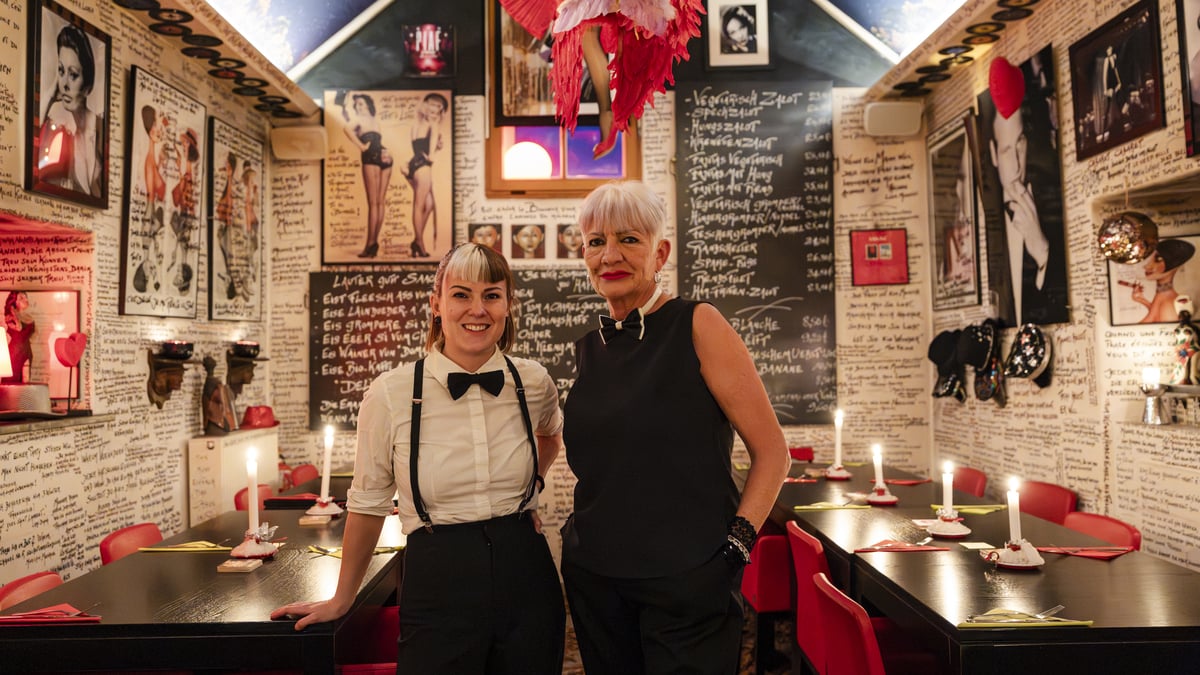
Inconspicuous from the outside, the building unfolds its very own magic on the inside. Black, white and red characterise the room, while candlelight reflects off the gleaming tables.
The walls are adorned with quotations and portraits of women from the 1930s to 1960s – Greta Garbo, Simone de Beauvoir, Marlene Dietrich. A Nana sculpture, by Niki de Saint Phalle, also has its place. “I want to lift up the women without belittling the men,” said Zieser.
The colourful signpost in front of the “Klenge Randschelter Bistro” shows the way to the nearest tradesperson, campsite or bookshop. © Photo credit: Caroline Martin
From the stable to the bistro
Before she came to Rindschleiden, Romaine Zieser ran cafés in Vichten and Bauschleiden for decades. “I used to work a lot, but one day I wanted something new, something small,” she said.
When she heard that the municipality was renovating an old stable in the valley, she travelled there – curious, but without much expectation. “When I arrived in Rindschleiden for the first time, I thought: What am I actually doing here?”
-
Romaine Zieser opened her restaurant, “De klenge Randschelter Bistro”, in July 2015. © Photo credit: Caroline Martin
-
Romaine and Anja (right) have been working together in the bistro for a long time. © Photo credit: Caroline Martin
The building was restored in 2014. Although the space was empty, Zieser saw potential. “I looked through the windows and thought: There’s a soul in here. This is mine.”
The municipality knew how unusual the location was and therefore offered her the first six months rent-free. Zieser, who had already been running restaurants for 35 years, accepted the offer. The small bistro opened on 3 July 2015. “I knew it would work – and it did,” she said.
Why locals of a 28-resident village say it is more attractive than the capital
The village that only has three inhabitants
The last inhabitant of the village was a priest, Father Adolphe Goffin. No-one has lived in Rindschleiden since his death in 2016.
“No-one gets a licence to live here and no more building is allowed,” explained Zieser. The only “residents” today are the three cats Marlene, Audrey and Dalida.
During the day, the cats belong to the museum opposite, but as soon as the bistro opens, they jump onto the bar stools or curl up in their little baskets. “They’re living the good life here – over there they have to hunt mice.”
-
Marlene the cat is a regular at the bistro. © Photo credit: Caroline Martin
-
Marlene the cat, one of the village’s few residents. © Photo credit: Caroline Martin
There’s no passing trade in a village without residents, and yet the bistro is packed almost every day. “People come because they’ve heard it’s nice here,” said Zieser.
Some even travel from far away; a couple from Echternach come every month. Others stumble in by chance – because someone has told them that this valley is worth a visit, or that there is a bistro here that’s truly one of a kind. At weekends, the tables are often occupied two or three times over.
Officially, the bistro seats 24. “But 33 fit too,” said Zieser, laughing. she says and laughs. It’s cramped, but that’s exactly what people like here. First the guests come to eat, later those who stay to drink, dance and sing along.
Transported back in time
It is no coincidence that the bistro feels like a time capsule. Zieser loves the aesthetics of the 1930s to 1960s.
“Women and men simply had a lot more class back then than they do today,” she said, pointing to a picture of Marlene Dietrich starring in The Blue Angel.
Four pairs of high heels hang between the entrance and the kitchen – red, glittering gold, black velvet, black leather, while black leather hats dangle above the bar. And a giant grey teddy bear with a lipstick print hangs from the ceiling. “I got the idea from Paris. If someone comes in alone, we put the teddy bear there – so they’re not sitting alone,” said Zieser.
-
According to Zieser, her bistro looks its best when the candles are lit and the lights are dimmed. © Photo credit: Caroline Martin
-
© Photo credit: Caroline Martin
-
In addition to the inscriptions on the walls, the ceiling and unusual lamps also ontribute to the feeling of stepping into a completely different world © Photo credit: Caroline Martin
-
I © Photo credit: Caroline Martin
-
© Photo credit: Caroline Martin
-
© Photo credit: Caroline Martin
-
© Photo credit: Caroline Martin
-
One of the most striking installations in the bistro is a bright red skirt that floats from the ceiling like a cabaret scene. © Photo credit: Caroline Martin
-
© Photo credit: Caroline Martin
The walls are densely covered with sayings, song lyrics and words of wisdom. “This is my passion,” she said. “When I find a new quote, I put it on the wall.” Two of her favourites are right at the entrance: ‘Because of the weakness of the stronger for the weaker, the weaker is the stronger’ by Greta Garbo and ‘No one is more aggressive or condescending towards women than a man who is not sure of his masculinity’ by Simone de Beauvoir.
The decor has evolved over the years – without a plan, but through emotions. “I find it hard to part with things. When a new picture comes along, I find a place for it somewhere,” said Zieser.
-
The walls of the bistro are decorated with hundreds of quotes. These include some of Zieser’s personal favourites, for example from Greta Garbo or Simone de Beauvoir. © Photo credit: Caroline Martin
-
A room like a notebook – the bistro is a collage of quotes, figures and memorabilia. © Photo credit: Caroline Martin
-
A room like a notebook – the bistro is a collage of quotes, figures and memorabilia. © Photo credit: Caroline Martin
A magnet in the middle of nowhere
Today, Zieser enjoys the special rhythm of the place. “Rindschleiden is a special place with a lot of history and extraordinary people.” In summer, she moves the bistro outside, right into the heart of nature. “Before we came here, it was nice too – but Rindschleiden has truly come alive since we’ve been here.”
During the interview with the Luxemburger Wort, visitors keep opening the door – even though the bistro is still officially closed. Many want to “just have a quick look”, marvel at the atmosphere, stay for a few curious questions and then disappear in the direction of the Advent market. Almost all of them say they will be back in the evening.
When this journalist leaves Rindschleiden a little later, the lights on the stalls have already been switched on, the music has become a little louder and the area is filling up noticeably. The peace and quiet expected here will not return until later in the night. But in the small bistro next door, behind the inscribed walls and under the gaze of the old icons, the evening is only just beginning.
(This article has been first published by the Luxemburger Wort, part of a series on lesser known places in the Grand Duchy. AI translated, with editing and adaptation by Lucrezia Reale)