Revisiting the familiar Nativity story for my Sunday School children, I found myself reflecting on the mysterious travelers from “the East” who followed a star to Bethlehem. My thoughts wandered to the lands they might have crossed and the people who lived there, particularly the Armenian highlands, which my own ancestors once called home. That reflection sparked my imagination, transforming the Three Wise Men into three wise Armenian women setting out from Moush, Van and Ararat, each carrying gifts only women would think to bring to a newborn child.
Following whispers of a prophecy and the appearance of a bright new star, merchants and scholars gathered caravans to travel along ancient trade routes on a long and uncertain journey.
In the town of Moush, known for its wool and weaving, a villager named Apraham led the community along historic east-west routes. He had a dream that a bright star would guide them to a newborn King — a remarkable and radiant child. Inspired by this vision, Apraham rallied the villagers to pack their caravans with wool, rugs, patterned fabrics, spices, precious metal coins and jewelry for trade. Meanwhile, his wife, Mariam, organized the village women to prepare gifts for the newborn.
“Sisters, let us honor this child and his mother,” Mariam encouraged, imagining a baby nestled in his mother’s arms. “Let us bring gold for his royalty and worth, and other gifts of security and honor: finely woven cloth, herbs and foods from our homes.
Let us carry the warmth and love of everything we create with our hands.”
In Van, a historic Armenian cultural and political center, villager Vartan also dreamed of the bright star that would lead them to the newborn King, a child of extraordinary intellect. He called upon merchants, negotiators, scholars and guides. “Bring armed men to deter bandits and protect our animals and cargo,” he instructed. Meanwhile, his wife Zabel gathered the women to prepare their gifts.
“Sisters, let us honor this newborn and his mother by bringing blessings into their lives,” Zabel said, inhaling the fragrances she knew would comfort them. “Let us bring frankincense and aromatic resins, herbs and dried flowers. A mother will want to mark moments of prayer and blessing in her home with these scents.”
From the Mount Ararat region, symbolizing hope, endurance and new beginnings, Davit led his village. He, too, dreamed of the star guiding them to a child who would one day bring healing. Davit gathered healers, bonesetters, messengers and strong horses for the journey. His wife, Anna, the village’s most skilled healer, called the women together to discuss gifts that would ease the burdens of childbirth and early mothering.
“Sisters, let us bring myrrh along with our remedies and plant medicines,” Anna said, her voice softening as she recalled births she had attended, some joyful and some heartbreakingly not. “We will bring salves, teas, dried fruits, nuts and flatbread for strength. And I will bring my medicine bag with remedies for recovery and infant care. Let us provide sustenance for both mother and child.”
Thus, the caravans set out westward, guided by the shining star through mountains, across rivers and along dusty roads. Near their destination, the three caravans converged and spent the evening around a shared fire, exchanging stories of their homelands and what they had heard of the prophecy. Apraham, Vartan and Davit agreed that their wives would bear the gifts, while they would observe from a respectable distance.
The next morning, Mariam, Zabel and Anna dressed in their finest garments to meet the King and his mother. Mariam wore a fitted, textured dress of rich red with a wide woven sash. Zabel chose a deep blue satin dress with a multicolored belt. Anna wore a green wool dress with a shawl draped over her shoulders. Each woman’s elaborate head covering, layered caps and veils adorned with coins and small metal ornaments signaled her married status.
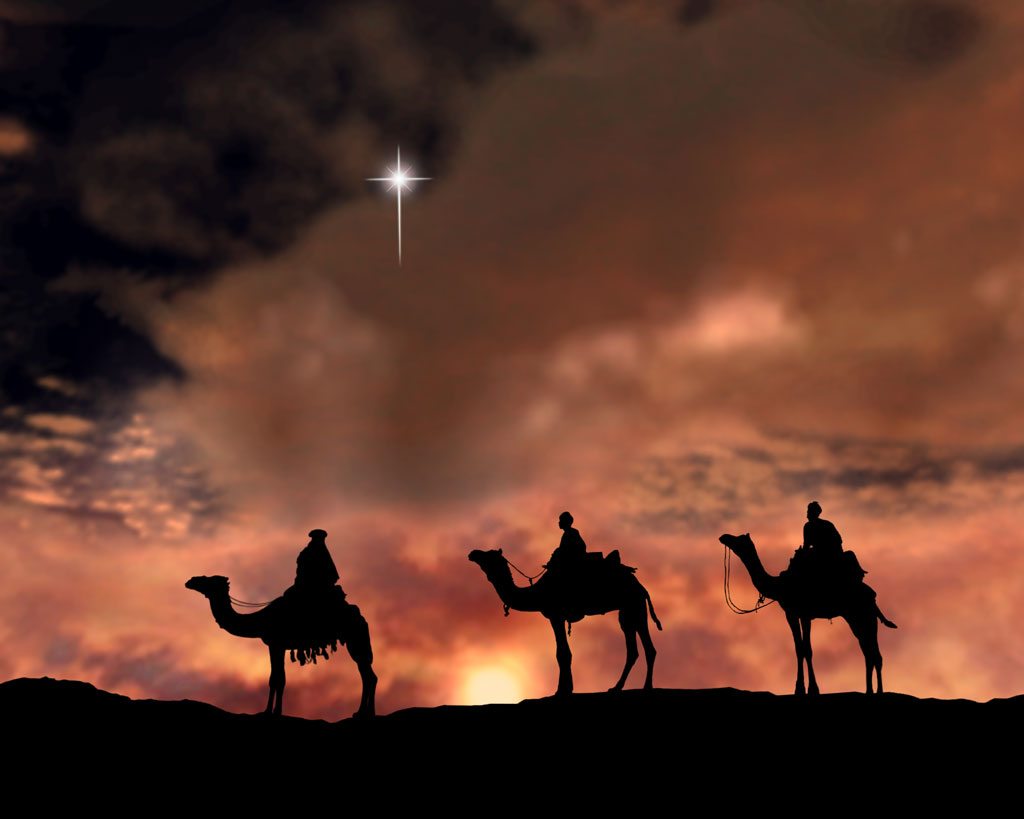
Riding their camels, the women followed the star to the humble place where it rested. They exchanged puzzled glances. Could this truly be the newborn King, lying in a manger with no crib for a bed, asleep on the hay?
Standing nearby, Joseph watched protectively. At his nod, the women dismounted and approached quietly, kneeling not as royalty but as women whose lives had taught them compassion.
The weary mother spoke first. “I am Mary, mother of Jesus, the Son of God. Welcome.”
Mariam stepped forward, taking Mary’s hand. “I am Mariam, wife of Apraham of Moush. We bring gold and other gifts of security and honor, herbs, food and a hand-spun woolen cloak for warmth, along with swaddling cloth for Jesus.”
As Mariam stepped back, Zabel moved forward and gently touched Mary’s cheek. “I am Zabel, wife of Vartan of Van. We bring frankincense and special fragrances to bless your home, ease breathing, encourage restful sleep and keep harm away.”
Zabel stepped aside, and Anna approached, placing a gentle hand on the infant’s head. “I am Anna, wife of Davit of Ararat. We bring myrrh and other gifts for healing and care, as well as salves, teas, fruits and nuts. We are thinking of your pain, your healing and the fragile body of your child.”
Mary’s eyes glistened as she smiled and whispered. “Thank you for sharing gifts so personal and heartfelt, shaped by your journeys as mothers, sisters and daughters.”
What these Armenian women teach us today is that wisdom comes in many forms.
They remind us that Armenians have long been travelers, survivors and bearers of hope. And they honor the truth that throughout history, women have offered gifts that sustain life, even when their names go unrecorded.
As we move through this season, may we reflect on the gifts we carry into the world.
Thank you for reflecting on Victoria’s Voice in this article and in my monthly column in the Armenian Weekly.
Wishing you peace, light and the enduring strength of our heritage.
Merry Christmas and a happy New Year.