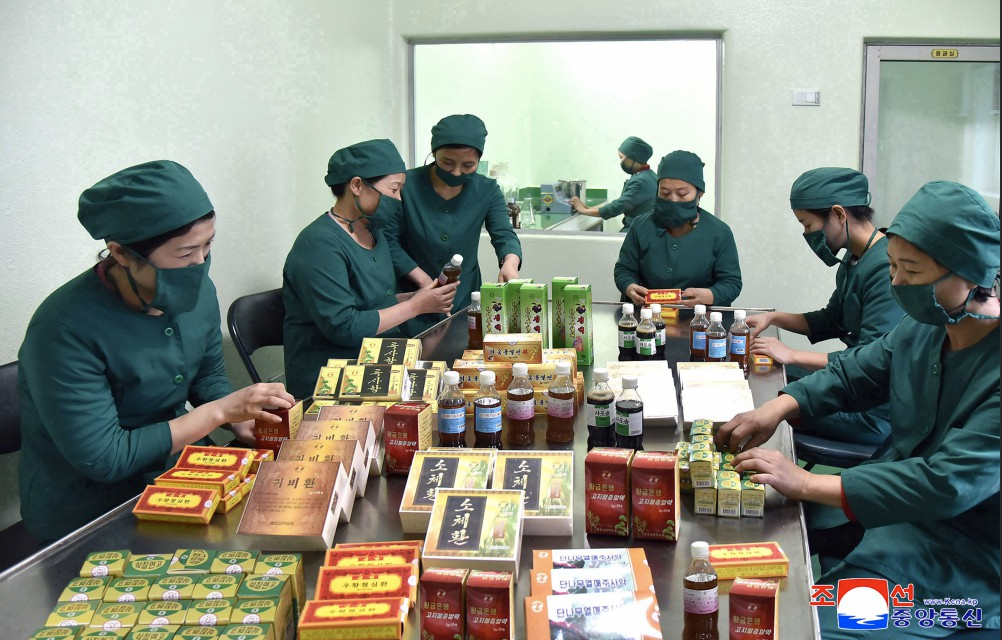
(Source: Korean Central News Agency)
Two previous 38 North articles examined a large dataset obtained from North Korea containing an extensive inventory of pharmaceuticals and medical devices. The first article analyzed the mobile phone app through which these products could be purchased, while the second focused on the medicines listed in the dataset, identifying which drugs were available for treating North Korea’s most prevalent conditions—tuberculosis, hypertension, and diabetes—and examining their relative prices.
This third piece turns to the traditional medicines listed in the dataset—Koryo medicines. The analysis aims to identify which Koryo medicines were offered through the app, what therapeutic value they might provide to users, and, more broadly, what their presence reveals about how “Koryo medicine,” North Korea’s traditional medical system, fits within the country’s public health landscape.
A large share of Koryo medicines in the app’s dataset are domestically produced and sold at low cost, reflecting North Korea’s effort to maintain affordable public health care with limited resources. However, evaluating their real impact on public health will require more open data on their safety and effectiveness.
Methodology
As noted in previous articles, the database contains 3,319 items, including Western medicines, Koryo medicines, health supplements, and medical devices. For this analysis, Koryo medicines had to be isolated from the full list. The first step was to filter products by country of origin, since all items include this information. Medicines produced outside North Korea were removed. Although some Chinese-made products also use natural ingredients similar to Koryo medicine formulations, North Korean Koryo medicine is not defined solely by ingredients but by a system developed over time using local resources, indigenous processing methods, and domestic therapeutic traditions. For this reason, foreign-made products were excluded. After this step, 38.3 percent of the dataset—1,270 items—were identified as domestically produced.
The next step involved removing medical devices and evaluating the remaining items to exclude chemically synthesized drugs and health supplements. Products that resembled Koryo medicines in appearance but offered only nutritional benefits and no recognized therapeutic effects were also removed. Following this process, 234 Koryo medicines remained, representing 7.1 percent of the entire database.
These 234 medicines were produced across 69 different factories. Among them, the Pyongcheon Koryo Medicine Factory (평천고려약공장) produced the largest number of items (31), followed by the Sokam Pharmaceutical Factory (석암제약공장) (23), the Toseong Pharmaceutical Factory (토성제약공장) (18), the Sŏn’gyo Koryo Medicine Factory (선교고려약공장) (17), and the Paektusan Pharmaceutical Factory (백두산제약공장) (11). Most other factories produced only a small number of Koryo medicines. Although additional Koryo medicine products and manufacturing facilities may exist outside this dataset, the size of the dataset suggests that the factories appearing most frequently are likely among the key producers in the sector.
Factory names varied, with many labeled as “pharmaceutical factories” (제약공장) or “pharmaceutical workshops” (제약소). Koryo medicines were most commonly produced in factories explicitly designated as Koryo medicine factories (고려약공장), but some general pharmaceutical facilities also manufactured Koryo medicines, suggesting that production and distribution of these products are widespread throughout the country.
Characteristics of Koryo Medicines
One notable characteristic of Koryo medicines in the dataset is that most products were sold in the form of powder, pills, or capsules. Given the country’s limited cold-chain capacity, it appears that solid formulations—easier to store at room temperature—are favored over ointments, decoctions, or other forms requiring more controlled conditions. Even for those with longer shelf lives, caution is needed, as exposure to moisture, direct sunlight, or storage beyond two years can reduce the potency of the herbal ingredients or cause the efficacy of the medicine to deteriorate.
Several medicines appeared in multiple versions, manufactured by different factories. Notably, 14 different facilities produced Uhwangch’ŏngsimhwan (우황청심환), a cardiotonic formula often used as an emergency treatment for stroke, implying strong domestic demand for this preparation.
A particularly interesting discovery was an injectable formulation of Angung Uhwanghwan (안궁우황환), a product derived from the same historical lineage as traditional Korean medicine in the South, where the formula is still administered exclusively orally. Such injectable delivery methods are found in today’s Chinese traditional medicine, suggesting some degree of academic or technical exchange between North Korea’s Koryo medicine and China’s traditional medicine. It may also indicate an effort to integrate Koryo medicine more actively into hospital-based settings.
Two hybrid products combining Western pharmaceuticals with Koryo herbal ingredients were also identified: one mixing aspirin with herbal components, and another combining diclofenac sodium, a nonsteroidal anti-inflammatory drug (NSAID) used to treat mild-to-moderate pain, and acetaminophen with traditional materials. These examples suggest attempts to expand and modernize Koryo medicine beyond strictly traditional formulations.
Pricing
The pricing of Koryo medicines was also analyzed. As noted previously, the app displays two price categories: red and blue price tags. Red price tags appear to reflect the official exchange rate—roughly 1 USD to 100 foreign exchange won—while blue prices appear tied to the market exchange rate—roughly 1 USD to 8,000 domestic won. Imported drugs in the dataset were overwhelmingly labeled with red tags, while domestically produced drugs generally carried blue tags. Surprisingly, however, Koryo medicines were split almost evenly between red and blue tags (106 red, 128 blue). The meaning of this distinction is unclear, thus Koryo medicines with red versus blue price tags were analyzed separately.
The 106 red-tagged Koryo medicines ranged in price from 0.18 USD to 132 USD per unit. The least expensive, Ryŏngsinhwan (령신환), a digestive aid, cost 0.18 USD for a two-day supply. The most expensive was a “β-glucan antioxidant drink,” purportedly used to lower cholesterol, priced at 132 USD for a 15-day supply. A different cholesterol-lowering formula (Chik-gliben diabetes pill) was available for 4.4 USD for a 40-day supply—roughly eighty times cheaper per unit.
Even identical Koryo medicine names appeared at widely varying price points. For Uhwangch’ŏngsimhwan (우황청심환), for instance, the cheapest version cost 0.06 USD per pill, while the most expensive cost 3.7 USD—more than sixty times higher.
The 128 blue-tagged medicines ranged from 0.125 USD to 44.7 USD per unit. The least expensive was powdered Paedoksan (패독산), commonly used for fever, pain, and colds; a ten-day supply cost 1.25 USD. Several forms of Paedoksan appeared in the list; among tablet formulations, the most expensive required 6.25 USD for a ten-day supply.
The most expensive blue-tagged medicine was Angung Uhwanghwan (안궁우황환), used for cerebrovascular conditions, at 44.7 USD per day. Another version of the same medicine was listed at 15 USD per day, and an alternative preparation for similar symptoms (Chŏnghyang sedative powder, 정향진정가루약) cost just 0.25 USD per day.
Taken together, these findings suggest that Koryo medicines play a useful role in supporting healthcare access in North Korea. The app offers a wide range of products at generally affordable prices. Even though Koryo medicines are made from natural ingredients, they are still pharmacologically active and require caution when taken; the app provides information not only on their composition and usage but also on precautions. While it remains unclear how diagnoses and prescriptions are handled within the healthcare system, individuals who have received a diagnosis from a clinician may be able to purchase appropriate Koryo medicines and adjust dosages safely according to economic constraints and medical instructions using the app.
Government’s Stewardship
The widespread availability and accessibility of Koryo medicine appear closely linked to the government’s active promotion of the system. For years, North Korean authorities have emphasized Koryo medicine as a practical solution for safeguarding public health amid limited resources and chronic economic challenges. State media reports indicate that health-sector workers are assigned quotas for medicinal herb collection each spring and autumn. Local governments, particularly in mountainous areas, have also been working to establish medicinal herb forests, with plans to cultivate 300 jongbo (roughly 735 acres) of land for herbal production by 2025.
In addition, the government is reportedly undertaking various initiatives to develop new Koryo medicines, showcase factories, improve quality, and modernize Koryo medicine production processes. Because the state manages medicinal herb resources directly and bears few costs for cultivation and harvesting, and because Koryo medicine factories are state-operated, the resulting products can be supplied to the public at low prices.
Questions About Quality and Effectiveness of Koryo Medicines
Despite these positive aspects, significant limitations remain. Little is known about standardization or regulatory verification of Koryo medicine safety and efficacy. Given the number of manufacturing sites, the quality and potency of products may vary depending on facility hygiene and ingredient composition. In South Korea, for example, all herbal medicine manufacturers must be certified by the Ministry of Health, and all herbal preparations distributed outside Korean traditional medicine clinics (한의원) undergo safety and efficacy testing by the Ministry of Food and Drug Safety. It is unclear whether comparable systems exist in North Korea or how they might operate.
Some Koryo medicines listed in the app also appear to exaggerate their therapeutic claims, describing efficacy across a wide range of unrelated conditions and listing few or no side effects. Greater oversight would be necessary to prevent overstatement and ensure accurate public health information.
Conclusion
By isolating Koryo medicines within the app’s dataset, this analysis shows that a substantial number of traditional medicines are domestically produced and sold at relatively low prices. As is often the case in the context of the development and evolution of traditional medicine, this reflects the North Korean government’s active efforts to maintain public health efficiently and at low cost in a setting where healthcare resources are limited. To assess the actual contribution of Koryo medicine to public health outcomes, however, further open data on the safety and effectiveness of these medicines will be essential.