The following remarks were delivered at the 2025 AYF D.C. “Ani” Chapter’s November Dance on November 15, 2025.
I still remember being on an AYF D.C. executive call in the summer of 2024 when Ungerouhi Elizabeth Chouldjian, our ARF Advisor, mentioned that an AYF World Panagoum was being planned. Right away, my mind flashed back to the 2023 Homenetmen Jamboree, my first ever trip to Hayastan and honestly, one of the most beautiful experiences of my life. After returning home from said trip, I found myself craving another moment like that, another opportunity to be surrounded by hundreds of Armenian youth in our homeland.
So, when Panagoum was officially announced, I knew immediately: I needed to be there. And I’m so proud that our chapter, AYF D.C. “Ani,” was represented by six members at this once-in-a-lifetime event, which hadn’t taken place in 14 years.
Fast forward to July of 2025: the opening ceremony at the Nemesis statue in Yerevan. Standing there, surrounded by AYFers from all over the world, immediately set the tone for the week.
And it was there that we first heard the phrase that would follow us everywhere: “Bidi Veratarnank” — “We will return.” Not just a motto, but a promise.
A reminder of our duty, our responsibility and the purpose that brought us all together. Following the ceremony, we marched through the streets toward the Aram Manoukian statue, singing together and flooding Yerevan with our presence. It was one of those moments where you just feel Armenian.
Washington, D.C. participants by the Eastern Region’s daghavar tent
After the opening, we headed to Camp Shoghig in Hankavan. The moment we got off the bus, you could feel the energy of people dragging suitcases in a million directions, taking photos, greeting new ungers, and reconnecting with old ones. It honestly felt surreal.
That first night, we learned we’d be split into khoumps. And I’ll admit: the thought of being separated from familiarity was nerve-racking. But looking back, it ended up being one of the best parts of the whole week. It pushed me out of my comfort zone and allowed me to build connections I never would’ve formed otherwise. I was placed in the Aram Manoukian khoump, which felt especially symbolic after the opening ceremony earlier that day. That’s when the real Panagoum began.
From that point on, our khoump became our home. Every khumpabed had their own style, and mine always made the effort to keep us united. We ate together, walked everywhere together, debated, laughed and had some of the most open, honest conversations I’ve ever experienced.
The Aram Manoukian khoump
One moment that meant a lot to me happened during our first lunch. One of the organizers, Unger Hovsep from France, was going around the table asking each person where they were from. When he got to me and I said “the U.S.,” he asked which chapter. I told him Washington, D.C., and he immediately said: “Are you part of the “Ani” chapter?” I said yes and, without hesitation, he replied: D.C. is one of our strongest chapters in the U.S.”
At that moment, I felt such pride — not just for myself, but for everyone sitting here today. It proved that the work we do back home matters, and it never goes unseen.
Another moment that really stayed with me happened after one of our lectures. There were times during Panagoum when I felt intimidated, surrounded by ungers whose Armenian felt so much more advanced than mine. After one lecture, I admitted to a few ungerouhis that I had trouble understanding parts of it. I was especially nervous telling that to an ungerouhi from Lebanon, where the Armenian community is so deeply rooted.
But her response changed everything. She said, “Mary, in Lebanon, our Armenian schools, churches and agoumps are everywhere. In America, you don’t have that. Many people from places like ours lose their identity when they move away. But seeing Armenians from the U.S. fighting to hold onto their culture with whatever they have, that’s inspirational.”
At that moment, I realized: being a good Armenian isn’t about perfection. It’s about commitment, and what you choose to do with what you have.
As the week continued, all these little experiences — the conversations, the different dialects, the small cultural differences — all came together during Daghavar. Daghavar felt like zooming out of a photograph. For days, we’d all been immersed in our individual khoumps, but suddenly, we were seeing the bigger picture: 400 AYFers from 17 countries, each representing their region with so much pride. Walking from tent to tent, you could see how each community expressed its Armenian identity in its own way: different histories, different accents, different experiences, but all rooted in the same purpose. It was the moment you realized the AYF isn’t just an organization; it’s a global family.
Panagoum also took us outside camp for excursions that grounded us in our history. Visiting Dzidzernagapert and especially Yerablur were incredibly emotional experiences. It was my first time at Yerablur, and hearing stories directly from ungers who fought beside our fallen heroes hit hard. Living far from the homeland can unintentionally create emotional distance, but standing there erased all of it. Their sacrifices became real in a way that’s difficult to put into words, and I’m grateful I had the chance to pay my respects.
12th Annual World Panagoum participants gathered at Sardarabad
Later in the week, we visited Sardarabad, Etchmiadzin and Lake Sevan, each place reminding us of everything our people endured and everything they built. One of the most meaningful visits was the Proshyan Military Pantheon, where 26 AYFers from six regions took their ARF oath. Watching them stand in such a historic space and dedicate themselves to the cause made us feel like a part of something far bigger than one camp.
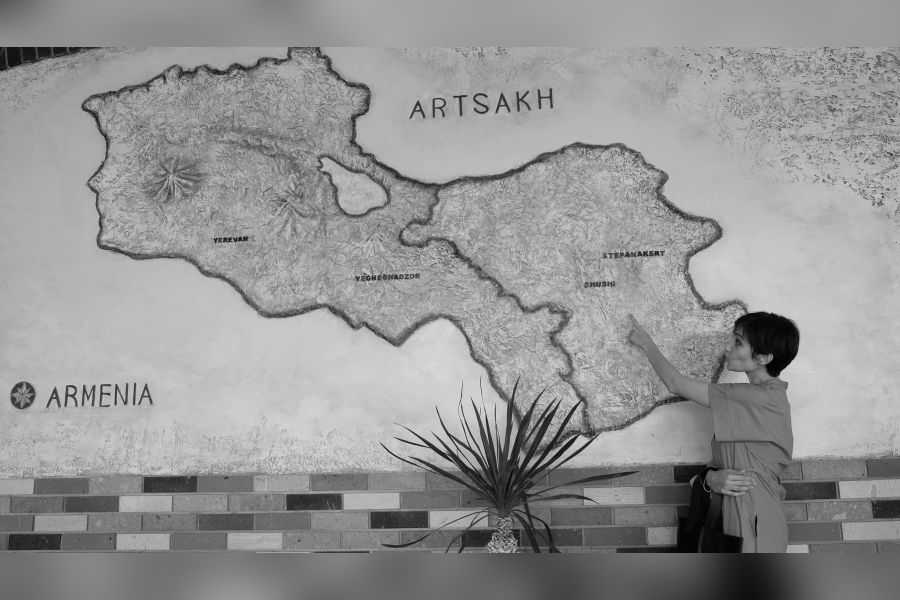
And then came Artsakh Day: my personal favorite day of the entire Panagoum. Artsakhtsi vendors filled the panagavair with what felt like a mini Vernissage: music, handmade crafts, artwork, food. But it wasn’t the aesthetics that made it powerful; it was the emotion behind it.
Every detail carried the pride, beauty, pain and resilience of Artsakh. You could feel the love and the loss at the same time. It proved that Artsakh is Armenian, not just because of borders, but because of its people.
And as long as we carry Artsakh in our voices, in our work and in our hearts, it will never be forgotten.
Celebration of Artsakh Day
After days as meaningful and heavy as that one, the nighttime kharouyg was exactly the space we needed. Every evening ended around the bonfire, singing heghapokhagan songs, telling stories, laughing and just being present with one another. I remember on one of our first nights, when our leaders tried sending us off to bed, every single one of us refused. We stayed and sang even louder than before. Those nights felt timeless, like the kind of memories that stay with you forever.
And, of course, then came the night watch. Every night, a different group guarded the panagavair. It was funny seeing how each region had its own way of responding to hartsagoum. Our ungers from Syria and Lebanon said that when someone yells it, everyone wakes up instantly to defend the flag. Meanwhile, our Hemagan ungers admitted they only get up if they hear a specific keyword. During my own bahag shifts, we passed around snacks and shared stories about everyone’s most intense hartsagoum experiences. Those two hours flew by every time.
The Aram Manoukian khoump on the final day of Panagoum
Our final night was bittersweet and, of course, it just had to be the only night it rained. But that didn’t matter. We still sang our hearts out with Nersik and Arabo Ispiryan, Souren Ajemian and Samuel Yeranian. And then, came our Kharouygahantes, where each khoump shared the songs, skits or poems they created throughout the week. It was genuine, creative, emotional and truly the perfect way to end eight unforgettable days.
World Panagoum participants gathered together at Camp Shoghik in Hankavan, Armenia
Looking back, Panagoum wasn’t just a camp. It was a reminder of who we are, what we carry and how powerful we are when we stand together. No matter where we come from, which dialect we speak or what our communities look like, we are bound by the same love for our homeland.
And together, we’re building its future.
Advertisement