Police dogs unleashed against NUP supporters
For weeks, Uganda’s presidential campaign trail carried an unusual quiet.
Candidates crisscrossed the country with little of the tear gas, sirens, and running battles that have long defined the nation’s electoral seasons. Even some youth, raised on viral images of clashes and chaos, complained that the race felt “boring.”
But the calm did not last. By late November, the quiet had cracked open, revealing familiar tensions beneath the surface of Uganda’s politics. Arrests of opposition activists, the disruption of National Unity Platform (NUP) rallies, and violent confrontations between security forces and supporters of NUP presidential candidate Robert Kyagulanyi, known widely as Bobi Wine, have reignited fears that the 2026 race may once again be overshadowed by force rather than debate.
The past month has shown how thin the line is between a peaceful campaign and one punctured by mistrust, and how deeply the question of police neutrality continues to shape Uganda’s political landscape.
A RACE BEGINS IN HOPE—AT FIRST
On September 23 and 24, 2025, eight presidential candidates were formally nominated at the Electoral Commission headquarters in Lubowa.
The lineup, familiar yet politically varied, included President Yoweri Museveni (NRM), Kyagulanyi (NUP), Nathan Nandala-Mafabi (FDC), Mugisha Muntu (ANT), Elton Joseph Mabirizi (CP), Robert Kasibante (NPP), Munyagwa Mubarak Sserunga (CMP), and Bulira Frank Kabinga (RPP).
At the campaign kickoff on September 29, the Electoral Commission praised the unusually calm start. Museveni launched from Munyonyo and Makindye, Kyagulanyi from Jinja, Nandala in Buikwe, and Munyagwa in Kawempe.
For a moment, the country tasted an election unaccompanied by the soundtrack of sirens and stun grenades.
“This is exactly what an election and campaign process should be,” said Julius Mucunguzi, the Electoral Commission spokesperson.
“Ugandans deserve a peaceful electoral process.” Even some traditionally sharp critics acknowledged the shifted tone.
Democratic Party president Norbert Mao, no stranger to Uganda’s volatile political seasons, noted that the lack of violence had become a talking point among young people.
“Some youth say the campaigns are boring because there’s no tear gas or arbitrary arrests,” Mao observed.
“But chaos shouldn’t be your campaign strategy. Ugandans are now ready to listen to your manifesto without interruption.” Kyagulanyi, too, cautiously admitted that the early weeks were calmer than in previous cycles.
“So far, the campaigns have been peaceful,” he said while in Busia. He noted, however, that subtle obstruction remained: key routes and trading centers blocked, supporters redirected, and convoys squeezed into narrow, manageable paths. The peace, in his telling, always felt conditional.
Early September, opposition activists, including NUP leaders Doreen Kaija, Waiswa Mufumbiro, and Saudah Madada, were arrested, triggering accusations of selective enforcement and political targeting. The turning point came in mid-November.
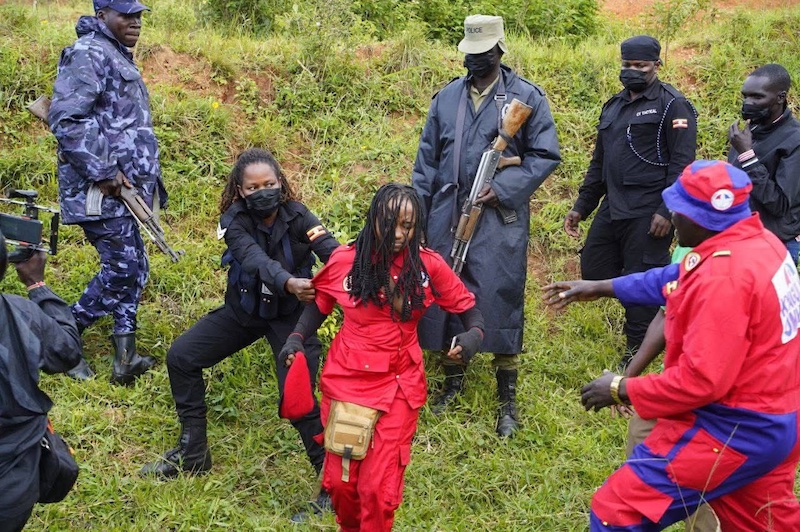
Rallies were blocked. Supporters clashed with security personnel. And by November 24, the situation had deteriorated into scenes reminiscent of earlier election cycles: police deploying tear gas and dogs on Kyagulanyi supporters in Kawempe.
These incidents revived a longstanding question: Is Uganda’s electoral security architecture capable of impartiality, or is it structurally aligned with the incumbency? Each confrontation, each arrest, each disrupted rally is now read not just for legality but for political intent.
A DEATH IN IGANGA
The fragile peace was shattered completely on November 28, when police shot and killed NUP supporter Misaki (Meshach) Okello after a rally in Iganga district. According to police, Okello was part of a crowd dispersing from Kyagulanyi’s rally. But accounts from Kyagulanyi and supporters paint a more troubling picture.
“They fired live bullets at peaceful people,” Kyagulanyi posted on X, formerly Twitter. “We have confirmed the murder in cold blood of Meshach Okello, who was shot through the head.”
Other supporters, 24-year-old Nuwamanya Samuel, 44-year-old Naminya Banuli, and 24-year-old Faima Namusobya, were left hospitalized with severe injuries. Okello’s death followed another violent episode in Kayunga, where police used tear gas, live ammunition, and other force to break up what they called “illegal processions.”
The pattern feels familiar: the state invoking public-order regulations to justify dispersing opposition crowds, and the opposition accusing security agencies of weaponizing those same laws to restrict political space.
The Electoral Commission condemned the killing, calling it “unfortunate and regrettable.” “Such incidents do not add value to Uganda’s democratic processes,” said Justice Simon Byabakama. He urged investigations into the violence and insisted that law enforcement act with proportionality.
But the Commission’s appeal lands in a political environment where trust is scarce. For many Ugandans, especially younger voters whose first political memories are filled with images of confrontation, the gap between official statements and lived reality can feel wide.
The EC’s call for peaceful conduct stands alongside another, more pointed warning: candidates must avoid sectarian rhetoric and inflammatory language, a sign that tensions are rising not only on the streets but within campaign messaging itself.
A SLOW SLIDE INTO FAMILIAR TERRITORY
The unfolding violence does not yet match the scale of the 2021 campaign crackdowns. But the pattern is similar: a hopeful start, a brief quiet, then a series of escalations, mostly around the same candidate, in the same districts, under the same policing logic.
The question is not just whether the 2026 elections will be peaceful. It is whether Uganda’s institutions can hold the line against pressures that tend to escalate once political competition sharpens.
In moments like these, elections become tests, not only of candidates or parties, but of the entire state architecture responsible for managing public space, public order, and public trust.
As the January 2026 election approaches, what once looked like a promising shift toward calmer politics now feels uncertain. The next weeks will determine whether the country maintains the early spirit of peaceful competition—or whether Uganda once again slips into the cycle of confrontation that has defined so many elections before.
But as November settled in, that promise began to fray. A series of violent clashes between security forces and supporters of the National Unity Platform (NUP) has once again put the Uganda Police Force at the center of national debate. Police insist they are trying to maintain order.
Opposition figures argue the force is repeating a familiar pattern, one in which law enforcement becomes an extension of political power. What’s emerging is a deeper contest over trust: whether the country’s security institutions can be believed when they say they are neutral.
A POLICE FORCE PRAISED ON PAPER
Only months before the clashes, the Uganda Police Force unveiled a five-year performance review, one that painted a picture of a modernizing, increasingly effective institution. According to Deputy Inspector General of Police James Ocaya, crime in 2024 had dropped 4.1 percent from the previous year, falling from 228,074 to 218,715 cases.
Emergency response times were improving. Technology was slowly integrating into everyday policing. More than 220,000 victims were recorded, nearly two-thirds of them men, a statistic reflecting not only victimization patterns but who most often comes in contact with the criminal justice system.
It was the kind of data police leadership hoped would shift the public narrative. And for a moment, it seemed to. But the turbulence of the campaign season has overshadowed those gains.
Arrests, detentions, injuries, and deaths involving opposition supporters have eroded the calm the police hoped to project, drawing fresh scrutiny from both domestic observers and international audiences.
THE KILLING IN IGANGA—AND THE HUNT FOR ANSWERS
When police shot and killed Okello as crowds dispersed from a Kyagulanyi rally in Iganga, the story ricocheted across the country. NUP called it “cold blood.”
Police said the matter was still under investigation. For now, the public is left with fragments.
“The Iganga incident is an investigation that needs more time,” police spokesperson Kituuma Rusoke said in an interview. “It is not something you can establish in a day or two. Between the day of the occurrence and today, I have not yet received feedback on the progress.”
NUP supporters being arrested in Mbarara
Rusoke maintained that the officers had been thoroughly briefed and warned against “overzealous behavior.” “You don’t have the right to simply choose when to beat or shoot at anybody,” he said.
He insisted that police disciplinary structures do hold officers accountable, if specific complaints are formally lodged. What he could not accept, he said, was sweeping criticism of the entire force.
“What we have failed to stomach is blanket blackmail,” he said. “Of course, some things go wrong and sometimes we descend into chaotic situations. But when it comes to specific violations of individuals’ rights, nobody can be protected.”
Rusoke urged Ugandans to report abuse rather than rely on rumor or group outrage. “Too much of what you are hearing is mainly group noise,” he argued. “If there are specific allegations, we are always ready.”
WHERE THE POLICE DRAW THE LINE
Rusoke also defended the force’s handling of political processions, pointing to what he called the “context” of crowd movement. If thousands of market vendors walked from Kangulumira to Kayunga, he argued, police would not intervene. But the dynamic changes when a candidate mobilizes large, unregulated crowds along the roadside.
“These groups pickpocket, people lose phones and other belongings,” he said. “That kind of lawlessness, security says no.”
Campaigns, he argued, should be controlled gatherings: let supporters travel separately, convene at the venue, listen to their candidate, and disperse by 6 p.m.
The police perspective frames the clashes as failures of crowd management, not political targeting. But that interpretation is sharply contested by many who see deeper, more long- standing political forces at play.
“A WRONG POSITIONING OF THE SECURITY FORCES”
Human rights lawyer George Musisi, who is also contesting for Kira Municipality MP, argues that what is unfolding is not an irregularity but a continuation of a decades-old pattern.
“There has been militarization and a wrong positioning of the security forces, particularly police, to involve themselves in politics,” Musisi said. “This has been evident in every election cycle.”
He points to what he describes as state capture, arguing that security agencies no longer separate professional duty from political loyalty. “Security agencies view themselves as part of the ruling government,” he said.
“We anticipated this. It is one of the reasons we believe the government must change if we are to redeem these institutions.” To Musisi, the burst of early-campaign calm was not evidence of reform but a temporary pause in a much deeper script.
“Even during the first 30 days of peaceful campaigns, they were simply restraining themselves,” he said. “The campaign environment was never free of potential intervention.”
“A REHEARSAL FOR WHAT IS COMING”
Senior lawyer Peter Walubiri is even more blunt. He argues that expecting a free and fair election under President Museveni is to misunderstand the entire logic of the system.
“Whoever imagined that there would be a free and fair election as long as Mr. Museveni and the NRM are still in control is mistaken,” Walubiri said.
“It is the antithesis of what Museveni seeks to achieve. He has never pretended to be a democrat.” Walubiri criticized those who hailed the early peaceful phase as a turning point.
“When I saw journalists saying elections are now peaceful, I knew they were just as gullible as the ordinary Ugandan,” he said. In his view, Museveni’s strategy is deliberate: start softly, then tighten control.
“He was getting everyone into the trap,” Walubiri said. “When you’re starting a vehicle, you begin in a low gear; then as you gain momentum, you move to higher gears.” What Uganda is witnessing now, he warned, is just the beginning. “What I expect from Mr. Museveni is beatings, imprisonments, abductions,” he said.
“What you are seeing now is a rehearsal to observe how the public reacts to violence.” Walubiri predicts darker days ahead, violence meant not just to suppress crowds but to test their resolve. “You are going to see a bloodbath,” he said.
WHAT THIS MOMENT TELLS US ABOUT ELECTIONS
Uganda has long held elections marked by an uneven balance of power, but the 2026 campaign season carries an added tension: two conflicting narratives unfolding at once. On one side, the police present themselves as a modernizing force dealing with an unruly political environment, responding to unregulated crowds, and disciplining officers who cross lines.
On the other, opposition figures and human rights analysts see a system that behaves as though political survival is its core mandate, not public safety. The truth may lie in an uncomfortable intersection: a police force trying to professionalize while operating in a highly politicized environment where neutrality is almost impossible.
With weeks to go before the election, the question is no longer whether violence will shape the campaign, but how far it will go, how the public will react, and whether the institutions charged with managing conflict will rise to the moment, or buckle under its weight.