
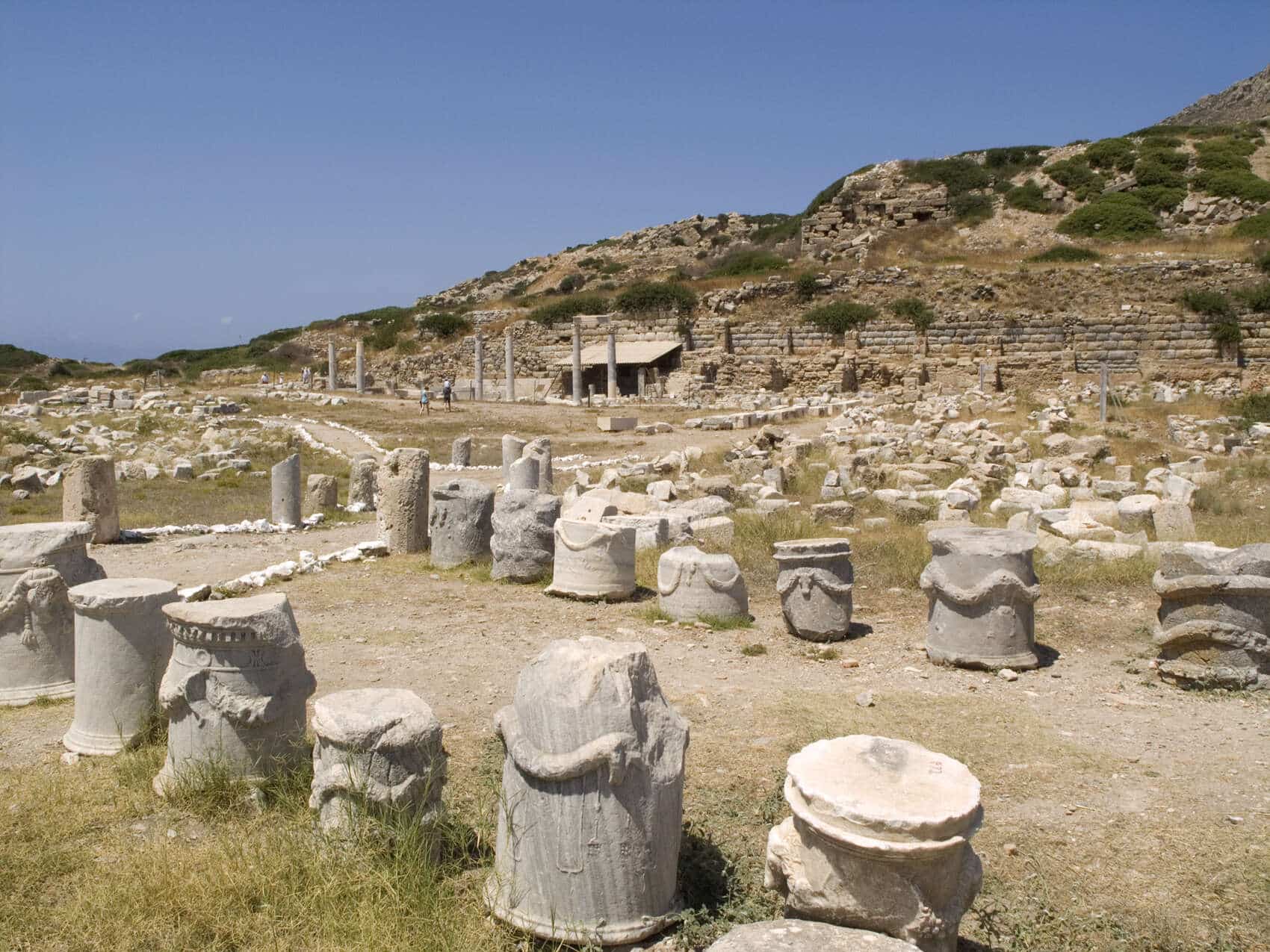
Southern province of Muğla, Turkey. Credit: Островский Александр, Киев-Wikipedia Commons, CC BY-SA 3.0
A shepherd walking through the highlands of Mugla’s Seydikemer district discovered a Roman‑era grave stele bearing carved human figures and an ancient Greek inscription. Authorities secured the artifact and transferred it to the Fethiye Museum, where conservation work will begin before public display.
The moment a Roman-era human-shaped grave stele was recovered after being discovered by a goat herder in the Seydikemer district of Muğla, Türkiye 🇹🇷
The grave stele approximately 1900 years-old, was found in a rugged, forested area near the village of Kayacık. As a local goat… pic.twitter.com/yDXTpShfTQ
— ArchaeoHistories (@histories_arch) December 1, 2025
Experts confirm Greek inscription on Roman-era monument
Archaeologists say the stele stands out for its carved reliefs and its inscription written in Ancient Greek. They note that Greek remained the preferred script for family memorials, making the inscription a valuable source for understanding cultural identity, social ties, and local traditions.
Officials describe a careful recovery from forested terrain
Local officials reported that the shepherd noticed the carved piece while tending his animals in a forested area near Kayacik. He immediately informed the Fethiye Museum Directorate. Experts conducted an on-site assessment and confirmed the stele’s historical importance.
Because the stone weighs about 300 kilograms, the team buried it temporarily for protection. They also installed motion-triggered cameras to monitor the site until recovery could begin.
The team carries the 300-kilogram stele over steep ground
Once preparations were complete, archaeologists and support workers hiked about 45 minutes from the nearest road to reach the spot. They wrapped the stele with protective materials and then began carrying it by hand. The descent across steep and rocky ground took nearly seven hours, requiring caution, endurance, and coordinated effort.
Reliefs show a family portrait carved on the front face
Archaeologist Ahmet Meke, who took part in the rescue, said the stele likely dates to the first–third centuries C.E. He identified it as an altar-shaped grave marker, a type common in Roman-era Anatolia.
A human-shaped grave stele in the form of an altar, discovered by a shepherd grazing his goats in Seydikemer district, Turkey.#AncientHistory #Greekinscription pic.twitter.com/eC7mov45xo
— Tom Marvolo Riddle (@tom_riddle2025) December 2, 2025
According to Meke, the front face depicts a man and a woman standing side by side, suggesting a family portrait created to honor the deceased. He said the clothing and styling of the figures reveal details about daily life and social identity in the region during the Roman period, where Greek remained the language of inscription.
Wreath carving hints at the status of the deceased
One of the side faces bears a carved wreath, a symbol associated with honor and distinction. Meke said this detail points to a respected social position for the person commemorated on the stele.
Conservation of the artifacts
Museum specialists will now begin cleaning and conservation before cataloguing the piece into the Fethiye Museum’s inventory. Officials have proposed protected status for the discovery site, which remains under surveillance.
Meke stressed the importance of public cooperation in safeguarding cultural heritage. He noted that the shepherd’s quick report in Mugla allowed the team to recover and protect a rare Roman-era stele marked with a Greek inscription—an artifact that sheds light on the intertwined cultural traditions of ancient Anatolia.


