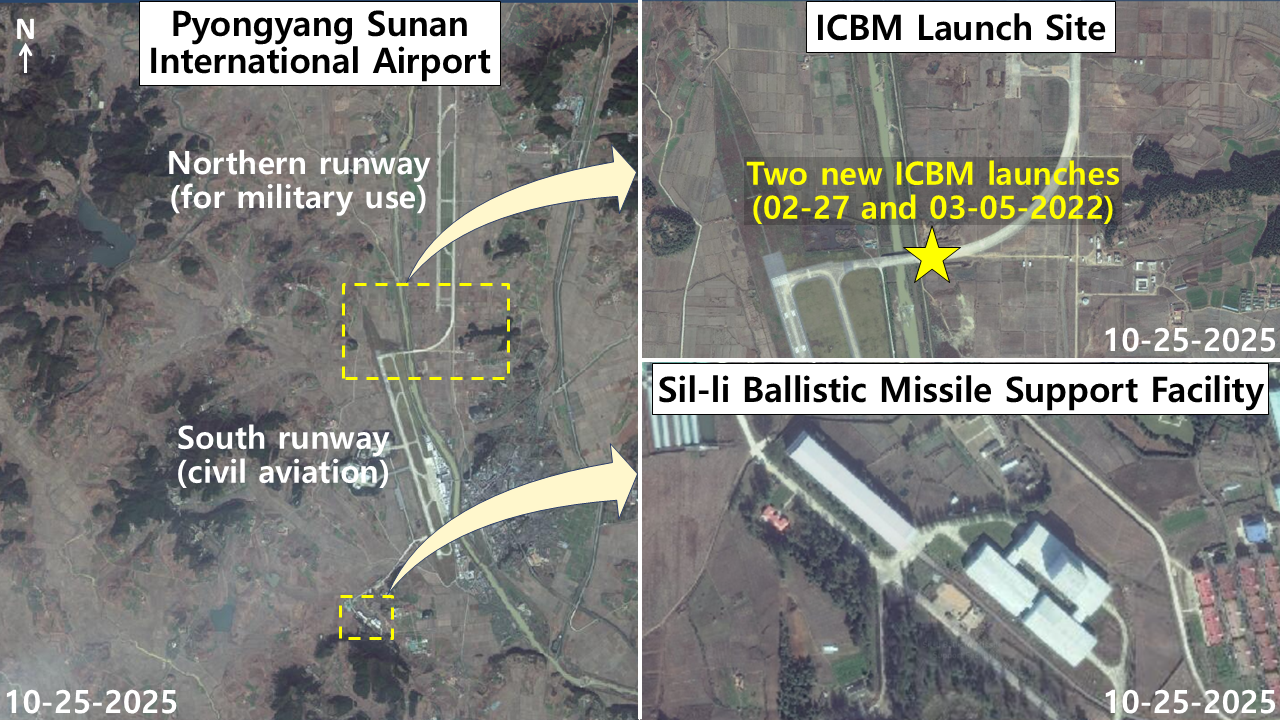
New intercontinental ballistic missiles (ICBMs) have been launched on several occasions from the international airport in the Sunan district of Pyongyang. While Sunan is ostensibly a civilian international airport, it doubles as a major strategic military facility for North Korea complete with missile support facilities. (WorldView-2)
The Asia-Pacific Economic Cooperation (APEC) summit was held on Oct. 31–Nov. 1, in Gyeongju, a city in South Korea’s North Gyeongsang province. Just one week before U.S. President Donald Trump arrived in South Korea on Oct. 29 for the two-day summit, North Korea launched a new type of missile from the Ryokpo district of Pyongyang on Oct. 22. North Korea threatened the world with its flagrant demonstration of its military capabilities while blatantly disregarding the United States’ repeated proposals for talks without any preconditions.
The missile launch site in Pyongyang’s Ryokpo district is camouflaged as a compact nine-hole golf course built on the former site of a residence (or guesthouse) belonging to North Korean leader Kim Jong Un. On several previous occasions, North Korea has also launched intercontinental ballistic missiles (ICBMs) from Sunan International Airport in Pyongyang. North Korea takes pains to deceive the international community by using nominally civilian facilities for military purposes. In this article, I examine the current state of two camouflaged missile launch sites in Pyongyang through recent satellite images.
Pyongyang’s first disguised missile launch site: Nine-hole golf course in Ryokpo District
This compact nine-hole golf course was built in the Ryokpo district of Pyongyang. This is where North Korea launched a new type of missile on Oct. 22, just days before U.S. President Donald Trump’s scheduled visit to Korea. (Google Earth)
There was a residence (or possibly a guesthouse) in Ryokpo district on the outskirts of Pyongyang that was mainly used by Kim Jong Un and other members of the dynasty’s “royal family.” NK Pro, an online outlet specializing in North Korea, was the first to notice the residence’s demolition in satellite images from late April 2024. After the residence and associated greenhouses were torn down, a compact nine-hole golf course was built on the meadows and crop fields running through a valley in the area.
According to satellite images from Google Earth, nine 20-meter-wide putting greens were built along the meadow, along with nine sand bunkers of various shapes. This is a classic example of the way North Korea conceals its missile launch sites.
Two items are conspicuously missing from this compact golf course. No flagsticks (or shadows) can be observed at the cups of the nine putting greens. Conceivably, the managers might not have bothered to put up flagsticks, or they may simply not be visible on satellite imagery.
Secondly, there are no water hazards on the golf course. To be sure, water features are not absolutely essential for play, although they are a commonly enjoyed part of the game.
Last month, a new kind of missile was launched from the Ryokpo district compact golf course. North Korea’s Korean Central News Agency (KCNA) reported the launch of two projectiles from a new weapon system—in other words, hypersonic missiles—from the Pyongyang district on Oct. 22.
Hypersonic missiles are regarded as being faster, and also tougher to intercept, than standard ballistic missiles.
North Korea launched its new hypersonic missiles just one week before Trump arrived in South Korea on Oct. 29 and other world leaders gathered at the APEC summit in Gyeongju on Oct. 30-Nov. 1. Coming before such a weighty global event, the hypersonic missile launch takes on strategic overtones as a showcase of North Korea’s military capabilities and an implicit threat to countries around the world. Pyongyang’s warning message capstones its continuous stonewalling of Trump’s multiple calls for talks without preconditions.
One reason for North Korea’s snubbing of Trump’s repeated overtures is Kim’s traumatic memory of the breakdown in dialogue during his previous summit with Trump in Hanoi in 2019 and the distrust resulting from that humiliating failure. But Kim’s behavior also appears to be grounded in his confidence that he can sustain the regime and strengthen his rule without negotiating with the US thanks to the political, economic and military support provided by his dependable sponsors in Russia and China.
Pyongyang’s second disguised missile launch site: Sunan International Airport
New intercontinental ballistic missiles (ICBMs) have been launched on several occasions from the international airport in the Sunan district of Pyongyang. While Sunan is ostensibly a civilian international airport, it doubles as a major strategic military facility for North Korea complete with missile support facilities. (WorldView-2)
North Korea’s only international airport is located in the Sunan district of Pyongyang. Despite being ostensibly a “civilian” airport, it is owned and operated by the Korean People’s Army and is occasionally used as a missile launch site.
This sleepy country town was turned into an airstrip during the Korean War through the slave labor of POWs from the U.N. forces. Sunan International Airport is thus a tragic site built on the backs of young foreign soldiers, many of whom died during the construction.
The airport originally only had one runway on the southern end. But a second runway was built on the airport’s northern end in 1989 on the occasion of the 13th World Festival of Youth and Students. According to NamuWiki (a Korean crowd-sourced online encyclopedia), North Korea is planning to relocate the Kang Kon Military Academy, which is currently seven kilometers east of Sunan airport, and building a third terminal and a third runway in its place.
Kang Kon Military Academy was formerly used as a site of public executions. It is rumored that the academy is where Jang Song Thaek, the husband of Kim Jong Un’s aunt, was blasted by antiaircraft guns, but all that can be known with any certainty is that Jang was killed in Pyongyang.
Sunan airport has been used to launch ICBMs and similar ballistic missiles on several prior occasions. The site of the first and second launches of a new ICBM model called the Hwasong-17 (on Feb. 27 and Mar. 5, 2022) is marked with a star on the top right corner of the satellite image above. Those ICBMs were launched from transporter-erector-launchers (TELs) on a taxiway connecting the southern and northern runways.
About 1.5 kilometers away from Sunan’s southern runway is the Sil-li Ballistic Missile Support Facility. This base maintains the TELs used for launching ICBMs and is capable of both storing and handling technical support for large ballistic missiles. Given the airport’s readiness to launch ICBMs—along with the assembly, inspection and storage capabilities at the Sil-li support facility—Sunan International Airport is considered a military complex of great strategic importance.
Read in Korean