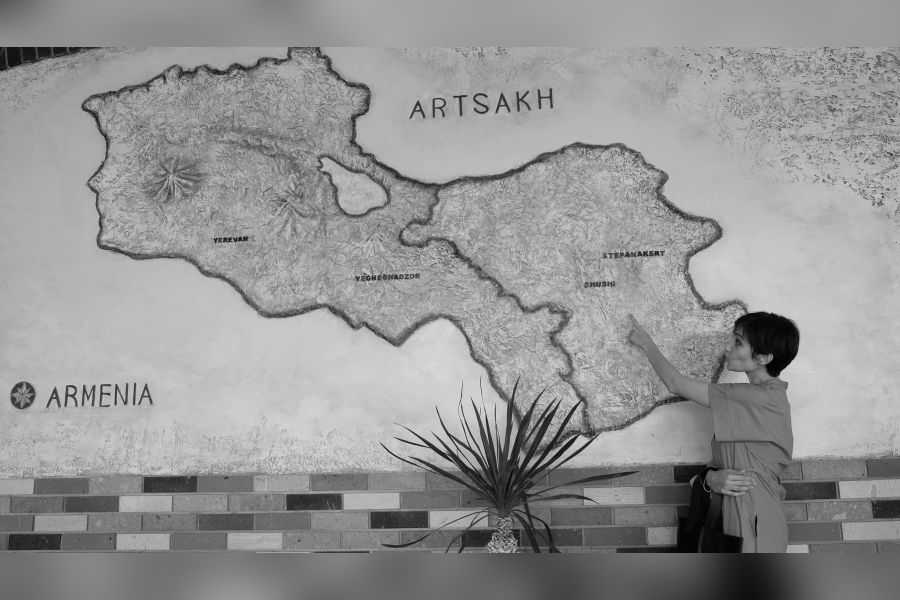
Specific terms have emerged in our political vocabulary in recent years that capture the struggles, hopes and disappointments of our journey. During the 30 years of the Artsakh liberation campaign, opposing views were expressed through the terms “self-determination” and “territorial integrity.”
Armenian interests, as defined by the former, are the right of all people to determine their own future. The latter served as Azerbaijan’s justification for oppressive policies toward Artsakh. Their warped sense of history centered on the false narrative that Nagorno-Karabakh (Artsakh) is an integral part of Azerbaijan. They considered the Armenian liberation struggle as nothing more than a rebellious venture — a justification eerily similar to the Ittihad rationale for genocide, when Armenians were labeled as “disloyal and rebellious.” We know the truth, but truth is often lost when violent aggression and war crimes are committed.
The global community of nations has proven countless times that it will turn its back on justice in the absence of self-interest. For years, we were told by the EU, the OSCE and the Minsk group, chartered to mediate the Artsakh conflict, that “territorial integrity” and “self-determination” stood on equal footing. In their desire to serve as neutral parties, they fell into the trap of standing for little in terms of justice or integrity. Quite often, territorial integrity and self-determination are incompatible in disputes, as the oppressing party denies the right to self-determination by creating an artificial right to territorial integrity. Given the cowardly position of the “mediator,” the aggressor was able to commit criminal acts to force compliance without ramifications. The act of genocide through attempted starvation, murder and deportation was a painful reminder of global ambivalence.
Although the winds of war have moved beyond Artsakh into a fragile attempt at “peace,” the issues have not vanished. Armenia has attempted a path of peace from a pragmatic, survivalist perspective. The price is a compromise — perhaps our dignity — and the constant reminders from our enemies that their vision is not peace, but weakening Armenia. The new term defining this process is “precondition,” meaning something that must be completed before a larger objective can be accomplished. In good-faith negotiations, preconditions can help prepare both parties for peace by creating opportunities to build trust.
In Armenia’s current engagements with Turkey and Azerbaijan, however, preconditions are not bilateral opportunities. They are unilateral demands meant to delay or weaken the peace process and injure the other party. This is the political opposite of good-faith dialogue.
Armenia has been engaged in complex, parallel negotiations with both countries in hopes of creating a peaceful neighborhood. Talks with Turkey concern “normalizing” relations with such acts as open borders, bilateral trade and diplomatic relations. The ever-present cloud of history complicates this dialogue. Talks with Azerbaijan are intended to bring peace after decades of contentious disputes over Artsakh, common borders and territorial integrity.
Despite the distinct nature of these issues, Turkey and Azerbaijan have continued to link their agendas through common preconditions on Armenia. These demands have evolved over the years, but the use of preconditions as obstacles has remained consistent. Before the 2020 Artsakh war and 2023 genocide, Turkey insisted that normalization could not proceed until the Karabakh issue was resolved in Azerbaijan’s favor. After the violent conclusion of the conflict in 2023, Turkey and Azerbaijan adjusted their preconditions. They now demand changes to Armenia’s Constitution to remove references in the preamble to Artsakh and other historical concepts. Armenia’s highest court ruled that the current Constitution makes no territorial claims against Azerbaijan and therefore changes are unnecessary.
Even as they insist on altering the constitution of a sovereign nation — which most would consider meddling in internal affairs — dictator Aliyev continues to refer to “Western Azerbaijan” and to Lake Sevan by an Azeri name, demanding the “return” of Azeris to their homes in the Republic of Armenia. Turkish Foreign Minister Hakan Fidan stated last week that relations with Armenia are conditional on the signing of a peace treaty with Azerbaijan. Of course, Azerbaijan has delayed any treaty until Armenia changes its Constitution.
Prime Minister Pashinyan has proposed drafting a new Constitution for a public referendum after the June 2026 parliamentary elections. He insists the process has nothing to do with Azeri demands and reiterates that Armenia has no territorial claims on Azerbaijan.But considering Aliyev’s disingenuous approach to peace talks, with constant preconditions, does this mean that nothing of substance will happen before mid-2026? Given how dynamic the situation is, we can be certain that the status quo will not remain.
Another variable is the Trump Route for International Peace and Prosperity (TRIPP), which should not be confused with a peace treaty, but is presented as a logistical path that could open up economic opportunities in the region. Aliyev and Pashinyan have made commitments to President Trump, and TRIPP is now decoupled from a peace deal. For Armenia, it serves not only as an opportunity to be a player in regional economics, but also as a potential deterrent to Azeri aggression. Although his assertive rhetoric will likely be tolerated, Aliyev will be constrained in how he proceeds with Armenia. Turkey and Azerbaijan may call TRIPP the “Zangezur Corridor,” but they do not define its terms.
For the United States, TRIPP represents a formal entry into the region through economic engagement rather than the threat of military presence. The U.S. wants this route built and functioning. However, it would be naive to say that the primary motivation is peace or Armenia — it is American self-interest. Alliances are built on overlapping interests, and Armenia is critical to the route’s success. As such, Armenia may have — for the first time in recent memory — some leverage over Azerbaijan. It is not significant in the grand scheme, but the timing may be right to use this new credibility.
It is important to note that the preconditions from the Turkish and Azeri sides can be characterized as offensive, intrusive and contrary to reconciliation. Armenia has always played the “good guy” in negotiations, offering compromises as outreach. Some call Armenia’s approach “over-compromising,” but what alternative is there besides seeking the threshold of peace? The introduction of a powerful third party may provide the deterrent needed to halt unbridled Azeri aggression.
An intense debate within the Armenian community concerns the peace treaty itself. The framework calls for respecting each other’s territorial integrity, which includes the slightly less than 30,000 square kilometers that constitute the Republic of Armenia. The offensive Azeri rhetoric aside, the delimitation process — which Azerbaijan has advanced at a snail’s pace — is critical to resolving the eastern border and preventing incursions driven by revisionism.
Another critical issue is the Armenians held in Baku prisons under deplorable conditions and subjected to “trials” that make a mockery of any judicial process. The release of at least 23 political hostages has been a vibrant discussion in Armenia and the diaspora. The Armenian government says it is pursuing justice for these prisoners, but so far, there have been no confirmed resolutions. Diaspora advocacy groups are also working through diplomatic channels to press for the release of victims of Azeri crimes.
It is inconceivable that any peace treaty signed with Azerbaijan would not include the release of all prisoners. With military action halted and negotiations underway, civilized nations are obliged under international law to comply with these humanitarian gestures. Armenia has complied. Azerbaijan behaves as if military action is still active — or as if it has no intention of peace.
There must be an Armenian precondition that integrates any peace treaty with the release of all prisoners.
While the Turkish precondition is to further the destruction of Armenia, the Armenian precondition is simply advocating for humanitarian compliance under international law. There is no threat to Azerbaijan or Turkey with this precondition. Since the TRIPP project has been effectively decoupled from the signing of a peace treaty, it would not impede any progress on the route. If the Turkish side responds negatively, it will have to accept the political consequences of undermining TRIPP.
Domestically, such a stance would improve the government’s position among those calling for more assertive action. The only reason not to pursue this option would be if back-channel U.S. negotiations were close to securing the prisoners’ release. In that case, no relationships would be harmed and peace talks could continue with integrity.
The outcome of this intricate situation — and these delicate “peace” talks — remains to be seen.