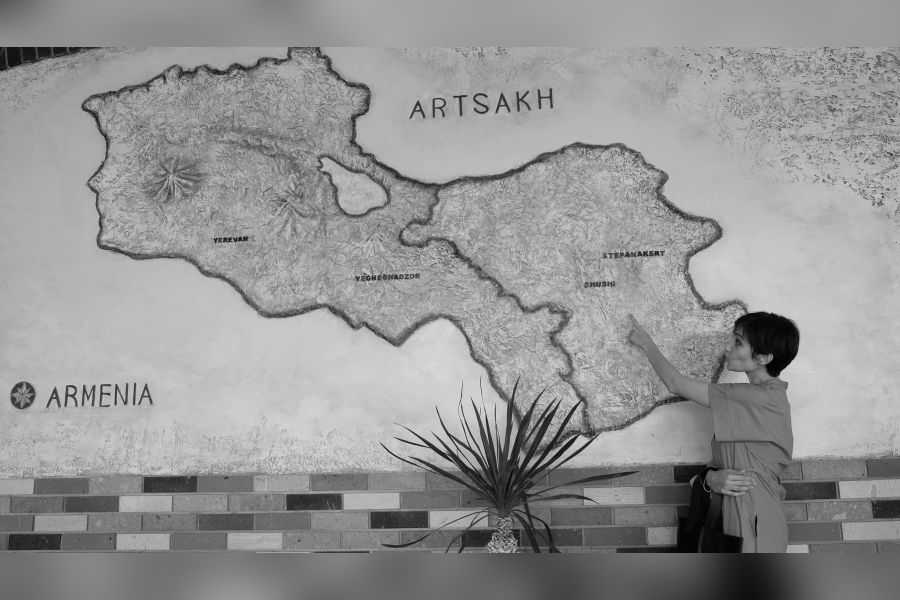
Armenia today is a transparent democracy. It is a democracy because, as the Greek root of the word suggests, “the people” rule. Some say “the people” who rule aren’t the Armenian people, but the people of Ankara and Baku. Nonetheless, people are people and Armenia is undoubtedly ruled by some people somewhere, so it is, by definition, still a democracy.
In addition to being democratic, the current government of Armenia is also highly transparent. All sides agree on this because everyone sees right through its rhetoric to what it actually is. How much more transparent can Prime Minister Pashinyan be when, channeling the “Sun King” Louis XIV during a press conference, he shrieked, “I am the government!”? And so, it is undeniable that Armenia today is both democratic and transparent.
In a democracy as forthright as Armenia’s, open dialogue and spirited discussion win the day. A clergyman, in a private conversation, is secretly recorded saying that to remove Pashinyan and his party, all that would need to happen is to burn a car and shoot a couple of people under a wall, and he is subsequently arrested for planning a coup by Pashinyan. Meanwhile, when — in front of parliament in broad daylight — an apoplectic prime minister screeches that he is going to “throw his opponents underfoot,” “smash their heads against the walls” and “trample over their corpses” (political corpses, he democratically adds), he is being nothing other than transparent. The clergyman’s crime was not that he used extreme, violent rhetoric endemic to post-Soviet Armenia, where if a coffee cup chips it is said to be “smashed to pieces”; where being a little peckish is called “dying of starvation”; and where feeling a slight chill is referred to as “freezing to death.” The clergyman’s crime was not that he used extreme, violent rhetoric endemic to post-Soviet Armenia, where if a coffee cup chips, it is said to be “smashed to pieces.” His crime, in reality, was that he said what he said in private, whereas he should have done as the Prime Minister had and said it publicly and transparently. That’s how democracy works.
In this era of democracy and transparency, where open dialogue and discussion reign, I wish to be of some use to the homeland of my ancestors in its newfound transparent democracy. The ruling party and its partisans need no advice on either of these; they are already at maximum democracy-ness and total transparenti-tude. It is those opposed to them that I wish to teach the ways of discourse necessary in Armenia’s newfound democracy, in order to make democracy even more democratic and transparency even more transparent.
Included below are highly democratic and extremely transparent rhetorical tools used by Pashinyan and his loyalists, or “Pashists” for short. Some may say the rhetorical tactics recorded below are all well-known logical fallacies. But they forget that Armenia is a democracy and that democracy itself operates on a logical fallacy called an argumentum ad populam, or simply “the democratic fallacy,” by which the truth of a proposition is made contingent on the number of people who support it. If four out of 10 people say 2+2 is 4 and six out of 10 say 2+2 is 5, then the latter must be correct because six say it’s 5, whereas only four say it’s 4. If democracy and appeals to the crowd are considered fallacious by logicians, then nothing else needs to be said, really. But because Armenia is a democracy and most people think democracy is not a fallacy but the only legitimate and — best form of — government known to man, then it must be true and we must accept it.
Thus, everyone in Armenia and the diaspora should, if not employ, at least recognize the following recurring arguments, if only to be as trans-demo-paren-cratic as Pashists.
- Argumentum ad Diasporium (or, argument from place, argumentum ad loco; or, simply, the “You Don’t Live Here” fallacy)
This is one of the most common tools used by Pashists everywhere, whether or not they live in what’s left of Armenia. They use it relentlessly against individuals in the Armenian diaspora who dare express an opinion contrary to their own about the goings-on in Armenia.
If a person doesn’t permanently live in the place they’re commenting on, then their observation is dismissed without any consideration for its merit.
For the Pashist, special, mysterious knowledge is obtained simply by being in proximity to the subject. A custodian who sweeps the floors of the Sistine Chapel every night knows more about the art on its ceiling than the art historian who lives in New York and visits to see it in person once every two years. Does the custodian know anything about art? Has he so much as glanced up at the ceiling during his nocturnal shifts sweeping the floors? It doesn’t matter. He is physically closer and, therefore, his opinion automatically holds more weight.
The beauty of this tool is that if a diasporan were to move to Armenia just to win an argument with a Pashist, the Pashist would simply say, “You just got here. You don’t know it like I do.” If the diasporan were to reside in the country for another six years, they would then say, “You’ve only been here six years. I was born here. I know better.” If they continued living in the country their whole life, died there and were buried in Tokhmakh Cemetery, the children of the Pashist would taunt the diasporan’s children, saying, “My father and grandfather were born here, unlike you. Now, believe me when I tell you that classifying the Artsakh war report is a great act of democratic transparency because I’ve lived here longer.”
While there’s something to be said for the proverbial “the dweller of the house knows it better than the architect” or the similar sentiment, “the wearer knows best where the shoe pinches,” when someone slips their feet into two live sharks, even someone at a great distance not wearing sharks for shoes might have an inkling as to where exactly they might pinch. If an Armenian in the diaspora, on the other hand, agrees with Pashinyan’s policies, then, in that case, they are obviously correct and allowed to have an opinion, for though they too are far away from Yerevan, they are correct via Pashist proxies in Armenia who function like cellphone towers broadcasting their correctness to Pashists abroad. But what of those who live in Armenia and disagree with Pashinyan? The following rhetorical tools dispense with them easily.
- Argumentum ad Russium (i.e., the argument to Russia)
All opposition is allowed in a healthy, transparent democracy like present-day Armenia — unless, of course, you’re an agent of Russia. And who is a Russian agent? Why, it is anyone who criticizes or opposes the current government.
Thus, a prime minister with a Russian first name (Nikol), a Russian patronym (Vovayi), a Russian last name (Pashin, the Russian diminutive of “Paul”); whose every fifth word is a jarring Russian Kalashnikov going off in a Matenadaran reading room; who entered office after duly meeting with and receiving the blessing of Vladimir Putin in Moscow; whose revolutionary slogan “duxov” (դուխով) was based on the Russian language word дух; has been purging Armenia of all Russian influence — except for half of his vocabulary and himself, of course.
- Argumentum ad Velvetium (i.e., appeal to velvet; or classically, argumentum ad populam, i.e., the democratic fallacy)
This is the classic, aforementioned fallacy in which the total number of people who support something has a bearing on its worth and veracity. If nine out of 10 people believe Pashinyan has a full head of hair or good posture, then he has, and does. If the majority believes Gagik Tsarukyan is skinny, then they are right.
The Pashist’s entire ideology is based on this supposed fallacy since it was by the democratic, so-called “Velvet Revolution” that Pashinyan came to power. He must be the best man for the job if more people than not want him to be. And let there be no doubt, Pashinyan will undoubtedly win the upcoming 2026 election by a wide margin, especially with the entire opposition and half the clergy in prison. What’s more democratic than unanimity? After all, Pashinyan is the government, as he says.
- Argumentum ad Nakhkinnerium (or, the argument to the predecessors; classically known as tu quoque, and more commonly known in English as Whataboutism)
This rhetorical tool is the Pashist variation of the well-known tu quoque fallacy, in which a response to an accusation is to level one’s own accusation without answering the charge. The perpetual bogeyman of the nakhkinner (նախկիններ, or predecessors) is a catch-all reply to any criticism, even of the most questionable policies of Pashinyan’s regime. Is Pashinyan secretly funneling state funds into his live-in girlfriend’s dubious public education initiative?
“His predecessors were corrupt!” Pashinyan promises transparency and then makes deals entirely in secret? “His predecessors were oligarchs who robbed the country!” Pashinyan’s motorcade runs over a pregnant woman, killing her and her unborn baby? “His predecessors ate babies!” Some say this constant shifting of blame for Pashinyan’s actions to instances of what his predecessors did is nothing more than a classic tu quoque. But they would be wrong because Robert Kocharyan embezzled money…
- Argumentum Ad Dashnakium (a special species of the classic argumentum ad hominem)
If you disagree with one or more of Pashinyan’s policies for any reason whatsoever, call them a “Dashnak.” It didn’t work? Call them a “Dashnak” three more times. Do they not belong to the Dashnak party at all? Then, they have been unwittingly influenced by Dashnak media sources and are thereby unconscious Dashnaks and, thereby, wrong. When the American NGO known as the Lemkin Institute for Genocide Prevention and Human Security not once but twice condemned Pashinyan for “cryptic genocide denial” and “echoing Turkish denialist narratives,” they were forced to include a statement in their second condemnation that read as follows: “At the risk of being accused of being a ‘Dashnak’ organization, taking Russian money and circulating ‘fake news’ by some Armenians…”
This is the degree to which Pashists favor the argumentum ad Dashnakium: an American organization started and led by a group of Western, Columbia-educated, white, liberal, human rights scholars and activists was accused of being a Dashnak cabal funded by Russia. One Pashist I had the privilege of discussing with, forgetting which one of their rhetorical tools to employ when, blurted out that the institute was under Russian control. “How,” I asked, “especially since the same institute had just condemned Russia for genocide in Ukraine?” No reply. No need: the argument had already been ended with the Pashist’s usual speed and persuasive power with a one-two punch of argumentum ad Russium and an argumentum ad Dashnakium.
One cannot argue with the Pashist’s invincible arguments, which are either derived from their mysterious knowledge gained from being in proximity to Yerevan (or, by proxy, in agreeing with a Pashist in Yerevan) or simply by employing the next powerful tool on the list, arguably the most powerful of them all: the argumentum ad Pashinium.
- Argumentum ad Pashinium (known to the ancients as ipse dixit; or, simply, appeal to authority)
When members of the Pythagorean cult were asked to give a reason for their beliefs, they would say, “He himself has said it,” referring to their leader, Pythagoras. The lawyer, statesman and philosopher Cicero coined the term in his native language as ipse dixit, that is, “He said it,” meaning a naked appeal to authority without any reasons. This is one of the most powerful rhetorical tools of the Pashist. If the man who is the government said it, then it must be true. The uninitiated might speak of fallacies, logical or otherwise, or point out stark contradictions in what Pashinyan says, but what they don’t understand is that he is infallible.
If he is infallible, then he couldn’t possibly engage in fallacious thinking. His contradictions make more sense than human sense.
For example, one day, he declared that Azerbaijan wants to commit genocide against the people of Artsakh and, the next day, declared that the people of Artsakh should stay in Artsakh. Later, Pashinyan and his acolyte Alen Simonyan tauntingly asked refugees from Artsakh why they fled, adding that they should have stayed. Logically, if they had stayed, they would have been subject to genocide, even by Pashinyan’s own statements. But for a Pashist, it is only earthly, human logic that dictates that this is contradictory or erroneous.
The same way that popes are infallible when they speak ex cathedra, so anything Pashinyan says in an official capacity is preserved from the possibility of human error or contradiction. When he says, “Let Aliyev call the road through southern Armenia the ‘Zangezur corridor.’ What does it matter to us?” and then, a month later, loudly complains to the Armenian public that Aliyev calling it the ‘Zangezur corridor’ is incorrect and counter to his plan for perpetual peace — this is no inconsistency or contradiction, much less pandering before a transparently democratic election. We simply don’t understand his ways. If he says it, it must be given assent unquestioningly, for we are laymen. In contrast, Nikol not only is the government, but the soon-to-be next Catholicos of the Armenian Church, or Catholnikol, if you will.
- Argumentum ad Dollarium (or, argumentum ad lucrum, appeal to money)
Listen carefully to Pashists, particularly those who are willing to offer reasons for their positions instead of — or sometimes, in addition to — employing all previous arguments, whether Dashnakium, Diasporium, Russium, Velvetium, etc. In all cases, without exception, the Pashist only has one criterion to choose between any two propositions: “Which is more financially profitable?”
Is it more profitable to open the Turkey-Armenia border than to keep it closed? Then, the border should be flung open immediately. Are there historical or ethical concerns in this? Are there military concerns? Was the border gate on the other side recently named after Talaat Pasha? No matter. The price is right.
When justifying paying Jennifer Lopez $6 million to perform in Yerevan while Artsakh refugees’ rent subsidies were expiring, the after-the-fact justification came: the concert raised $13 million, for a profit of $7 million. On this basis alone, it was deemed a great success, and government officials stated that this sort of spectacle would be repeated annually. This is no coincidence: point #4 of Pashinyan’s “Real Armenia” ideological platform is titled nothing other than “Get rich and make rich,” which may sound like a slimy pitch for a get-rich-quick Ponzi scheme rather than sound and prudent economic policy. But remember that “he himself has said it,” so it must not be any of the things that it sounds exactly like.
More plutocratic, still, is the proposal of a law that legalizes payments to reduce or avoid mandatory military service: $62,000 to serve for one month, $47,000 to serve for four months, while those who can’t pay up are required to serve for the full term of 24 months. (However, a more recent bill seeks to give the poor a discount and reduce even this to 18 months. Time is money, after all.)
Though this seems, by definition, oligarchical and would be recognized as such by, say, Plato or Aristotle, because Armenia’s democracy has proposed and will be approving these measures, it cannot possibly be anything but democratic.
But all this to what end? Pashists argue that these changes are positive because they are leading to an entirely voluntary military, staffed by paid professionals.
However, when it comes to this, Pashinyan’s Civil Contract contradicts Jean Jacques Rousseau’s “The Social Contract,” one of the major works on which the modern idea of a civil contract itself is based. In book three, chapter 15, Rousseau writes: “As soon as public service stops being the chief business of the citizen, and they prefer to serve with their money rather than with their persons, the state is not far from collapse.”1
Fortunately for the Pashists, Rousseau never lived in Armenia; his name sounds suspiciously like “Russia”; he has made un-Velvety statements like, “There never was a true democracy, and there never will be”; he lived centuries ago, which technically makes him a predecessor (nakhkin) of Pashinyan; and, lastly, he is a proto-Dashnak because Rousseau influenced European socialism and the Dashnak party ideology was originally based on socialist ideas from Europe.
Besides, can one even “get rich” off of Rousseau?