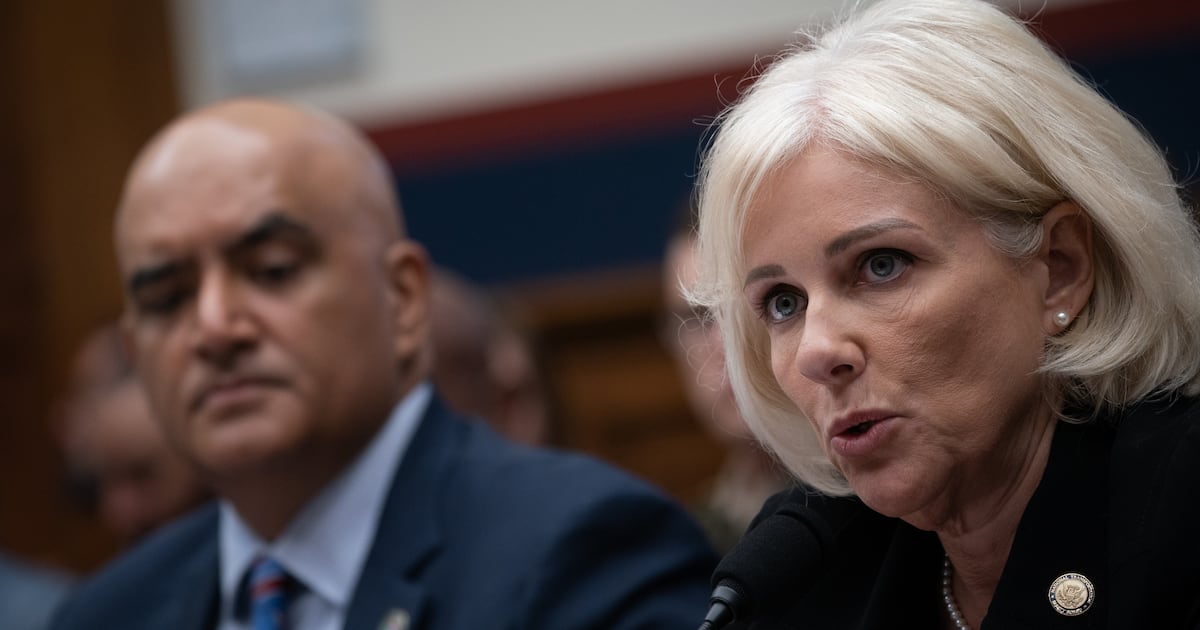
NTSB Chairwoman Jennifer Homendy testifies during a House Transportation Committee hearing on the Key Bridge crash on May 15, 2024. (Sarah L. Voisin/The Washington Post)
Had they been alerted, the six workers who died in the Francis Scott Key Bridge collapse would have had about one minute and 29 seconds to escape, potentially enough time to save their lives, federal investigators said Tuesday.
But police officers with the Maryland Transportation Authority who were stationed at the end of the Baltimore bridge to help keep the workers safe did not call the construction team inspector to warn him that the massive container ship Dali was veering toward one of the support pillars after it had lost power, the National Transportation Safety Board reported during a hearing in D.C. on the collapse.
“Despite previously exchanging cellphone numbers, the police officers did not call the inspector to warn him of the Dali’s emergency. Instead, one of the officers planned to drive to the workers’ location on the bridge to advise them once he was relieved by another officer,” said Scott Parent, an NTSB highway factors engineer.
Their cars were facing south, and the worker farthest from safety would have needed to drive 2,928 feet – just over half a mile – to avoid the Dali’s destruction, investigators said. Instead, the six workers were killed as the bridge toppled. Two workers survived.
A Coast Guard cutter passes a cargo ship that is stuck under the part of the structure of the Francis Scott Key Bridge after the ship his the bridge Tuesday, March 26, 2024, in Baltimore, Md. (AP Photo/Steve Helber)
After a probe lasting more than a year and a half, investigators offered a far-reaching examination of the technical and management problems that preceded a multibillion-dollar disaster with incalculable human costs.
The NTSB determined that the probable cause of the deadly crash was a critical loose wire on the Dali that created a “precarious electrical connection,” and ultimately a blackout, resulting in the ship losing its propulsion and steering close to the bridge.
Another cause was a lack of countermeasures to reduce the chance the bridge would collapse after being struck by a ship, the NTSB said. Such measures might have been put in place if the MdTA, which owned the bridge, had conducted a recommended vulnerability assessment, the agency said.
“Also contributing to the loss of life was the lack of effective and immediate communications to notify the highway workers to evacuate the bridge,” the NTSB found. Investigators said, however, that quick action by MdTA police to bar vehicles from the bridge prevented more deaths.
“The fact is none of us should be here today,” NTSB Chairwoman Jennifer Homendy said. “This tragedy should have never occurred. Lives should have never been lost.”
National Transportation Safety Board Chairwoman Jennifer Homendy presides over the NTSB fact-finding hearing on the DCA midair collision accident, at the National Transportation and Safety Board boardroom, Wednesday, July 30, 2025, in Washington. (AP Photo/Rod Lamkey, Jr.)
Homendy emphasized the sheer size of the ship and the ways in which it complicated the investigation. The Dali, she said, is as long as the Eiffel Tower is high, with miles of wire and thousands of electrical connections.
“Locating a single wire that is loose among thousands is like looking for a loose bolt in the Eiffel Tower,” she said.
NTSB member Michael Graham offered his condolences to the family members of the men who died, some of whom were in the audience, and member Thomas Chapman made them a promise.
“We’re going to do everything we can to make sure this doesn’t happen again,” Chapman said.
Ama Frimpong, legal director of CASA, a group that has represented family members of the immigrant workers who died, said in a statement that those responsible must be held accountable.
“These six men were spouses, fathers, brothers, and sons,” Frimpong said. “Their families should be whole, instead of grieving and suffering.”
The Maryland Transportation Authority said it is reviewing the NTSB’s findings, but it maintains that the collapse and “tragic loss of life were the sole fault of the DALI and the gross negligence of its owners and operators.”
Darrell Wilson, a spokesman for the ship’s owner, Grace Ocean Private Limited, and operator, Synergy Marine Group, said the companies fully cooperated with the NTSB. Wilson said the firms noted the NTSB’s comments on the vulnerability of the bridge, as well as those “relating to aspects of the vessel’s electrical arrangements.” Those matters will be reviewed by their technical teams and counsel, he said.
“We also thank the pilots and crew for their timely actions on the day of the incident, undertaken under exceptionally difficult circumstances,” Wilson said, noting that eight crew members have remained in the United States to support the investigation.
NTSB investigators found that the Dali’s fuel pumps were configured in a way that caused some of the ship’s system failures in the moments before the crash. For at least seven months before the March 2024 blackouts, investigators said, the crew had replaced the proper supply and booster fuel pumps with “inappropriate” flushing pumps.
Wreckage of the Francis Scott Key Bridge rests on the container ship Dali, as President Joe Biden takes an aerial tour of the collapsed Francis Scott Key Bridge in Baltimore, Friday, April 5, 2024, as seen from an accompanying aircraft. (AP Photo/Manuel Balce Ceneta)
Because of that, investigators said, the ship was starved of critical fuel needed to power and control the ship in the moments before impact with the bridge.
Investigators said that Synergy Marine probably knew about the improper use of the flushing pumps but did not stop it. Crew members told NTSB investigators that they did not know it wasn’t appropriate to use flushing pumps. At the time of the crash, investigators said, Synergy had no policies in place regarding the practice.
HD Hyundai Heavy Industries, which built the Dali, blamed the owner and operator for the improper pump use, which it said in a statement led to one of two blackouts and “made it impossible for the crew to recover the ship before its impact with the bridge.”
The shipbuilder also said there had been no indication, when it delivered the ship in 2015, of any loose wire. If one had loosened through vibrations or otherwise over the years, “the owner and operator should have detected that in a routine inspection and through normal maintenance,” according to HD Hyundai Heavy Industries.
Maryland transportation officials this week updated their financial and construction projections for the rebuilding of the destroyed Key Bridge, pushing the reopening date two years to 2030 and estimating that the cost could more than double the state’s initial estimate, to about $4.3 billion to $5.2 billion.
U.S. Transportation Secretary Sean P. Duffy had said in August that he thought the state’s initial projections probably weren’t “anywhere near accurate” and could be closer to “double plus.”
Maryland Transportation Authority officials said on Monday that the initial $1.9 billion estimate – which they said last year was in line with cost estimates of projects of a similar scale and complexity – was assembled in the immediate aftermath of the collapse to access emergency relief funding from the federal government.
More than 18 months later, MdTA officials said they have a much clearer picture of the price tag for constructing a span, which includes the cost of labor, enhanced safety measures and construction materials that have become more expensive because of tariffs.
Gov. Wes Moore (D) said in a statement that “national economic conditions have deteriorated and material costs have increased” since the state’s initial estimates. Moore’s office declined to comment on the NTSB’s findings Tuesday.
In many ways, the story of the Key Bridge disaster has been about more than technical problems, potential personnel or corporate issues, or missed prevention opportunities in a single U.S. state. Safety experts said the tragedy raises concerns about how various federal and state agencies, and private companies, managed a potentially catastrophic risk for bridges nationwide over decades.
This satellite image provided by Maxar shows the bow of the container ship Dali remains stuck underneath sections of the fallen Francis Scott Key Bridge, while salvage crews and barges with cranes continue removing some of the bridge debris and hundreds of shipping containers still onboard the vessel, in Baltimore, Monday, April 8, 2024. (Satellite image ©2024 Maxar Technologies via AP)
“We have to accept the fact that if we do nothing, if we don’t invest, something like the Key Bridge will happen again. And it won’t happen again 200 years from now. It will happen within the next couple decades,” said Michael D. Shields, a civil engineering professor at Johns Hopkins University in Baltimore who has led research into the vulnerability of bridges across the country. The question, Shields added, is what level of risk government and society will tolerate.
In March, the NTSB issued urgent safety recommendations to the owners of 68 bridges across the country. Citing a general “lack of awareness” of the risk of a catastrophic bridge collapse after a ship strike, the NTSB said state agencies or other owners should swiftly calculate such risks – and address them.
The Maryland Transportation Authority performed the calculations for the Bay Bridge, which crosses the Chesapeake Bay, and told the NTSB that the risk was above the allowed threshold. It has embarked on an approximately $177 million project to build protective barriers.
In May, the California Department of Transportation told the NTSB it is working on calculating the risk of collapse for the identified bridges, a process it had already begun. The agency said that in some cases it is “extending the scope” of ongoing work to obtain “detailed statistics on vessels navigating the bridge channels, including dry weight tonnage.” Such data is crucial for calculating a bridge’s potential vulnerability to the traffic beneath.
Long before the Baltimore collapse, a cargo ship knocked down the Sunshine Skyway Bridge over Tampa Bay in 1980, killing 35 people. That event would lead to new design specifications for bridges, taking into account the risks of vessel strikes.
Maintaining the safety of bridges over shipping channels in the long run would require numerous actors working in concert, experts warned at the time.
The absence of such a holistic approach became a key factor in the Key Bridge tragedy in 2024, experts said.
The NTSB board said it will release its final report in a few weeks, but it probably will be years before the legal issues surrounding the crash are resolved.
In U.S. District Court in Maryland, dozens of people and businesses have sued the Dali’s owner and operator, alleging that their negligence led to the power blackout and arguing that the two companies should not be allowed to limit their financial liability.
The companies have asked U.S. District Judge James K. Bredar to cap how much they may be required to pay out to those suing them at $43.6 million. But already, Grace Ocean and Synergy Marine agreed to pay the Justice Department more than $100 million in damages.
Maryland may also face its own onslaught of lawsuits.
Civil attorneys argued that Tuesday’s findings did not represent the complete story behind the tragedy, saying that more will be revealed during a civil trial scheduled for the summer.
They said NTSB investigators are not allowed to include information obtained through litigation in their findings. The attorneys said they were not able to elaborate on specific details because of a court order preventing them from doing so.
The NTSB issued a list of 18 safety recommendations, including calling on the Coast Guard to study “redundant means” to make sure big ships maintain their steering in restricted waters. The agency asked harbor safety officials to highlight the importance of having “immediately available emergency contact information” so ship pilots can quickly reach people on shore.
The NTSB also called on the owners of dozens of potentially vulnerable bridges nationwide to evaluate and, if needed, install motorist warning systems that could alert and stop motorists when a bridge faces a threat.
Although the NTSB doesn’t have formal enforcement powers, Homendy said it has “a lot of means” to ensure recommendations are adopted.
“We have a really big voice,” she said.
Damon Davis, the inspector on the bridge on the morning of the collapse, was in the meeting audience Tuesday, sitting with the Baltimore-based attorneys representing him in his civil lawsuit against the ship’s owner and operator. Davis had felt the bridge shaking and ran, barely making it to safety.
One of his attorneys, William Murphy, said after the meeting that it was difficult for Davis to relive those painful moments.
“It was awful for him,” Murphy said. “There were so many things that triggered what he went through.”