By Abdinoor Ibrahim Noor
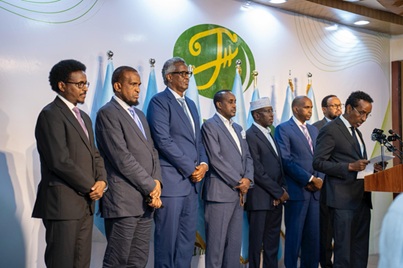
To the Esteemed Leaders and Members of Golaha Samata-bixinta (The Salvation Council),
Abstract
This open letter addresses Golaha Samata-bixinta at a pivotal moment in Somalia’s political trajectory, advocating for strategic patience amid escalating tensions surrounding land displacement and governance failures. Grounded in the Somali wisdom of “Qalad Qalad ku sax” (do not compound one error with another) and the universal principle of “Think before you act,” this analysis reflects on the devastating consequences of Somalia’s 1990s armed conflicts, examines contemporary patterns of authoritarian governance that exploit civil unrest, and evaluates the substantial dangers that mass demonstrations could pose to Mogadishu’s precarious peace. A critical dimension of this analysis addresses the security vacuum that characteristically emerges at the end of each administration’s mandate—a period of heightened vulnerability when state authority weakens and malicious actors, including Al-Shabaab, foreign elements with destabilizing agendas, and homegrown traitors, exploit political transitions to advance their interests.
While acknowledging that the forced displacement of over 142,000 Somalis in 2025 constitutes a serious humanitarian injustice requiring accountability, this letter argues that pursuing redress through street confrontations during this volatile transitional period risks unleashing a spiral of violence far exceeding past tragedies. Through an examination of strategic decision-making dynamics facing both government and opposition forces, the analysis reveals how choosing mutual confrontation produces devastating outcomes for all stakeholders. The letter concludes with urgent recommendations for the opposition to reconsider planned protests, transform strategic patience into a position of moral strength in negotiations, and advance justice through legal mechanisms and persistent civic engagement while allowing the current administration’s constitutional term to expire naturally. This approach represents not surrender but sophisticated leadership—the capacity to think carefully before acting, recognizing that righteous causes require righteous timing to achieve lasting transformation rather than temporary destruction.
Preface: A Citizen’s Plea for Wisdom
I write to you not as a politician, not as a partisan, but as a concerned Somali citizen who wishes nothing but good for our beloved nation and all its people. My motivation springs from a deep love for Somalia and an abiding hope that we can break the cycles of violence that have plagued our country for generations. The words that follow are offered in a spirit of constructive engagement, born from genuine concern for the path our nation is taking and the choices that will shape our collective future.
Your movement’s name, “Golaha Samata-bixinta” (The Salvation Council), carries the weight of our people’s aspirations and the burden of our nation’s destiny. It is precisely because of this profound responsibility that I address you directly, drawing upon the accumulated wisdom of our forebears, the harsh realities of our present circumstances, and the painful lessons etched into our collective memory.
A similar letter (published on Wardheernews) was recently directed to the current administration examining the government’s role in our unfolding crisis. Now, with equal urgency, I turn to your movement, for the decisions you make in the coming days and weeks will determine whether Somalia emerges strengthened from this ordeal or repeats the catastrophic errors that have already exacted such a terrible price.
Introduction: Standing at History’s Crossroads
The Somali proverb “Qalad Qalad ku sax” (do not compound one error with another) carries profound relevance for our current moment. This ancestral wisdom warns against layering mistake upon mistake, cautioning that seeking justice through unjust methods only deepens the wounds we aim to heal. Equally vital is the universal principle of “Think before you act”—a call for deliberate reflection and careful consideration of consequences before committing to irreversible courses of action. In moments of heightened emotion and justified anger, this principle becomes not a constraint on action but a safeguard against actions that produce outcomes contrary to our deepest intentions. Our present political landscape presents complex strategic challenges where both the governing regime and the opposition face critical dilemmas that demand exceptional wisdom and foresight.
This analysis examines the government’s forceful resistance to peaceful assembly and its deployment of excessive police force not simply as incompetence or crude repression, but as potentially calculated elements of an authoritarian approach designed to generate disorder, thereby creating justification for extending power indefinitely. Simultaneously, it critically assesses the serious risks that planned mass demonstrations pose to Mogadishu’s fragile stability, the potential reputational damage to the opposition, and the essential need for sophisticated leadership to navigate Somalia’s current crises of land seizure and political fragmentation
Read more: An Open Letter to Golaha Samata-bixinta: The Wisdom of Strategic Restraint and the Sacred Trust of Leadership
Abdinoor Ibrahim Noor
Email: abdinoor.fareey@gmail.com
———-
Abdinoor Ibrahim is a senior policy analyst and international relations scholar specializing in Global South geopolitics, Arab world affairs, and Pan-African international relations. His expertise encompasses post-colonial state formation, South-South cooperation mechanisms, and alternative international architectures. His research examines the intersection of civilizational identity and international relations theory, analyzing how Arab and African perspectives on sovereignty and collective security differ from Western liberal international order assumptions