Let us read it for you. Listen now.
Your browser does not support the audio element.
WASHINGTON — State Democratic leaders from across the country have spent this week in Little Rock discussing the party’s direction after the 2024 election, evaluating possible strategies and new investments to achieve electoral success in future cycles.
The Association of State Democratic Committees started its spring meeting on Wednesday, nearly four months after Democrats elected Ken Martin as the new national chair. Martin served as chair of the Minnesota Democratic-Farmer-Labor Party before taking the top Democratic National Committee role.
Martin previously led the Association of State Democratic Committees, whose membership includes top officials in Democratic Party affiliates in all 50 states, United States territories, the District of Columbia and Democrats Abroad. The organization provides a voice to state parties within the broader Democratic National Committee.
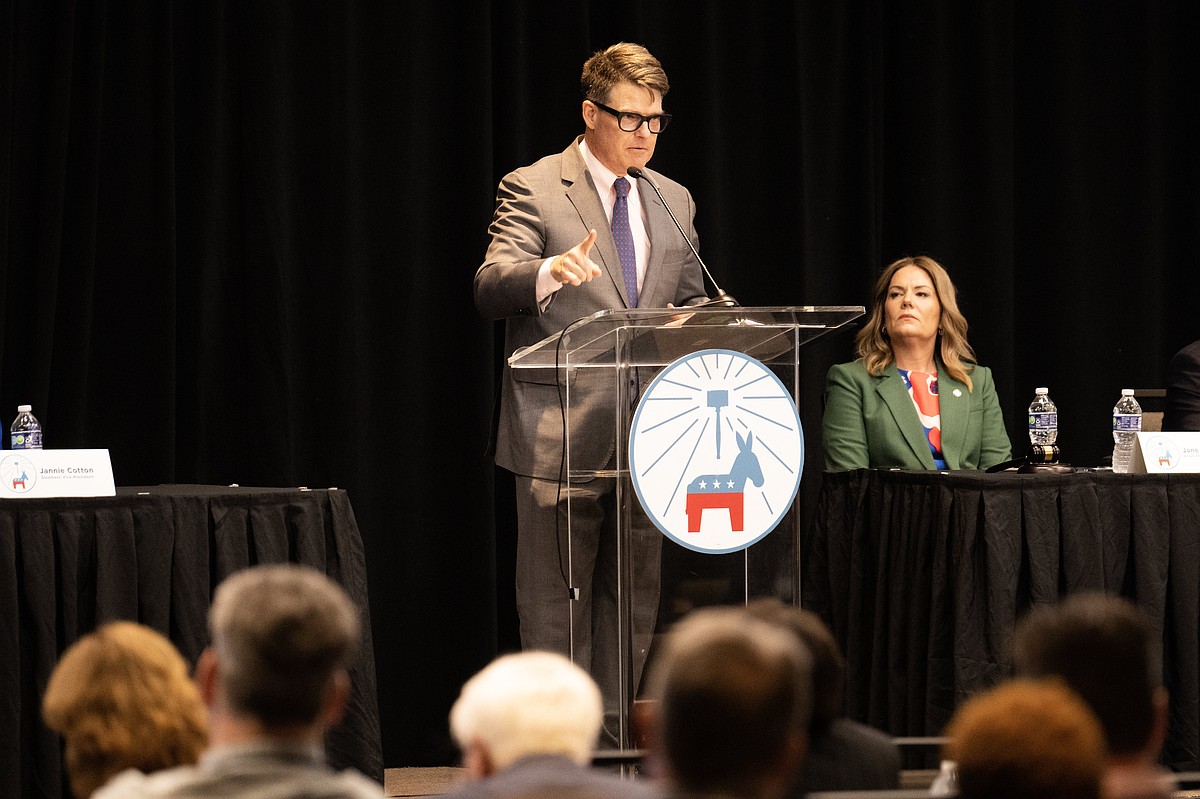
“I will always be honest with you, and I will always deliver on the promises that I make to actually build this party from the grassroots up,” Martin said Thursday in an address to the association. “The most critical thing I can do is to raise resources and get those resources out to you so you guys can do the work of building this party in each of your states.”
Arkansas does not seem like a logical first choice for the association to hold such a gathering, which will conclude Friday. Republicans hold all six of the state’s congressional seats and state offices, as well as supermajorities in the state Legislature.
Association President Jane Kleeb explained the organization’s interest in Little Rock stemmed in part from its prominence as a city in a Southern state with a local government friendly to Democratic politicians.
Little Rock Mayor Frank Scott Jr. addressed the association during Thursday’s session; he was elected to his position in a nonpartisan election in November 2018, but Scott gained political experience working under Gov. Mike Beebe, a Democrat.
Another factor, Kleeb noted, was the potential for a Democratic upset in future election cycles. She specifically mentioned her interest in flipping Arkansas’ 2nd Congressional District, which includes Little Rock and surrounding communities.
“Arkansas came to the top of the list,” said Kleeb, who additionally leads the Nebraska Democratic Party. “There’s just a lot of potential to move this state forward.”
Rep. French Hill, R-Ark., has represented the 2nd District since January 2015; the former Little Rock banker defeated Democrat Marcus Jones in the 2024 general election.
Kleeb did not offer any hints on any Arkansas Democrats interested in the 2nd Congressional District seat.
“We are hoping a really strong candidate announces very soon,” she said.
Democratic Party of Arkansas Vice Chair Jannie Cotton has a leadership position in the association, serving as its southern regional vice president. She described the organization as the “core of the party.”
“We are part of the DNC, but we are the grassroots because you have all of your leaders working diligently to get people elected,” she said. “We’re who the DNC comes to for our leadership, thoughts, ideas and what we bring to the table.”
The state party leaders arrived in Little Rock with an interest in reinvigorating the Democratic Party amid Donald Trump’s second presidency and congressional Republicans charging ahead with their “one big beautiful bill” full of GOP priorities.
Trump’s newest term in the White House has been tumultuous at times with changing economic policies and uncertainty caused by Department of Government Efficiency initiatives, but Martin said voters have maintained a negative perception of the Democratic Party following last November’s election.
“Some people think that people vote on issues and policy. They don’t,” he said. “People think we’re weak. They think we’re inauthentic. They think we don’t really believe the things we say and that we’re willing to fight for them, and they certainly feel like we’re not fighting for their families anymore.”
Martin said state Democratic parties need to prioritize their outreach efforts and steps to build relationships with voters over shared values. He further stated Democrats have lost ground to Republicans because the Democratic Party has treated voters as a “commodity.”
“When we really start to understand their hopes, their dreams, their challenges in their communities, and we start centering on that and less on the transaction and party and winning elections, that’s how we start to win again,” he continued. “That requires all of us to change how we do business.”
The association’s spring meeting and other similar conferences held every quarter provide state leaders with opportunities to share strategies for boosting voter engagement. The Democratic Party of Oregon, for instance, gave a presentation on its neighborhood leader program, which emphasizes Democrats encouraging their neighbors to participate in elections.
According to the Oregon Democrats, the strategy has resulted in higher voter turnout rates compared to traditional canvassing work.
Kleeb mentioned the Nebraska Democratic Party has adopted an identical model to their Oregon counterparts. Other states, she noted, have embraced similar techniques.
“That’s one of the best things about the ASDC,” she said. “It’s that we share best practices with each other.”
Martin and Kleeb have encouraged an “organize everywhere” approach in Democrats’ handling of future election cycles. Under Martin’s leadership, the Democratic National Committee is seeking to provide state Democratic parties with increased investments to win races. Democrats’ updated state partnership program will result in each state party receiving $17,500 per month from the national party, and state parties in Republican-controlled states like Arkansas will get an additional $5,000 each month.
Both Martin and Kleeb have argued the investment should result in state parties hiring additional staff and improving party infrastructure.
“This is really about getting back to the basics because we have failed to do that for at least 20 years,” she explained. “We’ve relied on a battleground state model, and it has done nothing but make us lose elections across the country.”
Kleeb said the Democratic Party remains interested in winning battleground states in elections, but the party should provide more resources to state parties so their candidates have a chance to win races.
“We deeply believe in the foundational value that when you organize everywhere, you can win anywhere,” she said.
Cotton said Martin and Kleeb understand the challenges facing state Democrats from their own experiences; Martin oversaw Minnesota Democrats’ success with re-energizing their party, and Nebraska Democrats are still celebrating Democrat John Ewing’s defeat of Omaha Mayor Jean Stothert, a Republican incumbent, earlier this month.
Cotton noted Arkansas’ position as a conservative stronghold should not disqualify Arkansas Democrats from receiving national support.
“We don’t want to be called a red state. We’re ready to be purple, but we really would like to skip to blue,” she said.