
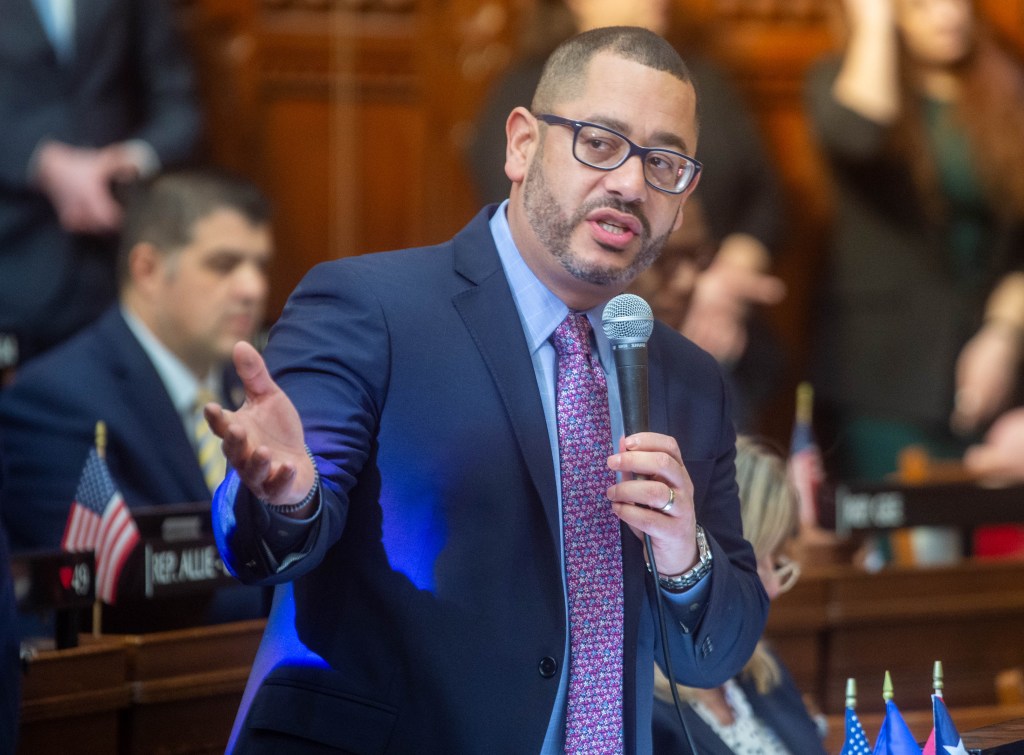
After struggling for years to solve an elusive problem, state legislators voted late Tuesday night for increasing affordable housing in one of the nation’s most expensive states.
Lawmakers expressed frustration as renters and homeowners of all ages have complained of the price of housing – whether a small studio for a recent college graduate, a modest home for a young family, or a larger home in a sought-after town in Fairfield County or along the shoreline.
After an all-day marathon with more than 11 hours of debate that started at 11:30 a.m., the state House of Representatives voted 84-67 at 11 p.m. Tuesday. At least 18 Democrats voted against the bill, including many with expensive housing in upscale communities. Those voting against the bill included Democratic representatives Stephen Meskers of Greenwich, Melissa Osborne of Simsbury, Jennifer Leeper of Fairfield, Jonathan Steinberg of Westport, Kerry Wood of Rocky Hill, and Minnie Gonzalez of Hartford.
House majority leader Jason Rojas, an East Hartford Democrat, described the measure as “incremental” progress on an issue that he has studied for years as he tries to craft the correct balance of pushing development but not taking away local control that many legislators and towns want. The bill, he said, is a step forward in a hard-to-solve problem that has gone without solutions for years.
“If you live in Connecticut, you’re spending a significant amount of your income right now on housing,” Rojas told his colleagues shortly before 11 p.m. Tuesday. “If you are working class, if you are middle class, if you are upper middle class in some parts of this state, you are housing cost-burdened. … The end result of not investing in deeply affordable housing is homelessness.”
Rojas added, “There is broad, bipartisan consensus that we have an affordability problem. … This is not about people who serve on planning and zoning commissions. … It does not take away local control.”
The legislation calls for allowing residential developments in commercial zones, eliminating mandatory minimum parking requirements in some cases to spark more housing, and spurring transit-oriented development, among others.
But House Republican leader Vincent Candelora of North Branford rejected the ideas that were unveiled with constant references during the debate to a “carrot-and-stick” approach.
“These aren’t carrots that we are eating,” Candelora said. “These are rocks that people will be swallowing. … To suggest because we oppose this bill, we are opposing homelessness is an insult to us.”
Rep. Doug Dubitsky, a Republican attorney from southeastern Connecticut, complained that the legislation represented a patchwork conglomeration of ideas from multiple bills that were strung together for the final product.
“It’s got more than a dozen different bills smashed into it,” Dubitsky said on the House floor. “Why? Why don’t we look at them each in due course as they went through committee? … This is not how a legislature should be acting. We had, I think, 16 different bills. We take them all, we smush them all together into one giant, omnibus monstrosity. All so the people of our districts have no idea what we’re doing and won’t find out until it’s rammed down their throats. Every person in this chamber and every constituent in this state should be ashamed of seeing this 92-page amendment to a three-page bill.”
The measure included pieces from the housing committee as well as the planning and development committee, among others.
State Rep. Antonio Felipe, a Bridgeport Democrat, said the bill was the product of “five months of intense conversations” among lawmakers.
“You can’t solve this crisis one step at a time,” Felipe said. “You need a big bill that makes progress.”
Rep. Tony Scott, a Monroe Republican, noted that the bill started in the housing committee months ago with only 10 lines and 91 words. The bill eventually grew to 92 pages before being changed once again with pieces of 20 different bills placed into the final legislation.
“Heck, we don’t even know what the definition of affordable housing is,” said Scott, the ranking House Republican on the legislature’s housing committee. “If you walked on the streets of Connecticut, affordable housing is different to everybody.”
As a conglomeration of various ideas, Scott said, “There is some good legislation in this bill.”
But he added that the bill’s bad parts overwhelm the good parts.
Brad Horrigan / Hartford Courant
State Rep. Doug Dubitsky and other Republicans spoke strongly against a bill concerning affordable housing. He is shown here on the floor of the state House of Representatives in Hartford.
Housing in commercial areas
A key provision, Scott said, is that the bill would allow “commercial properties to be switched over to residential properties as of right,” which is not currently the law.
“This bill says us, legislators in Hartford, know better,” Scott said. “We are taking away a major piece of that decision-making away … from local folks. When you see the words, as of right, that’s what it is.”
When Scott asked for the definition of “as of right,” Felipe responded, “You are still held to the same standards, but you don’t have to go through the zoning board.”
The problem, Scott said, is that residential units should not be constructed in certain areas.
“A lot of housing was put in bad sections of the city – smoke stacks, tire manufacturing,” Scott said.
Parking
Another controversial issue is relaxing the parking regulations so that more residential units could be built.
“The cities have street parking,” Scott said. “They have parking garages. In Monroe, we don’t have that – where I live. Theoretically, a developer can have zero parking. … I do acknowledge that I don’t think anyone will do zero. Theoretically, they could.”
He added, “If there’s not street parking, they’re going to have to go somewhere.”
The bill states that for construction of one to 24 units, it does not automatically require parking, lawmakers said. The parking requirements can vary sharply from town to town in a small state with medium-size cities and numerous rural towns in Litchfield County and eastern Connecticut.
Homelessness
In order to help the homeless, the multi-faceted bill calls for a pilot program for mobile, portable showers in trailers that can be transported from town to town to help residents.
The trailers, Felipe said, are readily available online.
“If this bill was on the floor by itself, I think you would get unanimous approval,” Scott said.
While helping the homeless, the omnibus bill also calls for a first-time homeowner’s savings account that can be used for a down payment or closing costs when purchasing a home.
Homelessness has been an issue in cities around the state. This shows the spot where the Rev. Charles Jacobs allowed a homeless man to sleep in a hammock outside of one of the entrances of Holy Trinity Church in Hartford, not far from the state Capitol.
Fair Share
Fair share is a zoning reform policy for achieving affordable housing in all towns across the state with a study showing that an estimated 100,000 additional units are needed.
Citing his hometown, Scott said that Monroe would need to build more than 1,000 apartments in his small town of about 19,000 residents in order to reach a smaller percentage that would include 326 affordable units. That would lead to problems with broader issues like infrastructure, the number of police, and other issues that come with additional apartments in small towns.
“These numbers are not realistic,” Scott said. “Getting to these numbers is going to be difficult for a lot of municipalities. … Having a lot of families ties up the schools a lot.”
Scott added, “The numbers are so outlandish. … There’s actually no penalties. … You’re not going to lose education funding.”
Felipe noted that lawmakers came up with the numbers for affordable units that were based on factors that included the area median income.
When discussing the bill’s mention of the “adjusted equalized net grand list per capita,” Scott said, “There might be 10 people in the state who know what that means. I don’t know what that means.”
Felipe responded, “I can get that answer in a minute. … It is the assessed value of all personal property divided by the assessment ratio in each town. … It’s to show how you intend to build this housing.”
Scott said that the small town of Easton would need to build 4,200 units, which he described as unrealistic.
“Easton will not be the Easton we know if something like this were passed,” he said. “It’s illogical.”
The bill also states that the state budget office, known as the Office of Policy and Management, will decide every 10 years on the amount of fair share housing that a municipality must have.
While the bill did not specify the exact number of units that would be needed in every town, Rep. Joe Zullo of East Haven offered an amendment that spelled out the numbers from the Fair Share study.
The amendment, which was unanimously rejected by 150-0 by both Democrats and Republicans, would have called for more than 1,000 additional units in South Windsor, Shelton, Sherman, Simsbury, Southington, Stratford, Weston, Woodbridge, West Hartford, Windsor, and Bloomfield, among others. The totals included nearly 3,500 in Greenwich, more than 2,000 in Fairfield, and more than 1,800 each in New Canaan and Darien, according to the amendment.
In an early test vote, the support for the legislation was shown in the state House of Representatives when an amendment passed by 92-47 on mainly party lines as deputy House Speaker Minnie Gonzalez of Hartford was the only Democrat to join with Republicans against the amendment.
The House adjourned at about 11:05 p.m. Tuesday and will be back again at 11 a.m. Wednesday.
Brad Horrigan/The Hartford Courant
From small apartments to waterfront mansions, Connecticut residents say housing prices are too high. Legislators are seeking to find ways to provide more affordable housing. This is a multi-million-dollar waterfront mansion in the Indian Harbor section of Greenwich – near where Donald Trump had a waterfront home before it was later sold.
Transit-oriented development
Another provision is the “work, live, ride” section that calls for optional transit-oriented development for additional housing near train or bus stations. Towns would make the final decisions on development near those sites.
Rep. Eleni Kavros DeGraw, an Avon Democrat who serves as co-chair of the planning and development committee, said the bill has had multiple iterations through the years and prompted a 14-hour public hearing this year.
“This is the best bet yet,” she said of the multiple changes through the years.
8-30g law
The state already has an affordable housing law, but many towns remain below the level of where they should be, according to state statistics.
Passed in 1989, the law is known as 8-30g, which is the number in the state statutes under a provision known as the “Connecticut Affordable Housing Land Use Appeals Procedure.” That law states that all towns must have 10% of all units as “affordable,” but most towns have not reached that level. For towns failing to meet that level, the law allows developers to construct higher-density housing than they normally would on a particular property – meaning more apartments or more houses on acreage that would normally have lower-density housing.
In his wrap-up remarks on the House floor, Rojas said, “Some communities are never going to reach that 10%.”
Three hours into the debate, Scott offered an amendment that would change the 8-30g law to include accessory dwelling units – sometimes called mother-in-law apartments – in the calculation to count toward affordable housing. The idea would be viewed as “watering down” 8-30g, he said.
But Felipe opposed the measure, despite saying “while the intent is actually good.”
Kavros DeGraw noted that the ADU’s are not affordable in all cases, saying they can cost $2,700 to $5,000 per month in Greenwich. The amendment was rejected by the Democratic majority in the House.
Zullo, an East Haven Republican, said the legislature did not need “a group of scholars” to study the issue because the accessory dwelling units are straightforward affordable units.
“This is a way to give towns some relief from 8-30g that is entirely reasonable,” Zullo told his House colleagues. “If you’re one of those towns that are right on that 10% threshold, this could help you out.”
Aaron Flaum
State Rep. Eleni Kavros DeGraw of Avon was a key supporter for the affordable housing bill as co-chair of the legislature’s planning and development committee. She was wearing a pin of the late State Rep Quentin “Q” Willams as she listened to Connecticut’s Governor Ned Lamont as he presented his budget proposal to the General Assembly on Feb. 8, 2023. (Aaron Flaum/Hartford Courant)
Christopher Keating can be reached at ckeating@courant.com
Originally Published: May 27, 2025 at 11:06 PM EDT


