Policymakers say it’s time to reassess a decades-old law that leaves the state’s consumer watchdog agency without teeth to protect tenants.
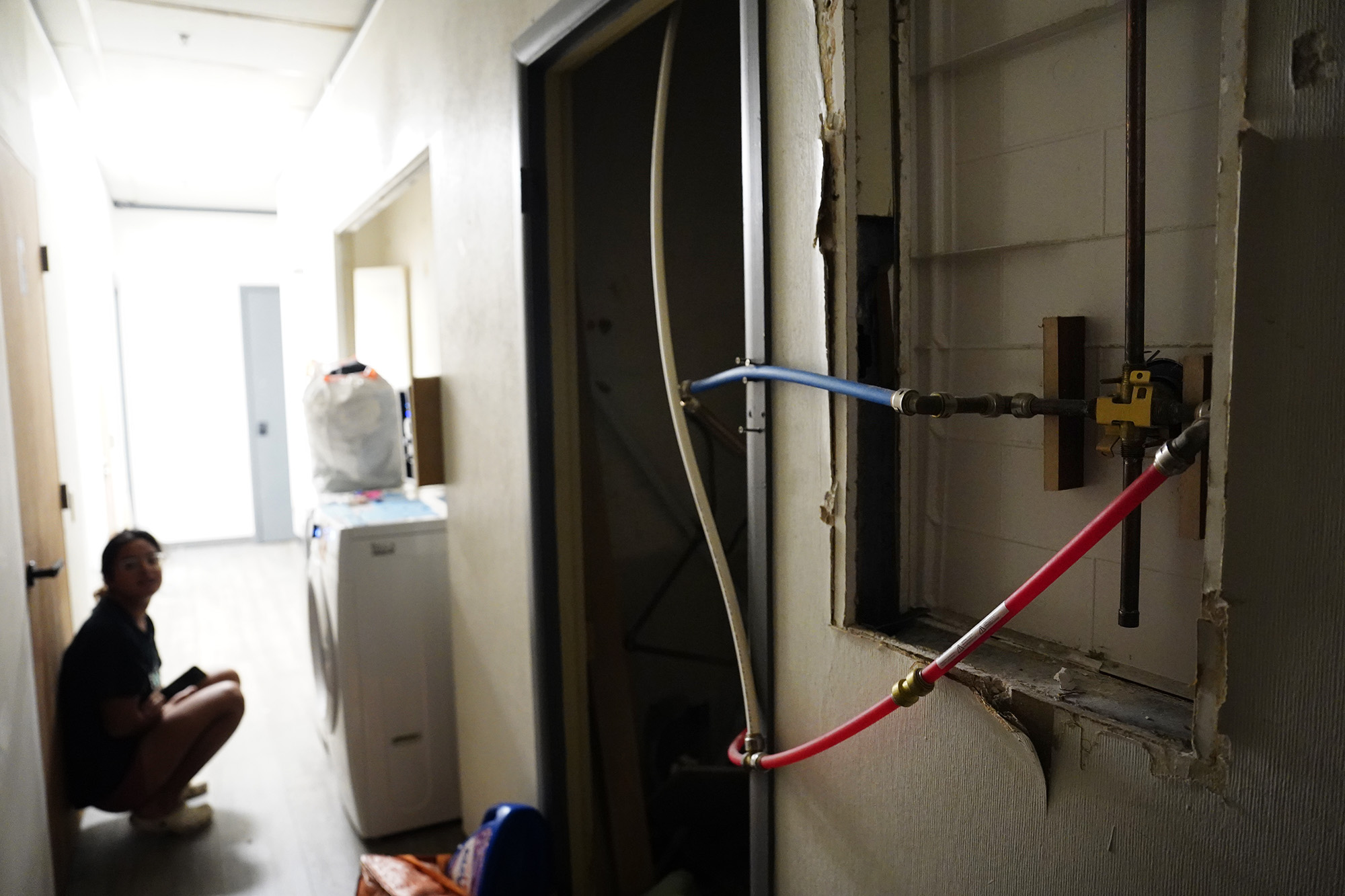
Christina Jordan thought she had presented a good case when she emailed the Hawaiʻi Office of Consumer Protection for help with problems at 1136 Union Mall, a downtown office building whose landlord had rented out commercial suites as unpermitted apartments to dozens of unwary residents.
Jordan laid out allegations about unsafe bathrooms, sparking electrical panels and locked fire escapes, along with an overarching issue that the landlord hadn’t fulfilled the basic duty to provide habitable homes to tenants, as required by law.
“Please direct any question/inquiry regarding the Residential Landlord-Tenant Code concerns and issues to the Hawaii Residential Landlord-Tenant Center,” Scot Robertson, an investigator with the Office of Consumer Protection, wrote to Jordan in September.
“Please be advised,” he added, “that the Center does not provide legal advice.”
Christina Jordan, in the foreground, at 1136 Union Mall in September. Jordan said she got no help from the Hawaiʻi Office of Consumer Protection when she reached out to report problems at the troubled building. The office says state law requires it to remain neutral in landlord-tenant disputes. (Stewart Yerton/Civil Beat/2025)
Since then, things have only gotten worse at 1136 Union Mall. The landlord has shut off the building’s electricity and hasn’t restored it despite an order by a state judge to do so on at least two of the floors.
The response to Jordan from Hawaiʻi’s consumer protection office underscores what some policymakers say is a gap in the laws designed to protect low-income tenants in Hawaiʻi. Even if a tenant makes a well-documented complaint that a landlord has violated the state’s landlord-tenant law, the state office set up to help consumers won’t help the tenant.
It’s a posture different from the office’s normal role of protecting consumers. The office regularly posts warnings about consumer scams. It also uses its statutory powers to file civil lawsuits against alleged miscreant companies.
After students at the start-up Hawaiʻi College of Pharmacy complained that administrators had misled them about the school’s accreditation, for instance, the office sued the college and won a $14 million judgment. The office has gone after an appliance repair company that allegedly ripped off customers. It’s investigated pushy cosmetics vendors who allegedly strong-arm tourists into unwitting, big-ticket purchases. And it’s taken on big pharmaceutical companies, hoteliers and carmakers.
But landlord-tenant disputes are different. If either side wants to hold the other accountable for violations of the landlord-tenant code, they need to hire their own lawyer, or, if they can’t afford one, represent themselves in court.
Sen. Jarrett Keohokalole, chair of the Senate Commerce and Consumer Protection Committee, said it may be time to reassess the Hawaiʻi Office of Consumer Protection’s statutory powers. (Cory Lum/Civil Beat/2022)
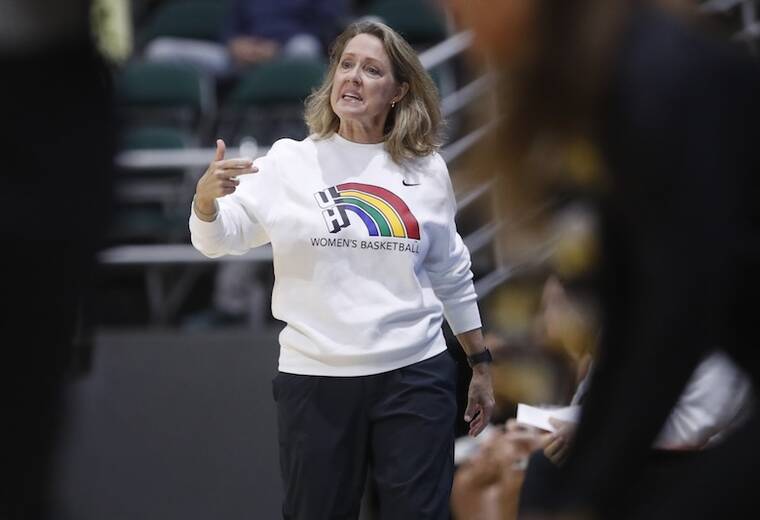
Hawaiʻi Rep. Tina Grandinetti is vice chair of the House Consumer Protection and Commerce Committee. She said if the Office of Consumer Protection can’t represent tenants, then she “would like to see another home for this work.”
Sen. Jarrett Keohokaloe, who chairs the Senate Commerce and Consumer Protection Committee, said a legislative working group established last session to study landlord-tenant issues should “definitely talk about the Office of Consumer Protection in that context.”
He also said the statute empowering the Office of Consumer Protection might need to be changed.
“Often they are unable to take aggressive action in instances where you need immediate solutions for people,” he said of the office.
Grandinetti cautioned that one issue involves capacity. Even if the Office of Consumer Protection were empowered to do the work, Grandinetti said, the office might need more staff.
But, she said, “It’s also a question of political will. This is a problem we could fix.”
Office Used To Help Indigent Tenants
It wasn’t always the case that the Office of Consumer Protection didn’t counsel tenants. According to a 2025 analysis by the Hawaiʻi Legislative Reference Bureau, the office would voluntarily assist tenants by investigating complaints and mediating with landlords even before lawmakers adopted the current landlord-tenant code in 1972.
The 1972 law went a step further, requiring the office to provide counsel to indigent tenants in disputes with landlords if appointed by the court.
But that changed again in 1976, when lawmakers amended the statute. The issue at the time, according to the reference bureau, was that the Hawaiʻi Supreme Court’s Office of Disciplinary Counsel had found it created a conflict of interest for the office to provide information to landlords while also providing legal counsel to tenants.
Rather than assign a different agency to help landlords, lawmakers took out the requirement that the office represent indigent tenants “to enable the Office of Consumer Protection to provide both landlords and tenants with information regarding the Code.”
This, lawmakers said, better served the code’s original intent and purpose: to “establish a balance of rights and responsibilities between Hawaii’s landlords and tenants.”
According to the bureau’s interpretation, there is an exception. The office can take action, the bureau found, when a landlord tries to take possession of a property by intentionally withholding water, electricity or other essential services. That would include the electricity shut-off at 1136 Union Mall.
But the Office of Consumer Protection disagrees with that interpretation.
“No court of law has reached this conclusion, and the conclusion ignores the findings cited elsewhere by the LRB,” William Nhieu, a spokesman for the office, said in a statement.
Additionally, Nhieu said, the office referred the matter of a pending electricity shut-off at 1136 Union Mall to the Attorney General’s Office shortly after the office became aware of the issue.
The Attorney General’s Office declined to comment, saying it doesn’t “make statements on the existence or status of specific investigations.”
Christine Mabery, a resident of Kapilina Beach Homes, believes her corporate landlord has been overcharging her for electricity. Her most recent bill indicates she uses three times the amount of electricity as a typical home on Oʻahu, even as she says she’s reduced her electricity use as much as possible. (Stewart Yerton/Civil Beat/2025)
The building at 1136 Union Mall isn’t the only residential property where tenants say they could use help from the Office of Consumer Protection or some other agency. More than 20 miles away from Union Mall, at Kapilina Beach Homes in ʻEwa, Christine Mabery spends her days at her computer pursuing an online business degree.
On a recent afternoon, her living room was dark except for sunlight streaming through jalousie windows and a sliding glass door; quiet except for the whir of a fan near her desk, the only artificial light a glowing laptop computer that displayed a recent electric bill.
Unlike most tenants on Oʻahu, Mabery pays not Hawaiian Electric Co., but her landlord, Kapilina Beach Homes, an affiliate of Greystar, a multinational property management firm. Greystar buys the electricity from the U.S. Navy, which formerly owned the subdivision and still manages its electrical grid, at a rate of 42 cents per kilowatt hour.
The issue isn’t the rate tenants are being charged, but the amount of electricity Greystar claims they’re using.
Mabery says many of her neighbors share concerns that Greystar is overbilling and one former tenant has taken the landlord to court, representing himself in a fight against a platoon of attorneys from two of Hawaiʻi’s most prominent corporate firms.
In Mabery’s case, even as she and her roommates cut their electrical use over the summer and into the winter, she watched her electric bills increase from more than $300 a month to $500 to $800 for a three-bedroom home.
Her latest bill, sent on Nov. 1, was for $620. The bill claimed she had used 1,523 kilowatt hours of electricity – more than three times that used by the typical home on Oʻahu, according to Hawaiian Electric Co.
That doesn’t make sense to Mabery. She’s cut back on washing clothes and has even unplugged portable air-conditioners, which she says she hasn’t used for months anyway. She’s the only person at home during the day and uses only her computer and a fan.
Mabery has repeatedly reached out to Kapilina Beach Homes and its utility management firm to no avail.
“I’m just at a loss right now,” she said.
Greystar declined an interview request. In a statement, it said, “We encourage residents with billing questions to reach out directly for individualized assistance.”
Without help from government lawyers, tenants must often represent themselves in disputes with landlords. In July, Paul Grant, a former resident of Kapilina Beach Homes, filed a federal suit against Greystar, one of the nation’s largest property managers, alleging the company has defrauded residents by overcharging them on electric bills. (Hawaiʻi U.S. District Court)
Paul Grant, who has been evicted from the property, started documenting electric meter readings for numerous tenants to see if the tenants’ actual electricity consumption matched their bills. He’s filed a lawsuit in federal District Court in Honolulu. Central to Grant’s argument is that Greystar has violated Hawaiʻi consumer protection laws. In addition to monetary damages, Grant wants the court to establish an independent party to oversee billing and tenant communications.
Grant’s latest 129-page court pleading is backed by hundreds of pages of exhibits, including bills and photographs of meter readings. A computer scientist by training, Grant says the ordeal has been a crash course in civil litigation going up against Greystar’s legal team from three firms, led by Calvert Chipchase, one of Hawaiʻi’s top land-use lawyers.
Greystar’s lawyers have asked the court to dismiss the suit, citing numerous alleged violations of rules governing procedures plaintiffs are supposed to follow when pursuing civil actions in federal courts.
Grant said he’s encouraged that the court hasn’t yet dismissed his suit but wonders why the Office of Consumer Protection or the Attorney General’s office hasn’t stepped up.
“Why am I having to do all this to keep my landlord from stealing from me?” he asked.
The consumer protection office says it hasn’t received any complaints concerning utility issues at Kapilina Beach Homes.
Rep. Tina Grandinetti, vice chair of the House Committee on Consumer Protection and Commerce, said a recent suit filed against the global property management firm Greystar by Colorado Attorney General Phil Weiser showed the need for government agencies to help consumers. (Screenshot/2025)
In other instances, government lawyers have stood up for tenants against Greystar. In January, Colorado Attorney General Philip Weiser joined the U.S. Federal Trade Commission in suing Greystar, alleging the company had violated state and federal consumer protection laws by charging tenants mandatory hidden fees not disclosed in leases.
As a result, the complaint says, Greystar has “bilked those consumers out of hundreds of millions of dollars.”
On Tuesday, the parties announced a settlement in which Greystar admitted no wrongdoing but agreed to pay $24 million in damages and “clearly and conspicuously” disclose all mandatory fees in its leases going forward.
Grandinetti said such high-profile cases underscore what’s often a power imbalance between large landlords and tenants.
“These aren’t auntie and uncle renting out their extra property,” she said. “It’s massive corporations. So having a self-help law where tenants have to challenge powerful private equity firms … How can we expect people to be able to access their rights in that situation without the support of their government?”
Civil Beat’s reporting on economic inequality is supported by the Hawaiʻi Community Foundation as part of its work to build equity for all through the CHANGE Framework; and by the Cooke Foundation.
Sign up for our FREE morning newsletter and face each day more informed.
Sign Up
Sorry. That’s an invalid e-mail.
Thanks! We’ll send you a confirmation e-mail shortly.