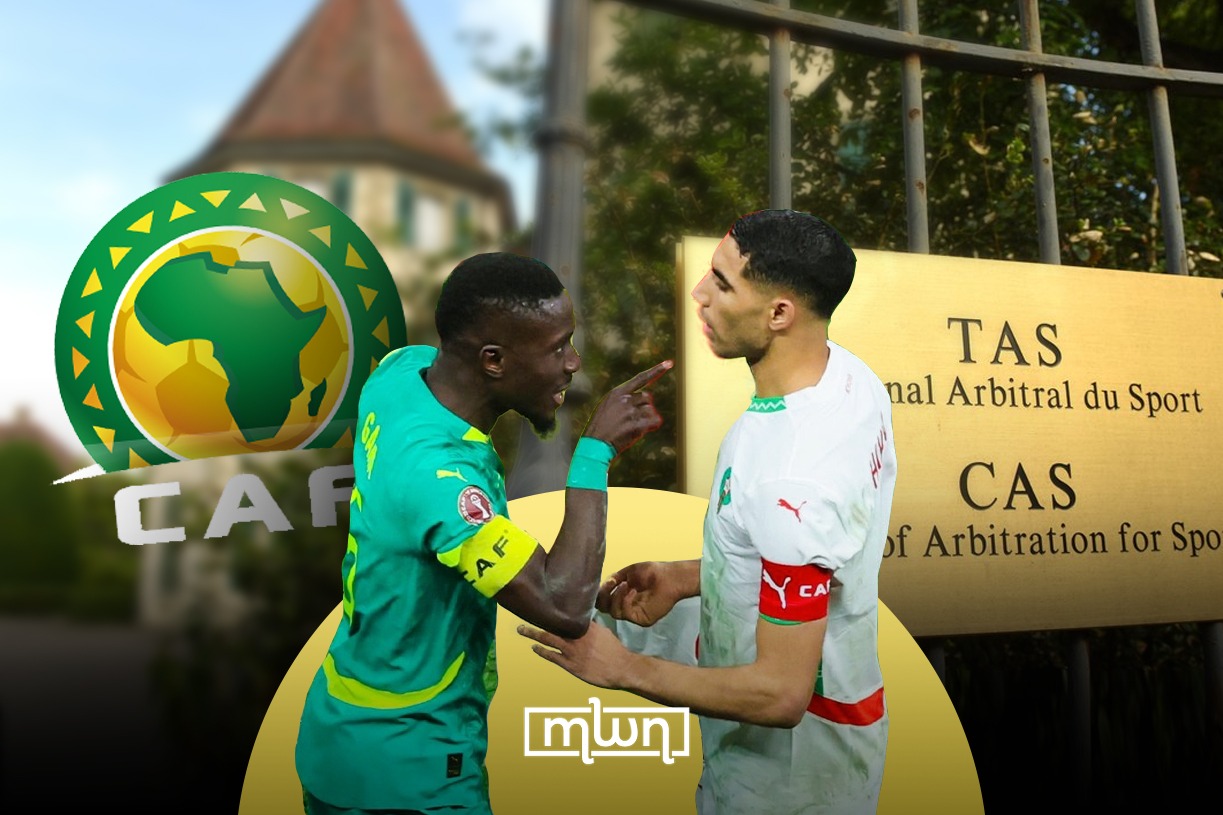
Football fans across the world were astonished by the statements that Samir Sobha, President of Mauritius Football Federation and member of CAF Executive Committee, recently made to The Guardian.
Speaking about the unprecedented chaos that happened during the AFCON final on January 18 in Rabat, Sobha said: “I want to plead with the Moroccan FA to forgive us for the injustice done to them. The rules have not been respected, as they should have been in this match. They were robbed.”
Most importantly, he went on to add that all Senegalese players should have been given yellow cards for leaving the pitch.
As a football fan familiar with CAF governance history, I was not shocked by Sobha’s statement. Still, I commend him for expressing in such a blunt and candid way what has long been an open secret for any astute observer of CAF’s governance and leadership decay in recent years. It really takes a great deal of courage and honesty to expose the ethical bankruptcy and leadership vacuum plaguing CAF. But no lover of the beautiful game should settle for such an inconsequential statement, no matter how courageous or heartfelt it may feel.
This is no longer about Morocco alone
As Africans who want to see our continent shine on the global stage and earn the respect it deserves, we demand that the rules be properly enforced. And this is precisely where the Court of Arbitration of Sports (CAS) must intervene to ensure compliance with the laws that the CAF leadership, elevating optics over fairness and performative brotherhood over procedural justice, ignored to appease Senegal.
This is no longer only about Morocco. It concerns the entire continent. For the sake of the integrity of this beautiful game, sporting fairness, and equality of chances, what happened during the AFCON final must never be allowed to happen again. That is why those responsible for this behavior should face the appropriate sanctions, so that such acts serve as a deterrent in the future.
Since that fateful final, African football fans have witnessed a flurry of instances where players unhappy with referees’ decisions have followed in the footsteps of the Senegalese team. Earlier this week, the players of an Egyptian team left the pitch after the referee awarded a penalty to the opposing side. The match resumed several minutes later following intense negotiations with the players and their management. This scenario was unthinkable in the world of football before the scandal that took place during the AFCON final.
As I said in an article last month, leniency is not an option in such severe cases of unsportsmanship and blatant disregard for the rules, the opponent, and the referee. What the Senegalese team did in Rabat was not just disgraceful. It was also unprecedented in the message of disrespect it sent to both the referee and Morocco, the hosting nation that had repeatedly gone the extra mile to ensure the comfort of the Senegalese team. As I argued in my article, any failure to severely punish Senegal’s scandalous walk-off would create a dangerous precedent both in Africa and beyond. Do we want football to turn into a grievance Olympics, a performative theater taken hostage by the freedom of teams to defy decorum, insult the rules, and storm off the pitch whenever they feel wronged by a refereeing mistake?
Make no mistake: The establishment of such a harmful culture would sound the death knell for football as we know it today. It could push sponsors away from the sport, which would have enormous consequences for the sustainability of national and continental championships across the world.
Which is why, given Senegal’s indefensibly outrageous attitude in Rabat on January 18, the least most fans and observers expected from CAF’s disciplinary committee was to impose exemplary sanctions on those responsible for the unprecedented chaos and shocking indiscipline that threatened to completely destroy the hard-earned reputation of African football. Yet CAF failed to rise to the occasion. Instead of seeking to apply the law firmly, the CAF leadership chose to sit on the fence, imposing sanctions that — rather than sending a clear message that such behavior will not be tolerated in the future — placed the perpetrators and the victims of these events on equal footing.
CAF’s leadership failure opens the CAS option
With CAF having failed in its duty to enforce its own laws, the ball is now in CAS’s court. That is, should Morocco file an appeal, which it will certainly do, CAS will be stepping in to show CAF’s spineless and optics-obsessed management what leadership and discipline mean when dealing with a case as serious as the AFCON final fiasco. Morocco has formally announced its intention to appeal CAF’s disciplinary decision.
This step should not be interpreted as a sign of confidence in the Appeals Committee’s willingness or ability to correct what was essentially a serious miscarriage of sporting justice. Rather, Morocco is following the procedural requirements: only after a CAF member country has exhausted internal appeal options can it take the necessary step of taking its grievance to a third party. In other words, Morocco has to abide by CAF’s regulations before it can then claim its right to seize CAS to deliberate on the AFCON final case.
The case of the Morocco-Senegal final involves multiple layers of injustice unheard of in the world of football. First, there is a clear case that the referee breached CAF’s own regulations by not whistling the end of the game despite Senegalese players having left the pitch without his authorization. Article 82 of CAF regulations is unequivocal in this regard. “Any team that leaves the field of play before the end of the regulation match time without the referee’s authorization shall be considered losing,” it emphatically states.
The wording of this article is important. The stipulation “shall be considered losing” rather than “may be considered” clearly means the provision leaves no discretion to the referee — or to CAF, for that matter — to refrain from applying the mandatory sanction required when this scenario occurs.
Moreover, since the article does not envisage any exception allowing a team to return to the field (i.e., it does not state “unless the team returns”), nor does it specify the duration for the withdrawal from the pitch for it to be regarded as such (i.e. two, five or 15 minutes or more), its application becomes automatic. Simply put, the mere occurrence of the scenario described in this article automatically triggers the application of the stipulated rule.
The second layer, closely linked to the first, concerns the non-application of Article 12 of IFAB regulations, which clearly states that any player who leaves the pitch without the referee’s authorization must receive a yellow card.
By failing to apply this rule, the referee caused irreparable injustice to Morocco. Had the law been applied properly, two Senegalese players, already on yellow cards – namely Ismaila Sarr and Hadji Diouf — would have been sent off. This would have seen Senegal continue the match with nine players against eleven Moroccan players. Under such a scenario, even after Diaz missed his now infamous penalty, Morocco’s chances of winning the match in extra time would have been dramatically higher.
The third layer that CAS will have to consider is the astonishing admission by the head of the Referees Commission, Olivier Kabene, that he instructed the referee not to apply the rule in order to ensure that the match would be completed.
This decision seriously compromised the independence of the referee — thereby violating one of the core principles of FIFA and CAF governance. Most importantly, it also breached the principle of equality of chances, since it allowed the match to continue under a different regulatory framework.
When CAF’s discipline committee convened recently to deliberate on the chaotic AFCON final, they were faced with a clear case of external interference that caused a serious breach of the integrity of the competition for the sake of preserving the optics of the final. Yet they decided, like Olivier Kabene, that optics mattered on January 18 more than justice. But should CAS be facing the same question – is institutional image more important than justice? – in the coming weeks, their ruling will highly likely be that CAF’s obsession with optics is not worth destroying the procedural infrastructure at the heart of football.
Samir Bennis is the co-founder and publisher of Morocco World News. You can follow him on Twitter @SamirBennis.